


















Lesson 17 of 45 · Titrations and Gravimetry
Titration basics: standards, standardization and stoichiometry
Learn how a titration works, the difference between equivalence point and end point, what makes a primary standard, and how to standardize NaOH with KHP.
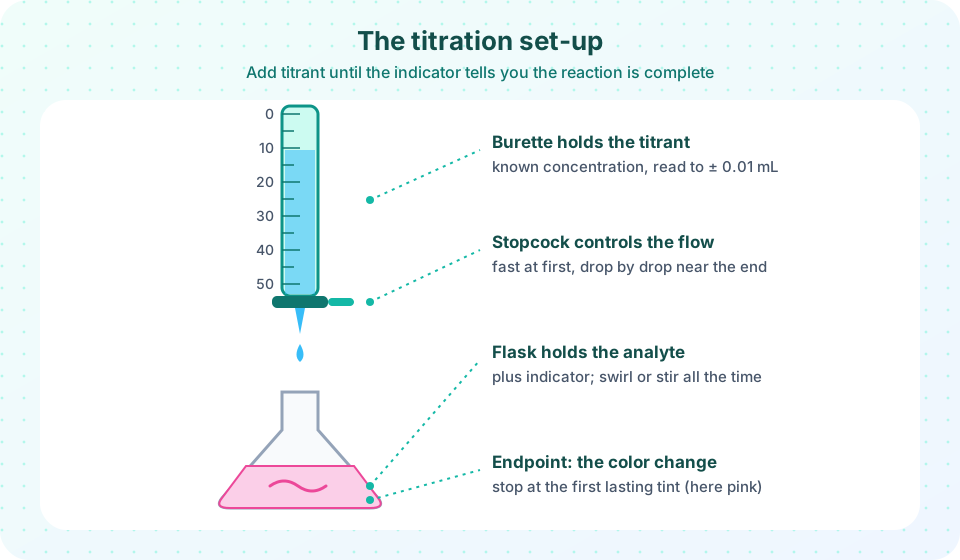
In a titration you add a solution of known concentration, the titrant, from a burette to a measured amount of analyte until the reaction between them is exactly complete. From the volume of titrant used and the balanced equation, you calculate how much analyte was present. It is one of the oldest quantitative methods and still one of the most precise and cheapest.
What you will learn
- Explain equivalence point, end point and titration error.
- Choose primary standards and standardize a solution.
- Do titration stoichiometry for 1:1 and other mole ratios.
- Plan a titration: direct, back and indirect.
Key terms
Titrant: the solution of known concentration delivered from the burette. Equivalence point: the point at which the moles of titrant added are chemically equivalent to the moles of analyte. End point: the point at which you stop, signaled by an indicator or instrument. Primary standard: a pure, stable, non-hygroscopic compound of known formula that can be weighed accurately. Standardization: determining the exact concentration of a titrant against a primary standard.
Equivalence point and end point
The equivalence point is a theoretical idea: the instant when stoichiometric amounts have reacted. The end point is what you actually observe, such as a color change. The difference between them is the titration error; a good indicator makes it small. For example, phenolphthalein turns pink between about pH 8.2 and 10, so in a strong-acid titration the end point comes a drop or so after the true equivalence point.
A reaction suitable for titration must be fast, complete (a large equilibrium constant), stoichiometric (no side reactions), and have a way of detecting the end.
The stoichiometry
For the reaction a A + t T → products, at the equivalence point n_T / n_A = t / a. When both coefficients are 1:
c_A V_A = c_T V_T
More generally n_A = (a / t) × c_T × V_T. Always work in moles: write the balanced equation, convert the titrant volume to moles, then use the mole ratio. Never memorize a formula without checking the coefficients.
Primary standards and standardization
NaOH is a poor primary standard: it absorbs water and carbon dioxide from the air. So you prepare an approximate solution (about 0.1 M) and standardize it against potassium hydrogen phthalate (KHP, KHC₈H₄O₄, 204.22 g/mol), which is pure, stable and solid and has a high molar mass, so weighing errors are small. The reaction is 1:1:
KHC₈H₄O₄ + OH⁻ → KC₈H₄O₄⁻ + H₂O
Example. 0.5105 g of KHP requires 24.85 mL of NaOH to reach the phenolphthalein end point. The moles of KHP are 0.5105 / 204.22 = 2.4997 × 10⁻³ mol. So c(NaOH) = 2.4997 × 10⁻³ mol / 0.02485 L = 0.1006 mol/L. You would repeat with three or more samples and report the mean and standard deviation (Chapter 2).
Other primary standards: sodium carbonate (acids), potassium dichromate (redox), sodium oxalate (permanganate), silver nitrate (chloride), and zinc or calcium carbonate (EDTA).
Kinds of titration
- Direct: titrant reacts directly with the analyte.
- Back titration: add a known excess of reagent to the analyte, then titrate the unreacted part. Useful when the reaction is slow, the analyte is an insoluble solid, or there is no good indicator for the direct reaction.
- Indirect (displacement): the analyte releases a product that you titrate (as in iodometric determinations).
Doing a good titration
- Rinse the burette with the titrant, fill, and remove air bubbles from the tip.
- Pipette the analyte into a clean flask; add indicator.
- Do a quick rough titration to find the approximate volume, then repeat accurately, adding titrant dropwise near the end point.
- Swirl constantly and wash the flask walls with water (this does not change moles).
- Repeat until three results agree within about 0.05 mL.
Common misconceptions
"End point and equivalence point are the same." The equivalence point is chemistry, the end point is observation; they differ by the titration error.
"Adding water to the flask spoils the result." Water does not change the number of moles of analyte, so it does not matter.
"NaOH from the bottle has the stated concentration." It must be standardized, since it absorbs CO₂ and water.
Try it
Press Run (or Ctrl + Enter) to see the result here.
Program input · what you'd type while the program runs
Type the answers before you press Run, one per line. Each time the program reads a line (with input()), it gets the next line from this box.
Press Run (or Ctrl + Enter) to see the console output here.
No output.
Check your understanding
Quick check · 5 questions
of 5 answered You scored / 5 · perfect!
-
1. Which is NOT a requirement for a titration reaction?
A gas is not required; many titrations produce none. -
2. 0.4000 g of KHP (204.22 g/mol) neutralizes 19.50 mL of NaOH. The molarity of the NaOH is
n = 0.4000/204.22 = 1.9588 × 10⁻³ mol; c = 1.9588 × 10⁻³ / 0.01950 = 0.1004 M. -
3. A back titration is useful when
A measured excess of reagent drives the reaction to completion; the leftover is then titrated. -
4. Why is NaOH not a primary standard?
Its mass and purity change in air, so its solution must be standardized. -
5. The difference between the end point and the equivalence point is the
It is the error caused by the indicator changing slightly before or after the true equivalence point.
Summary
- A titration finds moles of analyte from the volume of a standardized titrant and the balanced equation.
- The end point (observed) approximates the equivalence point (chemical).
- Standardize titrants against primary standards such as KHP.
- Back and indirect titrations extend the method to slow reactions and insoluble samples.
Track your progress
Create a free account to tick off lessons and pick up where you left off on any device.
of Analytical Chemistry lessons completed