


















Lesson 2 of 45 · Getting Started
The analytical process: from question to reported result
Learn the six steps of an analysis, the difference between qualitative and quantitative work, and why sampling and preparation usually dominate the error.
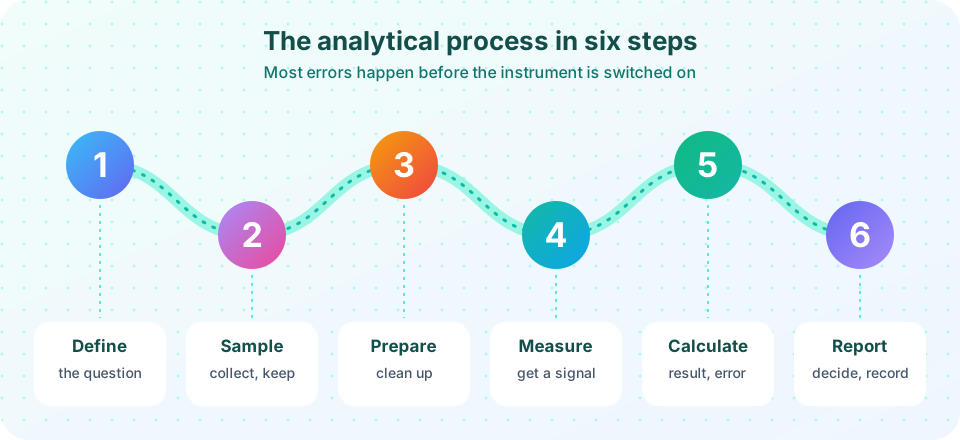
When someone hands you a bottle of river water and asks, "Is it polluted?", the answer is not a single measurement. It is a chain of decisions: what exactly is the question, how to collect a sample that represents the whole river, how to prepare it, which method to use, how to turn a signal into a concentration and how to report the result so that someone else can act on it. This lesson walks through that chain.
What you will learn
- The six steps of the analytical process.
- The difference between qualitative, quantitative and structural analysis.
- What "fit for purpose" means and why it drives every choice.
- Why sampling and sample preparation often limit the quality of the final result.
Key terms
Qualitative analysis: identifies what is present. Quantitative analysis: measures how much is present. Fit for purpose: good enough for the decision that will be made with the result. Sensitivity: how much the signal changes per unit of concentration. Selectivity: how well a method responds to the analyte and ignores everything else.
The six steps
1. Define the question
"How much lead is in the water?" is still vague. Is the limit 10 µg/L (the WHO guideline value for drinking water)? Then the method must measure well below 10 µg/L, and the uncertainty must be small enough to tell 8 from 12. Write down the analyte, the expected concentration range, the required uncertainty and the decision the result will support. This is the specification everything else must meet.
2. Sample
Most materials are not uniform: ore, grain, soil, river water at different depths. A sample must represent the whole. Chapter 3 treats sampling in depth; for now remember that no later step can repair a sample that does not represent the material.
3. Prepare the sample
Many instruments need the analyte in a clean solution. Preparation may mean dissolving a solid in acid, extracting with a solvent, filtering, diluting, or removing species that interfere. Every transfer risks loss or contamination.
4. Measure
Now the instrument or the titration produces a signal: a volume, an absorbance, a voltage, a peak area. Measure standards and blanks in the same session, so that the signal can be interpreted.
5. Calculate
A calibration (Chapter 3) converts the signal into a concentration, and you carry the sample mass, dilution factors and units through to the final answer. This is where you also calculate the uncertainty (Chapter 2).
6. Report
State the result, its unit, its uncertainty, the method and the number of replicates, and whether it meets the specification. A result is not finished until it is clear enough that another chemist could repeat it.
Kinds of analysis
| Kind | Question | Example |
|---|---|---|
| Qualitative | What is present? | Is there caffeine in this drink? |
| Quantitative | How much? | 95 mg of caffeine per 250 mL |
| Structural | What is its structure? | Which isomer is this molecule? |
| Speciation | Which chemical form? | Cr(VI) or Cr(III)? The toxicity is very different |
Another useful split is between classical methods (gravimetry and titration, which rest on mass and volume) and instrumental methods (spectroscopy, electrochemistry, chromatography, mass spectrometry, which rest on a measured physical signal). Classical methods are slower but need few standards; instrumental methods are fast and sensitive but always need calibration.
Where does the error come from?
Variances (squares of standard deviations) from independent steps add:
s_total² = s_sampling² + s_preparation² + s_measurement²
Because they add as squares, the largest term dominates. Suppose the sampling standard deviation is 5 % and the instrument's is 0.5 %. The total is √(25 + 0.25) = 5.02 %. Buying an instrument ten times more precise changes almost nothing; taking a better sample changes everything. A common rule of thumb is to improve the biggest contributor first.
Before buying anything or running a single sample, ask which step contributes the largest part of the uncertainty. Spend your effort there.
Common misconceptions
"The instrument's precision is the precision of my result." The result also contains sampling and preparation error, usually much larger.
"A sensitive method is a selective method." A method can detect tiny amounts and still respond to many other species. Sensitivity and selectivity are different properties.
"Fit for purpose means as accurate as possible." It means accurate enough for the decision. Over-engineering wastes time and money.
Try it
Press Run (or Ctrl + Enter) to see the result here.
Program input · what you'd type while the program runs
Type the answers before you press Run, one per line. Each time the program reads a line (with input()), it gets the next line from this box.
Press Run (or Ctrl + Enter) to see the console output here.
No output.
Check your understanding
Quick check · 4 questions
of 4 answered You scored / 4 · perfect!
-
1. Which step of the analytical process should come first?
The question and the decision it supports determine every later choice. -
2. Sampling has a relative standard deviation of 4 % and the measurement 1 %. Roughly what is the total?
Variances add: √(16 + 1) = √17 ≈ 4.1 %. The larger term dominates. -
3. Which describes selectivity?
Selectivity is about discriminating the analyte from other components; detection power is called sensitivity or detection limit. -
4. Determining whether chromium is present as Cr(VI) or Cr(III) is called
Speciation analysis identifies the chemical form, which matters because toxicity depends on it.
Summary
- An analysis has six steps: define, sample, prepare, measure, calculate, report.
- Qualitative work asks what, quantitative work asks how much, speciation asks which form.
- Variances of independent steps add, so the biggest source of error rules the total.
- Methods only need to be fit for the decision they support.
Track your progress
Create a free account to tick off lessons and pick up where you left off on any device.
of Analytical Chemistry lessons completed