


















Lesson 35 of 45 · Separation Methods and Chromatography
Chapter 7 review: separation methods and chromatography
Review Chapter 7: a one-picture summary of retention, efficiency, gas chromatography and HPLC, a recap table, practice tools and a ten-question quiz.
This chapter moved from simple extractions to the machinery of chromatography. If you can compute a retention factor, estimate a plate number, judge a resolution and say when to choose GC or HPLC, you have the working vocabulary of the field. Use the picture and the table to refresh your memory, then try the problems.
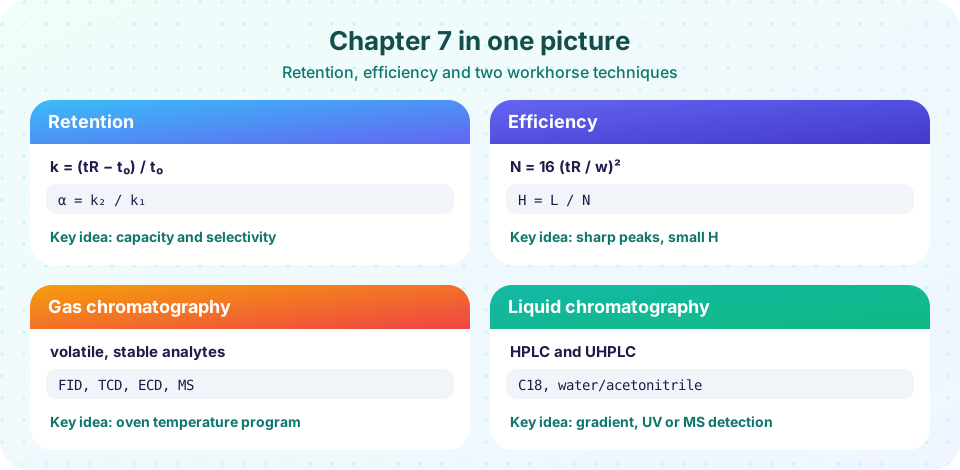
What you will learn
- Recall the main chromatographic quantities and their formulas.
- Decide between GC and HPLC for a given analyte.
- Use the resolution equation to plan an improvement.
Key terms
Retention factor k: (tR − t₀)/t₀.
Selectivity α: k₂/k₁.
Plate number N: 16 (tR/w)².
Resolution Rs: 2(tR2 − tR1)/(w₁ + w₂).
Gradient: a mobile phase whose strength changes during the run.
Recap table
| Topic | Key facts |
|---|---|
| Extraction | E = D/(D + V_aq/V_org); several small portions beat one large; SPE: condition, load, wash, elute |
| Retention | k between 1 and 10 is best; α > 1 is needed to separate |
| Efficiency | N = 16(tR/w)²; H = L/N; van Deemter H = A + B/u + Cu |
| Resolution | Rs ≥ 1.5 for baseline; √N, (α−1)/α and k/(1+k) are the handles |
| GC | Volatile, stable analytes; capillary column; temperature program; FID, TCD, ECD |
| HPLC | Dissolved analytes; C18 with water/acetonitrile; gradients; UV, fluorescence, MS |
Choosing GC or HPLC
- Is the compound volatile and stable at 250–300 °C? Choose GC.
- Is it polar, large, ionic or heat-sensitive? Choose HPLC.
- Can it be derivatized to be volatile? GC may still work, at the cost of extra steps.
- Do you need very high peak capacity for volatiles? Capillary GC wins.
Common misconceptions
"Resolution doubles when the column length doubles." It grows by √2 ≈ 1.41.
"Peak area is independent of the detector." Response differs per compound; always calibrate.
"If two peaks co-elute, they must be the same compound." They may simply have the same retention under those conditions. Change the selectivity or use a second detector to check.
Try it
Press Run (or Ctrl + Enter) to see the result here.
Program input · what you'd type while the program runs
Type the answers before you press Run, one per line. Each time the program reads a line (with input()), it gets the next line from this box.
Check your understanding
Quick check · 10 questions
of 10 answered You scored / 10 · perfect!
-
1. A compound elutes at 6.5 min and the unretained peak at 1.3 min. What is k?
k = (6.5 − 1.3)/1.3 = 4.0. -
2. Two peaks have k = 3.0 and k = 3.6. What is α?
α = 3.6/3.0 = 1.20. -
3. A peak at 12.0 min has a base width of 0.60 min. What is N?
N = 16 (12.0/0.60)² = 16 × 400 = 6400. -
4. Which is the best way to improve resolution when α is just above 1?
Selectivity has the strongest leverage on Rs when α is close to 1. -
5. A drug is polar, nonvolatile and decomposes above 150 °C. Which technique is appropriate?
HPLC works at room temperature on dissolved compounds. -
6. Which SPE step removes weakly held interferences?
The wash uses a weak solvent that leaves the analyte on the sorbent. -
7. What is the optimum velocity in the van Deemter equation?
Setting dH/du = 0 gives u_opt = √(B/C). -
8. Why is a splitless injection used in trace GC analysis?
Splitless injection transfers nearly the whole sample to the column and so raises sensitivity. -
9. In reversed-phase HPLC, increasing the acetonitrile percentage typically
A stronger mobile phase elutes compounds sooner. -
10. Which detector is NOT used for HPLC as a rule?
The flame ionization detector is a GC detector; it cannot be used with liquid flow.
Summary
- Retention, selectivity and efficiency combine in the resolution equation; aim for
Rs ≥ 1.5. - GC is for volatile compounds and uses temperature programs; HPLC is for dissolved compounds and uses gradients.
- Peak areas quantify, but only after calibration.
- Chapter 8 pairs these separations with mass spectrometry and the quality systems that make results trustworthy.
Next: Chapter 8 overview: mass spectrometry and quality assurance
Track your progress
Create a free account to tick off lessons and pick up where you left off on any device.
of Analytical Chemistry lessons completed