


















Lesson 43 of 45 · Projects and Practice
Glossary of analytical chemistry terms (chapters 5 to 8)
A searchable glossary of 42 key terms from electrochemistry, spectroscopy, chromatography, mass spectrometry and quality assurance, with short definitions.
A new field comes with a new vocabulary, and mixing up terms such as accuracy and precision, or selectivity and resolution, causes real mistakes. This glossary collects 42 terms from the second half of the course, each with a short definition and a pointer to the lesson where it is explained.
Use it as a reference while you study, or as a self-test: cover the definitions and try to explain each term in your own words.
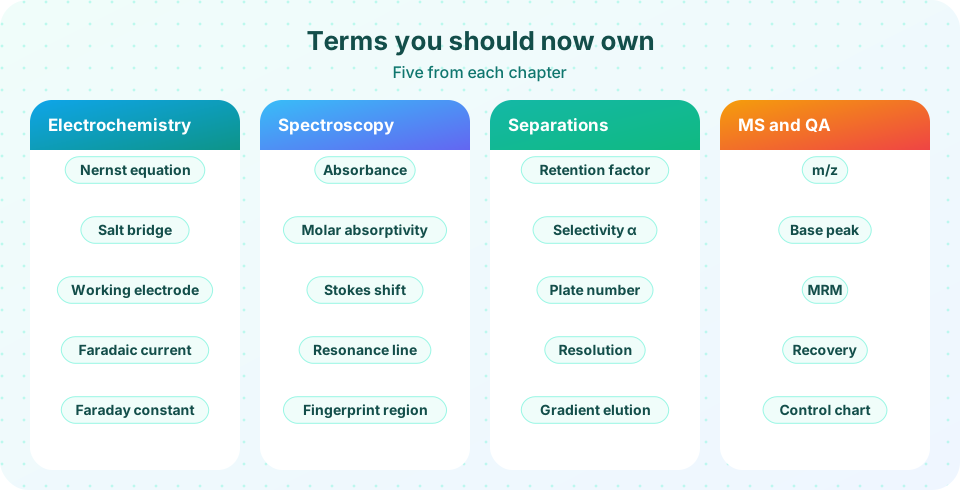
What you will learn
- Recall the precise meaning of the main terms of each chapter.
- Tell apart easily confused pairs of terms.
- Find the lesson that explains any term in more depth.
Key terms
Accuracy vs precision: accuracy is closeness to the true value; precision is closeness of repeated results to each other.
Detection vs quantitation: LOD says the analyte is present; LOQ is the lowest level that can be measured reliably.
Selectivity vs resolution: selectivity is about chemistry (α); resolution combines selectivity, efficiency and retention.
Standard vs reference material: a standard is a solution you prepare; a CRM comes with certified values.
The glossary
| Term | Meaning | Lesson |
|---|---|---|
| Absorbance | A = log₁₀(I₀/I); proportional to concentration under Beer–Lambert conditions |
Beer–Lambert |
| Accuracy | How close a result is to the true or accepted value | Validation |
| Activity | The effective concentration of an ion in solution, a = γc |
Potentiometry |
| Adduct | An ion formed when a molecule picks up a charge carrier, such as [M+Na]⁺ |
Mass spectrometry |
| Atomization | Conversion of the analyte into free gaseous atoms | Atomic spectroscopy |
| Base peak | The most intense peak in a mass spectrum | Mass spectrometry |
| Blank | A sample with no analyte, carried through the whole method | Validation |
| Calibration curve | The relation between instrument response and concentration of standards | Beer–Lambert |
| Carrier gas | The inert mobile phase of a gas chromatograph | Gas chromatography |
| Certified reference material | A material with certified property values and stated uncertainty | Validation |
| Control chart | A plot of QC results over time with limits at ±2s and ±3s | Validation |
| Coulometry | Measuring charge to find the amount of substance, N = Q/(nF) |
Voltammetry and coulometry |
| Cyclic voltammetry | Sweeping the potential up and back while recording current | Voltammetry and coulometry |
| Distribution ratio | Total analyte concentration in one phase divided by that in the other | Chapter 7 overview |
| Eluent | The mobile phase that carries analytes through a column | HPLC |
| Faraday constant | 96,485 C of charge per mole of electrons | Voltammetry and coulometry |
| Fingerprint region | The part of an IR spectrum below about 1500 cm⁻¹, unique to each compound | IR and fluorescence |
| Fluorescence | Light emitted within nanoseconds after absorption, at a longer wavelength | IR and fluorescence |
| Gradient elution | Changing the mobile-phase composition during a run | HPLC |
| Hollow cathode lamp | An element-specific lamp used as the source in AAS | Atomic spectroscopy |
| Ion-selective electrode | An electrode with a membrane that responds mainly to one ion | Potentiometry |
| Isotope dilution | Quantitation by adding an enriched isotope spike and measuring a ratio | Hyphenated MS |
| Junction potential | A small voltage at the boundary of two different solutions | Potentiometry |
| Limit of detection (LOD) | The lowest amount that can be detected, about 3.3σ/S |
Validation |
| Limit of quantitation (LOQ) | The lowest amount measured with acceptable precision, about 10σ/S |
Validation |
| m/z | Mass of an ion divided by its charge number | Chapter 8 overview |
| Matrix | Everything in a sample except the analyte | Chapter 8 overview |
| Molar absorptivity | How strongly a species absorbs at a wavelength, in L mol⁻¹ cm⁻¹ | Beer–Lambert |
| MRM | Monitoring selected precursor → product transitions in MS/MS | Hyphenated MS |
| Nernst equation | Relation between electrode potential and activities, slope 59.16/n mV per decade | Potentiometry |
| Plate number | N = 16(tR/w)², a measure of column efficiency |
Chromatography theory |
| Precision | Closeness of repeated results, expressed as %RSD | Validation |
| Quantum yield | Photons emitted divided by photons absorbed | IR and fluorescence |
| Recovery | Found divided by added, times 100 | Validation |
| Reference electrode | An electrode with a fixed, known potential, such as Ag/AgCl | Potentiometry |
| Resolution | Rs = 2Δt/(w₁ + w₂), the separation of two peaks |
Chromatography theory |
| Retention factor | k = (tR − t₀)/t₀ |
Chromatography theory |
| Selectivity factor | α = k₂/k₁, how far apart two compounds are retained |
Chromatography theory |
| Stokes shift | The shift of emission to longer wavelength than absorption | IR and fluorescence |
| Supporting electrolyte | Excess inert salt that suppresses migration and lowers resistance | Voltammetry and coulometry |
| TISAB | A buffer that fixes pH and ionic strength for fluoride measurements | Potentiometry |
| van Deemter equation | H = A + B/u + Cu, plate height against velocity |
Chromatography theory |
Try it
Press Run (or Ctrl + Enter) to see the result here.
Program input · what you'd type while the program runs
Type the answers before you press Run, one per line. Each time the program reads a line (with input()), it gets the next line from this box.
Easily confused pairs
- Calibration vs verification. Calibration builds the curve; verification checks it with a known standard.
- Repeatability vs reproducibility. Same analyst and day, versus different laboratories.
- Absorption vs emission. Atoms remove light from a lamp beam, versus atoms producing light of their own.
- Retention time vs retention factor. One depends on flow and column length; the other is a dimensionless ratio.
- Fluorescence vs phosphorescence. Fast, spin-allowed emission versus slow emission through a triplet state.
Common misconceptions
"Sensitivity and detection limit are the same." Sensitivity is the slope of the calibration; the detection limit also depends on noise.
"Resolution and selectivity are interchangeable." Selectivity is a ratio of retention factors; resolution also depends on peak width.
"A standard is a CRM." A CRM has certified values with traceable uncertainty; a prepared standard does not unless it is made from one.
Check your understanding
Quick check · 4 questions
of 4 answered You scored / 4 · perfect!
-
1. Which term describes the closeness of repeated results to each other?
Precision describes scatter among repeated results; accuracy compares them with the true value. -
2. What does m/z stand for?
m/z is the ion's mass divided by its charge number. -
3. Which term refers to the mobile phase in chromatography?
The eluent is the mobile phase that carries analytes through the column. -
4. Which quantity is the slope of a calibration curve?
Sensitivity is the change in signal per unit change in concentration.
Summary
- Forty-two terms organize the vocabulary of electrochemical, spectroscopic, chromatographic and mass-spectrometric analysis.
- Accuracy and precision, LOD and LOQ, selectivity and resolution are pairs worth learning together.
- Use the table to find the lesson that explains each term.
Track your progress
Create a free account to tick off lessons and pick up where you left off on any device.
of Analytical Chemistry lessons completed