


















Lesson 4 of 45 · Getting Started
Glassware and balances: measuring mass and volume
Learn when to use volumetric flasks, pipettes, burettes and beakers, what Class A tolerances mean, and how balances and burette readings add uncertainty.
Analytical results rest on two humble measurements: mass and volume. A balance weighs the sample; glassware delivers the volumes. Each has a tolerance, and those tolerances combine into the uncertainty of your answer. Knowing which glass to pick, and how to read it, is the cheapest way to improve a result.
What you will learn
- Choose between a volumetric flask, transfer pipette, burette, graduated cylinder and beaker.
- Read a burette correctly and estimate its reading uncertainty.
- Understand the tolerance of Class A glassware and what "to contain" and "to deliver" mean.
- Use an analytical balance properly and know what buoyancy and drift do.
Key terms
Tolerance: the largest permitted error of a piece of glassware. Meniscus: the curved surface of a liquid in a tube; read its bottom for water. Tare: set the balance to zero with the empty container on it. Weighing by difference: weigh the container before and after transferring the sample.
The glassware
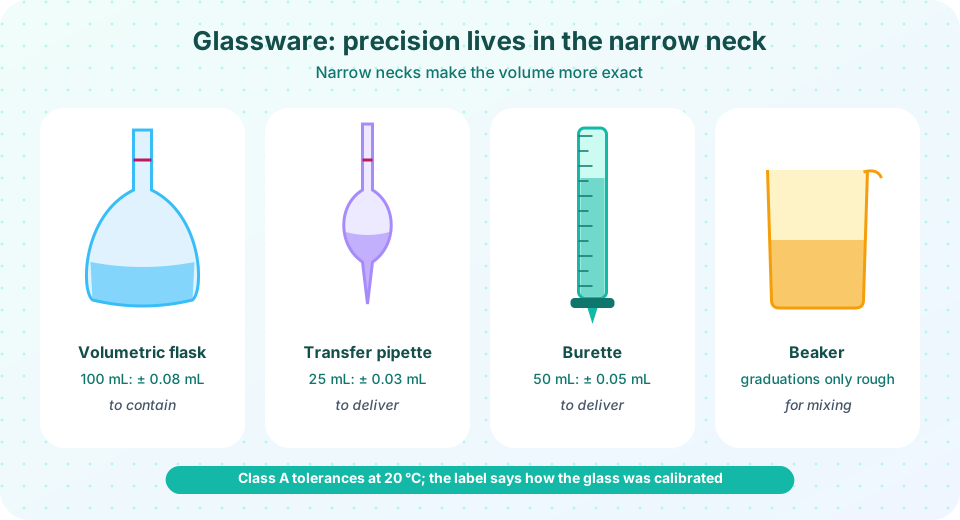
| Glassware | Calibrated | Typical use | Class A tolerance |
|---|---|---|---|
| Volumetric flask | to contain (TC) | making standards to an exact volume | 100 mL: ±0.08 mL |
| Transfer pipette | to deliver (TD) | delivering one fixed volume | 25 mL: ±0.03 mL |
| Burette | to deliver (TD) | titrations, variable volume | 50 mL: ±0.05 mL |
| Graduated cylinder | TD | rough volumes (about 1 %) | much larger |
| Beaker, Erlenmeyer flask | markings only | mixing, heating, receiving liquids | about ±5 % |
Class A glassware is certified to the tolerances above at 20 °C. Class B has tolerances about twice as large. Volume depends on temperature (water expands by about 0.02 % per kelvin near room temperature, and glass slightly), so volumetric work is done at the calibration temperature or the difference is corrected.
To contain means the flask holds the stated volume when filled to the mark; liquid left clinging to the wall counts as part of the volume. To deliver means the instrument dispenses the stated volume when drained as instructed, with the little residue in the tip accounted for in the calibration.
Using a pipette and a burette
Rinse the pipette or burette with a little of the solution it will deliver; rinsing with water would dilute it. Fill past the mark, drain to the mark with the eye level with the meniscus, and let the liquid drain by gravity. For a burette, remove the air bubble in the tip, record the initial reading, titrate, and record the final reading. The volume delivered is the difference. A burette is graduated every 0.1 mL; you estimate between the lines to the nearest 0.01 mL. Each reading has an uncertainty of about ±0.01 mL, so the volume (a difference of two readings) has an uncertainty of about √2 × 0.01 ≈ ±0.014 mL.
The analytical balance
A typical analytical balance reads to 0.1 mg (0.0001 g); a microbalance reads to 1 µg. Good habits:
- Let the balance warm up and keep it level, away from drafts and vibrations.
- Never touch samples with fingers (skin grease has mass); use tongs or gloves.
- Let hot or cold objects reach room temperature: convection currents change the apparent mass.
- Use weighing by difference for hygroscopic or sticky solids: the tare of the container cancels out.
- Close the draft shield before reading.
Buoyancy. Air pushes up on every object with a force equal to the weight of the air it displaces. A balance is calibrated with steel weights (density about 8 g/cm³). If your sample is much less dense, such as water or a powder, the true mass is slightly larger than the reading. For a 100 g water sample the correction is about 0.1 g, which matters only for the most exacting work; for a 1 g sample it is 1 mg.
Worked example: combining tolerances
You pipette 25.00 mL into a 100.0 mL flask to make a four-fold dilution. The relative tolerance of the pipette is 0.03/25 = 0.12 %; of the flask 0.08/100 = 0.08 %. Combined in quadrature: √(0.12² + 0.08²) = 0.144 %, so the dilution factor of 4.000 is uncertain by about 0.006. For most measurements that is negligible, but it adds to the other contributions, and it is a deterministic reminder that bigger volumes have smaller relative error. A 1 mL pipette with ±0.007 mL tolerance is already 0.7 % uncertain.
Common misconceptions
"Beaker markings are good enough for standards." They are only rough guides (a few percent).
"Drain the last drop out of a pipette by blowing." Transfer pipettes are calibrated to leave the last drop in the tip. Blowing it out delivers too much.
"A balance that shows 0.0001 g is accurate to 0.0001 g." Drift, drafts, static charge and buoyancy can all exceed that unless you control them.
Try it
Press Run (or Ctrl + Enter) to see the result here.
Program input · what you'd type while the program runs
Type the answers before you press Run, one per line. Each time the program reads a line (with input()), it gets the next line from this box.
Press Run (or Ctrl + Enter) to see the console output here.
No output.
Check your understanding
Quick check · 4 questions
of 4 answered You scored / 4 · perfect!
-
1. Which glassware should you use to make a standard solution of exact volume?
A volumetric flask has a narrow neck with a single calibration mark, giving the most exact volume. -
2. A burette is read to the nearest 0.01 mL. The initial and final readings are 1.20 mL and 23.45 mL. What volume was delivered?
23.45 − 1.20 = 22.25 mL. The burette does not need to start at zero. -
3. Why rinse a pipette with the solution it will deliver?
A film of water would dilute the first portions; rinsing with the solution replaces it. -
4. Weighing by difference is useful because
You weigh container plus sample, transfer, and weigh again; only the transferred mass counts.
Summary
- Choose glassware by how exact the volume must be: flask, pipette and burette for accuracy; beakers and cylinders for convenience.
- Class A tolerances are small but add in quadrature; relative error is smaller for larger volumes.
- Rinse with the solution, read the meniscus at eye level, and estimate burette readings to 0.01 mL.
- Control drafts, temperature and contamination on the balance; weigh by difference where possible.
Next: Chapter 1 review
Track your progress
Create a free account to tick off lessons and pick up where you left off on any device.
of Analytical Chemistry lessons completed