


















Lesson 44 of 45 · Projects and Practice
Cheat sheet: the equations on one page
A one-page recap of the key equations and decision rules of electrochemical, spectroscopic, chromatographic and mass spectrometric analysis, with calculators.
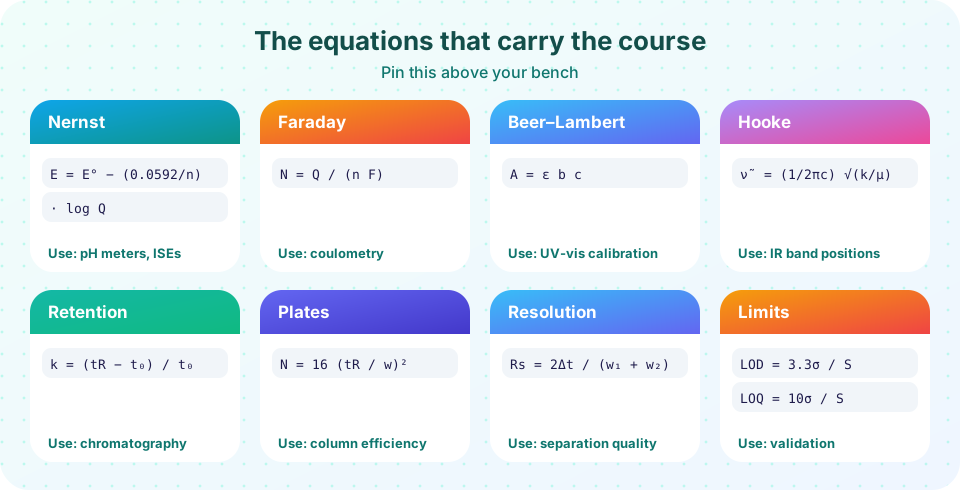
This page is the revision sheet for the second half of the course. The poster shows the eight equations you will use most often; the tables below add the decision rules and the units to watch. Print it, pin it above your bench, or keep it open while you solve the practice problems.
What you will learn
- Recall the key equations and when to use them.
- Choose a method from the question, the level and the matrix.
- Avoid the most common unit and sign mistakes.
Key terms
Signal: what the instrument measures (E, i, Q, A, F, peak area, ion count).
Slope (sensitivity): change in signal per unit concentration.
Working range: the concentrations from the LOQ up to the highest valid standard.
QC sample: a sample with a known value, run to check the process.
Constants and conversions
| Quantity | Value |
|---|---|
Faraday constant F |
96,485 C/mol |
Gas constant R |
8.314 J mol⁻¹ K⁻¹ |
Nernst factor 2.303RT/F at 25 °C |
0.05916 V (59.16 mV) per decade |
Planck constant h |
6.626 × 10⁻³⁴ J s |
Speed of light c |
2.998 × 10⁸ m/s |
| Wavenumber | ν̃ (cm⁻¹) = 10⁷ / λ (nm) |
| Karl Fischer charge | 10.71 C per mg of water |
| Reference electrodes vs SHE | SCE +0.241 V; Ag/AgCl (sat. KCl) +0.197 V |
Methods at a glance
| Chapter | Technique | Signal | Best for |
|---|---|---|---|
| 5 | Potentiometry, ISE | E at i ≈ 0 | pH, ions, end points |
| 5 | Voltammetry | i against E | Trace metals, redox species |
| 5 | Coulometry | Q | Absolute amounts, water |
| 5 | Conductometry | κ | Titrations, water purity |
| 6 | UV-vis | A | Colored species |
| 6 | IR | Bond absorption | Functional groups |
| 6 | Fluorescence | F | Trace emitters |
| 6 | AAS / ICP-OES | Atomic absorption / emission | Metals |
| 7 | GC | Peaks against time | Volatile, stable compounds |
| 7 | HPLC | Peaks against time | Dissolved, polar, large compounds |
| 8 | MS, LC-MS/MS, ICP-MS | Ions against m/z | Identification, trace quantitation |
Rules of thumb
- Keep absorbance between 0.1 and 1.
- Baseline resolution needs
Rs ≥ 1.5; regulated methods often require 2 or more. - Retention factors between 1 and 10 give the best peaks.
- Resolution improves only with the square root of the plate number.
- A tenfold change in activity moves an ISE by
59.16/zmV. - Recovery of 90–110 % is typical for assays; trace residues may allow 70–120 %.
- A point beyond
±3son a control chart means stop and investigate. LOD = 3.3σ/S,LOQ = 10σ/S; confirm them experimentally.
Units checklist
- Convert mg/L to mol/L with the molar mass before using
ε. - Convert mA to A and minutes to seconds before using
Q = i·t. - In Randles–Ševčík use
Ain cm²,Din cm²/s,Cin mol/cm³ andvin V/s. - In chromatography use the same time unit for
tRandw. - In ppm error, divide by the theoretical mass, not the measured one.
Try it
Press Run (or Ctrl + Enter) to see the result here.
Program input · what you'd type while the program runs
Type the answers before you press Run, one per line. Each time the program reads a line (with input()), it gets the next line from this box.
Common misconceptions
"One technique fits every problem." Match the signal, level and matrix to the method.
"A cheat sheet replaces understanding." Equations help only if you know their conditions, such as dilute solution, 25 °C or monochromatic light.
Check your understanding
Quick check · 4 questions
of 4 answered You scored / 4 · perfect!
-
1. What is the Nernst slope for a monovalent ion at 25 °C?
2.303RT/F = 59.16 mV at 25 °C for n = 1. -
2. Which formula gives the plate number from a peak at tR with base width w?
N = 16 (tR/w)² uses the base width. -
3. You need a quick screening method for Na and K in blood serum. Which is simplest?
Both Na and K are easily measured by flame emission or ISEs. -
4. What must you do first before using epsilon with a concentration given in mg/L?
ε has units L mol⁻¹ cm⁻¹, so the concentration must be in mol/L.
Summary
- Eight equations carry most calculations: Nernst, Faraday, Beer–Lambert, Hooke,
k,N,Rs, and LOD/LOQ. - Pick a method from signal, level and matrix; check units before every calculation.
- Rules of thumb (A between 0.1 and 1,
Rs ≥ 1.5,kfrom 1 to 10) save time.
Track your progress
Create a free account to tick off lessons and pick up where you left off on any device.
of Analytical Chemistry lessons completed