


















Lesson 36 of 45 · Mass Spectrometry and Quality Assurance
Chapter 8 overview: mass spectrometry and quality assurance
A big-picture look at mass spectrometry and analytical quality assurance: how ions are measured by m/z and how laboratories prove their results are reliable.
By now you can separate a mixture and measure each part with a detector. Two questions remain. What exactly is this molecule? And can anyone trust the number I report?
Mass spectrometry answers the first. It weighs molecules, or rather ions, and gives a mass-to-charge ratio so exact that it can identify a compound or an element's isotopes. Quality assurance answers the second. It is the system of validation, controls and records that turns a measurement into evidence that stands up in a court, a hospital or a regulator's audit.
What you will learn
- Describe the three stages of every mass spectrometer.
- Calculate an ion's m/z and the mass of common adducts.
- Explain why isotope clusters help to identify elements.
- Outline the idea of quality assurance and quality control in an analytical laboratory.
Key terms
m/z: mass of an ion (in daltons) divided by its charge number z.
Molecular ion (M⁺•): the intact ion formed by removing one electron from a molecule.
Adduct: an ion formed when a molecule picks up a charge carrier such as H⁺ or Na⁺.
Quality assurance (QA): planned activities that give confidence results will be right.
Quality control (QC): checks done during the work to show that it is right.
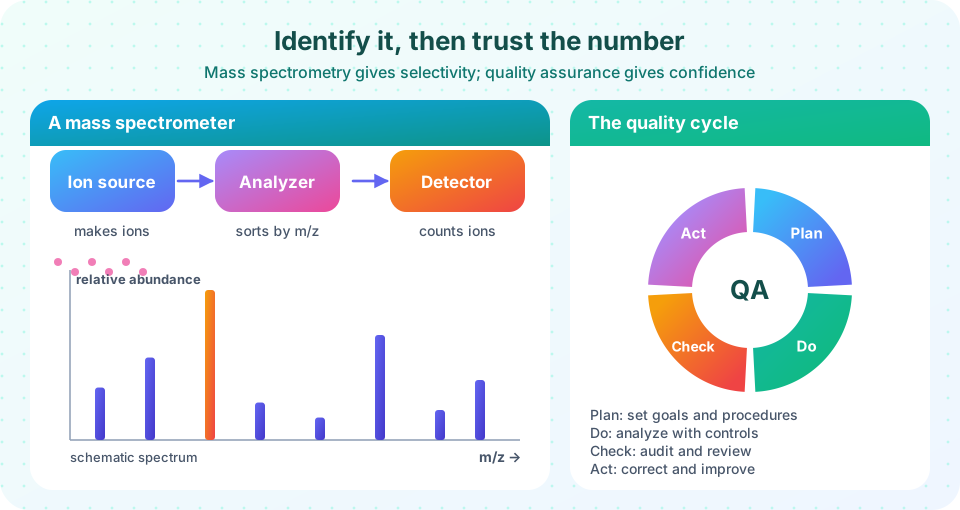
Mass spectrometry in three steps
Every mass spectrometer, whether it costs a few thousand dollars or half a million, has the same stages.
- Ionization. Neutral molecules are turned into gas-phase ions, because only ions can be moved and sorted by electric and magnetic fields.
- Mass analysis. The ions are separated according to their mass-to-charge ratio,
m/z. - Detection. An electron multiplier or similar device counts the ions of each
m/zand produces a mass spectrum, a plot of abundance againstm/z.
The whole path is kept under high vacuum so that ions do not collide with air molecules.
What is m/z?
For an ion with mass m (in unified atomic mass units, u or Da) and z elementary charges, m/z is the number plotted. A singly charged ion has z = 1, so m/z equals its mass. An ion carrying two charges appears at half of its mass.
The mass of an ion is not simply the molecular weight on a label. Mass spectrometers work with the monoisotopic mass, built from the most abundant isotope of each element: ¹²C = 12.000000, ¹H = 1.007825, ¹⁴N = 14.003074, ¹⁶O = 15.994915. For caffeine, C₈H₁₀N₄O₂, the monoisotopic mass is 194.0804. In positive electrospray the protonated molecule [M+H]⁺ appears at m/z 195.0877, since a proton has a mass of 1.007276.
Press Run (or Ctrl + Enter) to see the result here.
Program input · what you'd type while the program runs
Type the answers before you press Run, one per line. Each time the program reads a line (with input()), it gets the next line from this box.
Isotope clusters
Many elements have more than one stable isotope, so a molecule appears as a small cluster rather than one line. Chlorine is ³⁵Cl (75.8 %) and ³⁷Cl (24.2 %), so a compound with one Cl shows peaks at M and M+2 in roughly a 3:1 ratio. Bromine is ⁷⁹Br (50.7 %) and ⁸¹Br (49.3 %), which gives two nearly equal peaks. Carbon contributes a small M+1 peak from ¹³C (1.07 % per carbon atom). Reading these patterns is a quick way to count halogens and carbons. The next lesson develops them.
Quality assurance in a sentence
A measurement is useful only if you know how good it is. Quality assurance (QA) is the framework: written procedures, trained staff, calibrated and maintained instruments, traceable standards and records. Quality control (QC) is the day-to-day part: blanks, duplicates, spiked samples, certified reference materials and control charts run alongside real samples. A laboratory goes through a plan-do-check-act cycle:
- Plan the method, the acceptance criteria and the training.
- Do the analysis with controls included in every batch.
- Check the results against the criteria, audits and proficiency tests.
- Act to correct faults and improve the method.
International standard ISO/IEC 17025 sets out the general requirements for the competence of testing and calibration laboratories. Pharmaceutical work follows Good Laboratory Practice and Good Manufacturing Practice rules.
From sample to trusted result
Every link in the chain needs evidence.
Why mass spectrometry matters
Identification and quantification in one instrument.
The most common QC tools
Charts turn history into early warnings.
Common misconceptions
"Mass spectrometry always identifies a compound on its own." A spectrum is strong evidence, but isomers often give similar spectra. Retention time, high resolution and standards add confidence.
"The molecular mass on the bottle is what the instrument measures." The instrument measures monoisotopic ions at a given charge state, so the numbers differ slightly.
"Quality control only matters for regulated labs." Any lab that wants repeatable results needs controls.
What each lesson covers
- Mass spectrometry: ions, analyzers and spectra
- Hyphenated MS: GC-MS, LC-MS/MS and ICP-MS
- Method validation and quality control
- Chapter review
Check your understanding
Quick check · 4 questions
of 4 answered You scored / 4 · perfect!
-
1. A singly charged ion has a mass of 195.088 Da. What is its m/z?
m/z = mass/z, and z = 1, so m/z equals the mass. -
2. Which pattern is expected for a molecule with one bromine atom?
79Br and 81Br have nearly equal natural abundances. -
3. What is the role of quality control during a batch?
QC items such as blanks, spikes and control samples run with the batch show whether the process is under control. -
4. Which standard sets general requirements for competent testing laboratories?
ISO/IEC 17025 covers competence, impartiality and consistent operation of testing and calibration laboratories.
Summary
- Mass spectrometers ionize, separate by m/z and detect; the path is under vacuum.
- Monoisotopic masses and adducts such as
[M+H]⁺define the m/z you look for. - Isotope clusters reveal Cl, Br and carbon count.
- QA plans and QC checks make results trustworthy; ISO/IEC 17025 is the benchmark.
Track your progress
Create a free account to tick off lessons and pick up where you left off on any device.
of Analytical Chemistry lessons completed