


















Lesson 26 of 45 · Spectroscopic Methods
Chapter 6 overview: spectroscopic methods
A tour of analytical spectroscopy: the electromagnetic spectrum, absorption, emission and scattering, and which technique answers which question.
Spectroscopy is the study of how matter interacts with light. For an analyst it is the most widely used family of methods: a spectrophotometer sits in almost every laboratory, from a school classroom to a pharmaceutical plant. Light is cheap to produce, fast to measure and gentle on the sample, and each region of the spectrum carries different information.
In this chapter you will measure how much light a solution absorbs, identify functional groups from infrared bands, detect traces with fluorescence, and count metal atoms with atomic absorption and emission. This overview gives you the map. It shows what the spectrum is, the three ways light meets matter, and how to pick a technique.
What you will learn
- Convert between wavelength, frequency, wavenumber and photon energy.
- Name the spectral regions used in analysis and the transitions they probe.
- Distinguish absorption, emission and scattering methods.
- Choose a spectroscopic technique for a given analytical question.
Key terms
Wavelength (λ): the distance between wave crests, in nm or µm.
Wavenumber (ν̃): the number of waves per centimeter, ν̃ = 1/λ, in cm⁻¹.
Photon: a quantum of light with energy E = hν = hc/λ.
Transition: a jump of an atom or molecule between two energy levels.
Spectrum: a plot of signal against wavelength or wavenumber.
The language of light
Light is an electromagnetic wave, and also a stream of photons. Wavelength, frequency ν and wavenumber describe the same thing:
c = λν ν̃ = 1/λ E = hν = hc/λ
with h = 6.626 × 10⁻³⁴ J s and c = 2.998 × 10⁸ m/s. Short wavelength means high frequency, high wavenumber and high energy. A violet photon carries more energy than a red one, and an ultraviolet photon more still.
Take 500 nm green light. Its wavenumber is 1 / (500 × 10⁻⁷ cm) = 20,000 cm⁻¹. Its photon energy is 3.97 × 10⁻¹⁹ J, which is 2.48 eV or about 239 kJ/mol. That is of the same order as the energy needed to promote an electron in a molecule, which is why visible and UV light drive electronic transitions.
Press Run (or Ctrl + Enter) to see the result here.
Program input · what you'd type while the program runs
Type the answers before you press Run, one per line. Each time the program reads a line (with input()), it gets the next line from this box.
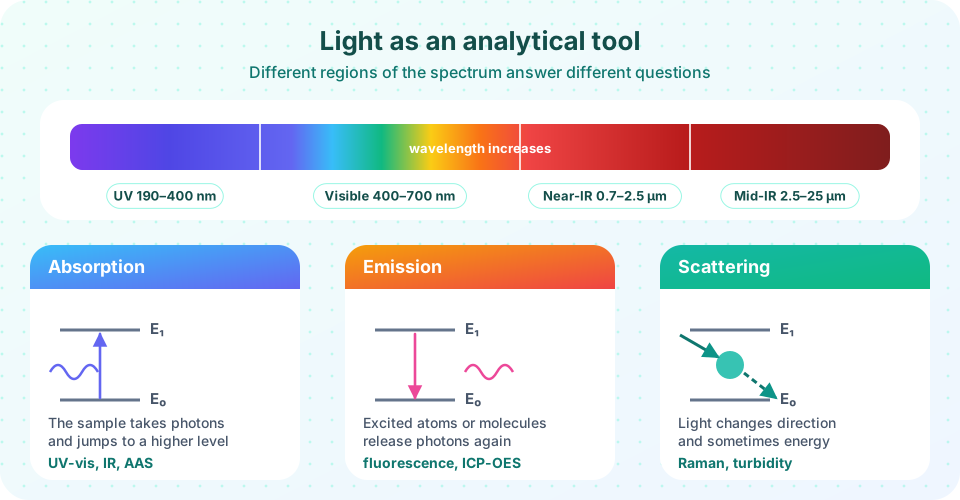
Regions of the spectrum
Each region probes a different kind of change in the sample.
| Region | Approximate range | What happens in the sample | Typical techniques |
|---|---|---|---|
| Ultraviolet | 190–400 nm | Electrons in bonds and conjugated systems jump to higher orbitals | UV-vis absorption, atomic emission |
| Visible | 400–700 nm | Electrons in colored compounds and metal complexes jump | Colorimetry, fluorescence |
| Near-infrared | 0.7–2.5 µm | Overtones of C–H, O–H and N–H vibrations | NIR analysis of grain, fuels, pharmaceuticals |
| Mid-infrared | 2.5–25 µm (4000–400 cm⁻¹) | Bond vibrations | FTIR, ATR |
| Radio and microwave | cm to m | Nuclear spins, rotations | NMR, microwave spectroscopy (not covered here) |
Some textbooks put the near-IR edge at 780 nm; the boundaries are conventions, not physical limits.
Absorption, emission and scattering
- Absorption. A photon is absorbed when its energy matches the gap between two levels. The detector sees less light than the source emitted. UV-vis and IR spectrophotometry and atomic absorption belong here. The key law is Beer–Lambert, which you meet next.
- Emission. An excited species releases energy as light. In fluorescence the excitation is by light; in flame and plasma emission it is by heat. The detector sees light against a dark background, which makes emission methods very sensitive.
- Scattering. The photon is deflected, sometimes with a small change in energy. Turbidity and nephelometry measure the intensity of scattered light from particles. Raman spectroscopy measures energy shifts that reveal bond vibrations.
The spectroscopy toolbox
Four techniques cover most laboratory questions.
What every instrument has
Source, selector, sample, detector.
Good spectroscopy habits
Most errors come from the sample handling.
Picking a technique
Ask three questions: What do I want to know? (which element, which group, how much), how little is there? and what else is in the sample? The answer usually points to one of these:
- A colored ion or a reagent that makes it colored: UV-vis (Chapter 6, next lesson).
- Which bonds are present in an unknown organic compound: infrared.
- Traces of a naturally fluorescent or tagged molecule: fluorescence.
- A metal at mg/L or µg/L in water, blood or soil: atomic absorption or ICP.
Common misconceptions
"A colored solution absorbs its own color." A blue solution absorbs orange and red light and transmits blue. The color you see is what remains.
"Wavenumber and frequency are the same." Wavenumber is the reciprocal of wavelength in cm⁻¹; frequency is cycles per second. They are proportional but not equal.
"UV light is always more useful because it is energetic." Higher energy gives sensitive electronic transitions but less structural detail than infrared bands.
What each lesson covers
- Beer–Lambert law and UV-visible spectrophotometry: the absorbance law, instruments, calibration and deviations.
- Infrared and fluorescence spectroscopy: bond vibrations, FTIR, ATR, excited states and quenching.
- Atomic spectroscopy: flame and furnace AAS, ICP-OES and the physics of atomization.
- Chapter review: a summary picture and a ten-question quiz.
Check your understanding
Quick check · 4 questions
of 4 answered You scored / 4 · perfect!
-
1. Which photon has the highest energy?
Energy is inversely proportional to wavelength, so the shortest wavelength carries the most energy. -
2. What is the wavenumber of light with a wavelength of 2.5 µm?
2.5 µm = 2.5 × 10⁻⁴ cm, and 1 / (2.5 × 10⁻⁴ cm) = 4000 cm⁻¹. -
3. In which process is light detected against a dark background?
In emission and fluorescence the detector sees only the photons released by the sample, which gives low background and high sensitivity. -
4. A solution looks blue. Which light does it mainly absorb?
A colored solution absorbs the complementary color and transmits the rest.
Summary
- Wavelength, wavenumber and photon energy are linked by
ν̃ = 1/λandE = hc/λ. - UV and visible light drive electronic transitions; infrared drives vibrations.
- Absorption, emission and scattering are the three ways light meets a sample.
- Every instrument has a source, a wavelength selector, a sample and a detector.
Track your progress
Create a free account to tick off lessons and pick up where you left off on any device.
of Analytical Chemistry lessons completed