


















Lesson 33 of 45 · Separation Methods and Chromatography
Gas chromatography
Learn how gas chromatography works: carrier gas, injectors, capillary columns, temperature programming, retention indices and detectors such as FID, TCD and ECD.
Gas chromatography, or GC, is the method of choice for compounds that can be vaporized without breaking down. That covers petrol and solvents, flavors and fragrances, pesticides, the volatile compounds in breath and blood alcohol testing. A well-tuned instrument separates hundreds of components in under an hour and detects picogram amounts.
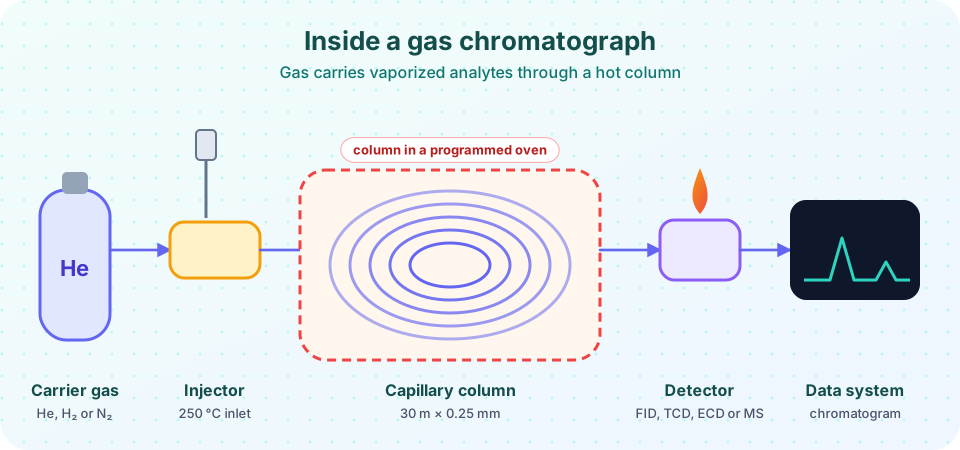
The idea is simple. The sample is flash-vaporized in a hot injector, a stream of inert gas sweeps it into a long, thin coated tube, and the molecules race through it at speeds that depend on how strongly they stick to the coating. A detector at the end counts them as they emerge.
What you will learn
- Name the main parts of a gas chromatograph and the role of each.
- Choose a column phase and understand why polarity matters.
- Explain temperature programming and why it narrows late peaks.
- Calculate Kovats retention indices.
- Match common detectors (FID, TCD, ECD) to analytes.
Key terms
Carrier gas: the inert mobile phase, usually helium, hydrogen or nitrogen.
Split/splitless injection: two inlet modes; split sends only a fraction of the sample to the column, splitless sends it all.
Capillary column: a fused-silica tube, typically 15–60 m long and 0.25 mm in inner diameter, with a thin film of stationary phase on its wall.
Temperature program: a planned rise in oven temperature during a run.
Retention index: a number that places a compound between n-alkanes, independent of many instrument details.
The instrument
Carrier gas. Helium is traditional and safe. Hydrogen gives faster separations at the same efficiency, but needs a leak-tight system and a generator or cylinder with appropriate safety measures. Nitrogen is cheaper but slow. Because carrier-gas supplies fluctuate, many laboratories have moved methods to hydrogen. Pressure or flow controllers hold the flow constant, typically 1–2 mL/min through a capillary column.
Injector. A microliter syringe pierces a septum and delivers the sample into a heated glass liner at about 250 °C, where it vaporizes instantly. In split mode, a splitter vents most of the vapor (for example 50:1) so that the column sees a narrow plug: it suits concentrated samples. In splitless mode, the vent is closed for about a minute so that nearly everything reaches the column, which suits trace analysis. Headspace samplers inject only the vapor above a liquid or solid, which is ideal for residual solvents and blood alcohol.
Column and oven. The column is coiled inside a thermostatted oven that can be controlled from room temperature to about 300–400 °C. Capillary columns dominate; they have no packing, so the A term of the van Deemter equation vanishes and efficiency is very high.
Detector. An FID, TCD, ECD or mass spectrometer, discussed below.
Choosing the stationary phase
Gas chromatography follows an old rule: like dissolves like. A nonpolar phase separates nonpolar compounds mainly by boiling point; a polar phase also separates by polarity.
| Phase type | Example composition | Order of elution | Good for |
|---|---|---|---|
| Nonpolar | 100 % dimethylpolysiloxane | Boiling point | Hydrocarbons, solvents |
| Low polarity | 5 % phenyl, 95 % dimethylpolysiloxane (the most popular) | Mostly boiling point | General purpose, pesticides, drugs |
| Intermediate | 35–50 % phenyl | Boiling point plus polarity | Aromatics |
| Polar | Polyethylene glycol (a "WAX") | Polarity first | Alcohols, fatty acid methyl esters, flavors |
The film thickness (typically 0.25 µm) and the inner diameter also matter. Thicker films retain volatile compounds better; narrower columns give higher efficiency but need higher pressure.
Derivatization
Polar compounds such as acids, amines and sugars stick to the column or decompose. Derivatization converts them to volatile, less polar forms, for example silylation of -OH groups with a trimethylsilyl reagent, or methylation of fatty acids. Many biochemical GC methods depend on it.
Temperature programming
A mixture of compounds with a wide range of boiling points is awkward at one temperature (isothermal operation). At a low temperature the light compounds are resolved but heavy ones take forever and give broad, flat peaks. At a high temperature the heavy ones are quick but the light ones merge near the front.
In a temperature program, the oven starts cool and rises at a fixed rate, for example 10 °C/min. Each compound spends most of its time near the temperature at which it elutes. Late peaks come out sharper and taller, and the run is much shorter. The price is the cool-down time between runs.
Press Run (or Ctrl + Enter) to see the result here.
Program input · what you'd type while the program runs
Type the answers before you press Run, one per line. Each time the program reads a line (with input()), it gets the next line from this box.
The simulation is a model with invented numbers: it shows the shape of the effect, not real retention times.
Retention indices
Retention times change when you shorten the column or change the flow. The Kovats retention index I places a compound between two n-alkanes that elute before and after it. By definition an n-alkane with n carbons has I = 100n. In isothermal work,
I = 100 · [ n + (log t′x − log t′n) / (log t′n+1 − log t′n) ]
where t′ is the adjusted retention time (tR − t₀), and n and n+1 are the alkanes eluting just before and after the compound x. In temperature-programmed analysis the same index is calculated with the raw retention times and linear interpolation. Libraries list indices for thousands of compounds, a powerful extra confirmation next to a mass spectrum.
Press Run (or Ctrl + Enter) to see the result here.
Program input · what you'd type while the program runs
Type the answers before you press Run, one per line. Each time the program reads a line (with input()), it gets the next line from this box.
Detectors
| Detector | Responds to | How | Notes |
|---|---|---|---|
| Flame ionization (FID) | Almost all organic compounds | Carbon ions formed in a hydrogen flame give a current | Rugged, linear over about seven decades; does not respond to water, CO₂, N₂ |
| Thermal conductivity (TCD) | Everything | Compounds change the heat loss from a hot filament | Universal and non-destructive, but about 1000 times less sensitive than FID; used for permanent gases |
| Electron capture (ECD) | Halogens, nitro groups, some organometallics | Compounds capture electrons from a radioactive source | Extremely sensitive for organochlorine pesticides and PCBs |
| Nitrogen-phosphorus (NPD) | N and P compounds | Heated alkali bead | Drugs and pesticides |
| Flame photometric (FPD) | S and P compounds | Flame emission | Sulfur compounds in gas and petrol |
| Mass spectrometer (MS) | Everything, with structure | Ions sorted by mass | Chapter 8 |
A good internal standard and a calibration curve turn peak area into concentration, as in Chapter 3.
A typical run, step by step
- Condition the column and check the carrier gas, septum and liner.
- Set the injector (250 °C), the oven program (for example 50 °C for 2 min, then 10 °C/min to 250 °C), and the detector.
- Inject 1 µL of standard and check retention time and shape.
- Inject a blank, then samples bracketed by standards.
- Integrate peaks, calibrate, and review the system suitability (resolution, tailing, repeatability).
Common misconceptions
"GC can analyze anything if the oven is hot enough." The analytes must survive vaporization. Salts, sugars and proteins decompose, so they need derivatization or another method such as HPLC.
"The FID sees everything." It responds to carbon-hydrogen bonds. Highly oxidized or halogenated carbon gives a lower response, and inorganic gases give none.
"A longer column is always better." Resolution grows with the square root of length while analysis time grows linearly.
Check your understanding
Quick check · 5 questions
of 5 answered You scored / 5 · perfect!
-
1. Which detector would you choose for trace organochlorine pesticides?
The ECD responds with extreme sensitivity to halogenated compounds. -
2. Why is temperature programming used?
Rising temperature moves late compounds faster and keeps peak widths similar across the run. -
3. A compound elutes between C9 (I = 900) and C10 (I = 1000) halfway on a logarithmic scale. What is its approximate Kovats index?
Halfway between 900 and 1000 gives I = 950. -
4. Which carrier gas gives the fastest separation at the same efficiency among the common choices?
Hydrogen has the flattest van Deemter curve, so it keeps efficiency at high velocity. -
5. Why is derivatization used for amino acids in GC?
Polar groups are converted to nonpolar, volatile derivatives that survive the hot injector.
Summary
- GC separates vaporized, thermally stable compounds on a coated capillary column carried by an inert gas.
- Splitless injection is for trace levels, split for concentrated samples, and headspace for volatiles in matrices.
- Like dissolves like: nonpolar phases separate by boiling point, polar phases also by polarity.
- Temperature programming sharpens late peaks and shortens runs.
- Kovats indices make retention data portable; FID, TCD and ECD cover most routine detection needs.
Track your progress
Create a free account to tick off lessons and pick up where you left off on any device.
of Analytical Chemistry lessons completed