


















Lesson 29 of 45 · Spectroscopic Methods
Atomic spectroscopy: AAS, flame emission and ICP-OES
Learn how atomic absorption, flame emission and ICP-OES measure metals: atomization, hollow cathode lamps, graphite furnaces, interferences and detection limits.
Molecules give broad bands, but free atoms give razor-sharp lines. A sodium atom absorbs and emits at 589.0 nm and almost nowhere else. That narrowness makes atomic spectroscopy highly selective: you can measure lead in blood or calcium in milk without separating it from everything else first.
The price is that the sample must first be turned into free atoms, which means a flame, a hot graphite tube or a plasma. This lesson shows how each atomizer works, how the three main methods (atomic absorption, flame emission and ICP-OES) differ, and how to avoid the typical interferences.
What you will learn
- Explain why atomic spectra are line spectra and why a hollow cathode lamp is needed.
- Compare flame and graphite furnace atomization.
- Distinguish atomic absorption, flame emission and ICP-OES.
- Estimate the fraction of atoms in an excited state with the Boltzmann equation.
- Identify and reduce spectral, chemical, ionization and physical interferences.
Key terms
Atomization: converting the analyte in a sample into free gaseous atoms.
Resonance line: the line where an atom absorbs from the ground state to the first excited state.
Hollow cathode lamp (HCL): a lamp whose cathode is made of the analyte element.
Plasma: a hot, partly ionized gas; in ICP, argon at 6000–10,000 K.
Matrix: everything in the sample except the analyte.
Atomic absorption spectroscopy (AAS)
The idea
Free ground-state atoms absorb light of exactly the wavelength that lifts an electron to a higher level. The amount absorbed follows Beer–Lambert behavior: A = log₁₀(I₀/I) increases with the number of atoms in the light path, so the absorbance is proportional to the concentration in the sample.
Why the lamp is element-specific
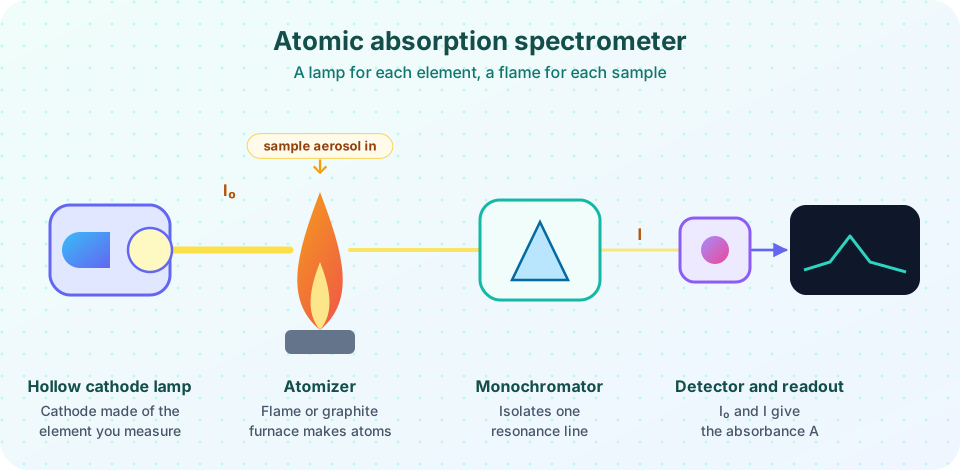
An atomic line is only about 0.002 nm wide. The best monochromators have a bandpass of 0.2 nm or more, which is much wider. If you used a continuum source, the atoms would absorb only a tiny fraction of the light passing through the monochromator slit, and the signal would be hopelessly small. Alan Walsh solved this in the 1950s with a source that emits the same line: a hollow cathode lamp. The cathode is made of (or coated with) the element you want to measure, and a low-pressure inert gas (neon or argon) sputters atoms from it. These atoms are excited and emit their own narrow lines. In practice you need one lamp for each element, or a multi-element lamp with a few metals.
Atomizers
Flame. A nebulizer turns the sample solution into a fine aerosol that is mixed with fuel and oxidant. An air–acetylene flame (about 2300 °C) is the workhorse. A nitrous oxide–acetylene flame (about 2700 °C) atomizes refractory elements such as aluminum and silicon. Only a small portion of the sample reaches the flame, and the atoms spend about a millisecond in the light path. Typical detection limits are in the mg/L to 0.01 mg/L range.
Graphite furnace (electrothermal AAS). A few microliters of sample are placed in a small graphite tube, which is heated in steps by passing current through it. The atoms are confined in a small volume for a second or more, so the detection limits are 100 to 1000 times lower: µg/L or even below. A typical program is: dry the solvent (about 100–130 °C), ash or pyrolyze the matrix (a few hundred to about 1000 °C, depending on the element), atomize in a sharp high-temperature step (1500–2800 °C) while the signal is measured, and clean out at a higher temperature. The price is slower analysis and more matrix problems.
Special techniques. Mercury is measured by cold vapor: Hg²⁺ is reduced to Hg(0) with tin(II) chloride and swept into a quartz cell at room temperature. Arsenic, selenium and antimony are measured by hydride generation, which converts them to volatile hydrides with sodium borohydride.
Press Run (or Ctrl + Enter) to see the result here.
Program input · what you'd type while the program runs
Type the answers before you press Run, one per line. Each time the program reads a line (with input()), it gets the next line from this box.
Atomic emission: flame photometry and ICP-OES
In atomic emission, the heat of the atomizer does the exciting, so no lamp is needed. Some atoms are lifted into excited states and fall back, emitting their characteristic lines. A flame photometer measures sodium (589 nm), potassium (766 and 770 nm), lithium and calcium in biological fluids and water. It is simple and cheap.
How many atoms are excited? The Boltzmann equation answers:
N* / N₀ = (g* / g₀) · exp(−ΔE / kT)
where g is the statistical weight of the level, ΔE = hc/λ, k = 1.381 × 10⁻²³ J/K and T is the temperature in kelvin. The fraction is tiny in a flame and grows rapidly with temperature, so emission is sensitive to temperature fluctuations, while absorption, which uses the huge ground-state population, is much less so.
Press Run (or Ctrl + Enter) to see the result here.
Program input · what you'd type while the program runs
Type the answers before you press Run, one per line. Each time the program reads a line (with input()), it gets the next line from this box.
The numbers show why the plasma is so valuable. In an inductively coupled plasma (ICP), argon gas flows through a quartz torch inside a radiofrequency coil (27 or 40 MHz). The radio field heats the argon to 6000–10,000 K. The sample aerosol is carried into the central channel, where it is desolvated, atomized, ionized and excited. At this temperature:
- almost all analytes, including refractory elements, are atomized, with far fewer chemical interferences than in a flame;
- many lines are strongly excited, so dozens of elements can be measured at once with a polychromator or an echelle spectrometer (ICP-OES, also called ICP-AES);
- the linear range spans four to six orders of magnitude.
AAS and ICP-OES overlap, so the choice is practical.
| Flame AAS | Graphite furnace AAS | ICP-OES | |
|---|---|---|---|
| Elements per run | one at a time | one at a time | many |
| Typical limits | 0.01–1 mg/L | 0.01–1 µg/L | 1–100 µg/L (about) |
| Sample volume | mL | 5–50 µL | mL |
| Speed | fast | slow | very fast |
| Cost | low | medium | high |
| Interferences | chemical, ionization | matrix, background | spectral overlaps |
The limits are rough orders of magnitude and depend on the element. ICP-MS, covered in the next chapter, goes lower still.
Interferences and how to handle them
- Spectral. Another line or a broad molecular band overlaps the analyte line, or particles scatter light. AAS corrects the background with a deuterium lamp or the Zeeman effect. Choose an alternative line if possible.
- Chemical. The analyte forms a compound that does not atomize. Calcium with phosphate gives a stable compound in a flame. Add a releasing agent such as lanthanum or strontium that ties up the phosphate, or a protecting agent such as EDTA that complexes the analyte, or use a hotter flame.
- Ionization. In hot flames, easily ionized atoms (K, Cs, Ca, Ba) lose an electron and the atom signal drops. Add an ionization suppressor, an excess of an even more easily ionized element such as cesium or potassium, to supply electrons.
- Physical. Viscosity and surface tension change the nebulization efficiency. Match standards to the sample matrix, or use the method of standard additions, which you meet in Chapter 3.
Common misconceptions
"AAS measures the light the atoms emit." AAS measures the light the atoms absorb. Emission is another method, with different strengths.
"The flame is the light source." In AAS the lamp is the source and the flame is only the atomizer.
"ICP-OES always beats AAS." It handles many elements at once but costs more to buy and run; flame AAS is perfectly adequate for a few metals at mg/L.
Check your understanding
Quick check · 5 questions
of 5 answered You scored / 5 · perfect!
-
1. Why does AAS use a hollow cathode lamp rather than a continuum lamp?
Only a source that emits the very narrow resonance line can give measurable absorption with an ordinary monochromator. -
2. Which atomizer gives the lowest detection limits in AAS?
In a furnace the atoms stay in the light path for about a second, giving 100 to 1000 times lower limits. -
3. Calcium signals fall in the presence of phosphate in a flame. What is the best remedy?
Lanthanum binds phosphate preferentially and releases calcium so that it can be atomized. -
4. What temperature range is typical in the ICP?
An argon ICP reaches about 6000–10,000 K, much hotter than any flame. -
5. Why is flame emission sensitive to small temperature changes?
N*/N0 has the factor exp(−ΔE/kT); small changes in T give large relative changes in the excited population.
Summary
- Atoms give narrow line spectra, which makes atomic methods selective.
- AAS uses a hollow cathode lamp, an atomizer (flame or furnace) and a monochromator; it measures absorbance.
- Flame emission and ICP-OES measure light emitted by thermally excited atoms; ICP is hotter and multi-element.
N*/N₀ = (g*/g₀) exp(−ΔE/kT)explains why emission is temperature-sensitive.- Control spectral, chemical, ionization and physical interferences with background correction, releasing agents, suppressors and matrix matching.
Next: Chapter 6 review
Track your progress
Create a free account to tick off lessons and pick up where you left off on any device.
of Analytical Chemistry lessons completed