


















Lesson 30 of 45 · Spectroscopic Methods
Chapter 6 review: spectroscopic methods
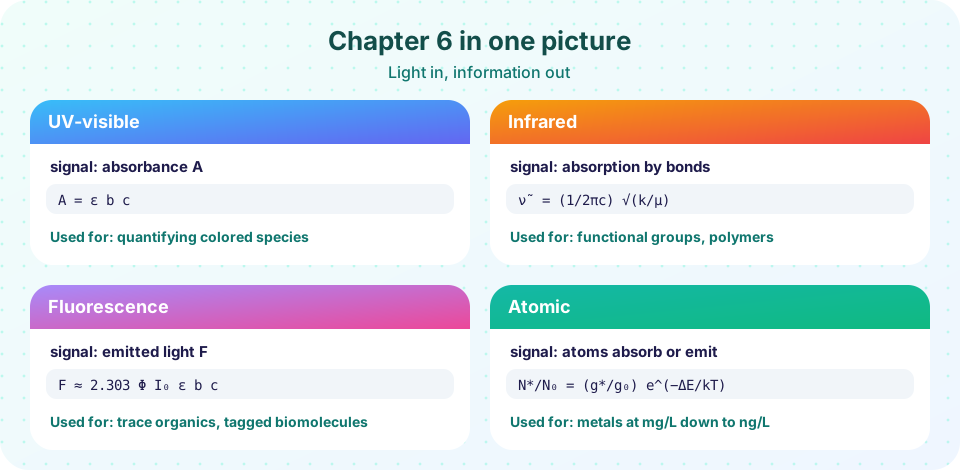
Review Chapter 6: a one-picture summary of UV-vis, infrared, fluorescence and atomic spectroscopy, a recap table, practice tools and a ten-question quiz.
This chapter showed how light turns into analytical information. Four techniques cover most laboratory questions: UV-visible absorption for colored species, infrared for bonds, fluorescence for traces of emitters, and atomic methods for metals. Use this page to consolidate them before moving on to separations.
What you will learn
- Recall the principle, equation and use of each technique.
- Choose a technique from the sample type and the detection requirement.
- Check a result for the classic mistakes before you report it.
Key terms
Absorbance: A = −log₁₀ T = ε b c.
Group frequency: the typical wavenumber range of a functional group in an IR spectrum.
Quantum yield: the fraction of absorbed photons that are emitted.
Hollow cathode lamp: the element-specific source used in atomic absorption.
Recap table
| Technique | What is measured | Key relation | Strength | Limitation |
|---|---|---|---|---|
| UV-vis | Light absorbed by a solution | A = ε b c |
Simple, cheap, quantitative | Few features, needs a chromophore |
| IR (FTIR, ATR) | Bond vibrations | ν̃ = (1/2πc)√(k/μ) |
Functional groups, fingerprint | Water absorbs strongly, not trace-sensitive |
| Fluorescence | Light emitted after excitation | F ≈ 2.303 Φ I₀ ε b c (dilute) |
Very sensitive | Only some molecules; quenching |
| Atomic (AAS, ICP) | Atomic absorption or emission | N*/N₀ = (g*/g₀) e^(−ΔE/kT) |
Selective for metals | Destroys the sample; interferences |
A decision path
- Metal or metalloid? Atomic methods. Few elements at mg/L: flame AAS. Many elements, or a wide range: ICP-OES. Ultra-trace and a single element: graphite furnace.
- Colored, or can it be made colored? UV-vis with a calibration curve.
- Need to know which bonds are present? IR, with ATR for convenience.
- Looking for nanomolar amounts of a fluorescent molecule? Fluorescence.
Common misconceptions
"A higher absorbance gives a better calibration." Linearity and precision are best between A = 0.1 and A = 1.
"The strongest IR band is the most important." Use all regions together: the functional group region and the fingerprint region.
"AAS and emission are interchangeable names." They use different physics: ground-state absorption versus excited-state emission.
Try it
Press Run (or Ctrl + Enter) to see the result here.
Program input · what you'd type while the program runs
Type the answers before you press Run, one per line. Each time the program reads a line (with input()), it gets the next line from this box.
Check your understanding
Quick check · 10 questions
of 10 answered You scored / 10 · perfect!
-
1. A solution transmits 10.0 % of the light. What is its absorbance?
A = −log10(0.100) = 1.000. -
2. Which technique is best for quantifying 0.5 µg/L of lead in drinking water in a single-element laboratory?
Graphite furnace AAS has detection limits in the µg/L range and below for many metals. -
3. A peak at 2250 cm⁻¹ points toward which group?
Triple bonds absorb between about 2100 and 2260 cm⁻¹. -
4. Which quantity is the same for both the absorbed and the emitted photon in fluorescence?
Energy is lost before emission, so the emitted wavelength is longer (Stokes shift). -
5. Why does a stray-light fraction limit the maximum useful absorbance?
Stray light sets a floor for the transmitted intensity and flattens the calibration at high A. -
6. What is the best remedy for ionization interference when measuring potassium in a hot flame?
An ionization suppressor, a more easily ionized element such as cesium, supplies electrons and reduces analyte ionization. -
7. In UV-vis, a 1.00 cm cell with ε = 2.0 × 10⁴ L mol⁻¹ cm⁻¹ gives A = 0.800. What is c?
c = 0.800 / (2.0 × 10⁴ × 1.00) = 4.0 × 10⁻⁵ mol/L. -
8. Why is ICP-OES less affected by chemical interferences than flame AAS?
At 6000–10,000 K most compounds are fully atomized, so chemical interferences are small. -
9. Which part of a fluorometer is placed at 90° to the excitation beam?
Collecting emission at a right angle keeps the transmitted excitation light out of the detector. -
10. Which statement about Beer–Lambert is correct?
A = ε b c holds for dilute solutions and monochromatic light, and it is linear in c and b.
Summary
- UV-vis, IR, fluorescence and atomic methods each have a different signal and relation; match the method to the question.
- Keep absorbance within 0.1–1, dilute if needed, and always run a blank and standards.
- Infrared and atomic spectra give selectivity; fluorescence gives sensitivity; UV-vis gives simplicity.
- Next the focus moves from detecting to separating: chromatography.
Next: Chapter 7 overview: separation methods and chromatography
Track your progress
Create a free account to tick off lessons and pick up where you left off on any device.
of Analytical Chemistry lessons completed