


















Lesson 42 of 45 · Projects and Practice
Practice set: problems with worked answers
Practice problems for electrochemistry, spectroscopy, chromatography, mass spectrometry and quality control, each with a worked answer and a runnable checker.
Reading about a method is not the same as using it. The fastest way to make the formulas stick is to solve problems, check your answer, and then see where you slipped. This set has 14 problems, grouped by chapter, each with a worked answer. Try each one on paper first, with units. Then open the answer.
The last two interactive tools let you check all the answers in code and practice with endless fresh numbers.
What you will learn
- Apply the key equations of Chapters 5 to 8 to numerical problems.
- Keep track of units and significant figures.
- Judge whether an answer is reasonable.
Key terms
Significant figures: the digits that carry meaning, set by the least precise input.
Order-of-magnitude check: a quick estimate that tells you whether an answer is plausible.
Dimensional analysis: carrying units through each step to confirm the result has the right unit.
Worked answer: a solution that shows the steps, not only the final number.
Chapter 5: electrochemical analysis
Problem 1. A copper electrode is dipped in 0.0010 M Cu²⁺ at 25 °C. With E°(Cu²⁺/Cu) = +0.340 V, what is its potential against the standard hydrogen electrode?
Answer. E = 0.340 + (0.05916/2) log(0.0010) = 0.340 + 0.02958 × (−3) = 0.340 − 0.0887 = +0.251 V.
Problem 2. A constant current of 25.0 mA flows for 20.0 minutes while silver deposits from Ag⁺. How much silver is deposited? (M = 107.87 g/mol.)
Answer. Q = 0.0250 A × 1200 s = 30.0 C. N = 30.0 / 96,485 = 3.11 × 10⁻⁴ mol. Mass = 3.11 × 10⁻⁴ × 107.87 = 0.0335 g = 33.5 mg.
Problem 3. A coulometric Karl Fischer titration uses 5.35 C. How much water is in the sample?
Answer. 10.71 C per mg of water, so 5.35 / 10.71 = 0.500 mg.
Chapter 6: spectroscopic methods
Problem 4. An iron(II)-phenanthroline solution (ε = 1.11 × 10⁴ L mol⁻¹ cm⁻¹) has A = 0.385 in a 1.00 cm cell. What is the iron concentration in mg/L? (M(Fe) = 55.85 g/mol.)
Answer. c = 0.385 / 11,100 = 3.47 × 10⁻⁵ mol/L, and 3.47 × 10⁻⁵ × 55.85 × 1000 = 1.94 mg/L.
Problem 5. A sample transmits 35.0 % of the light. What is its absorbance?
Answer. A = −log₁₀(0.350) = 0.456.
Problem 6. The C–H stretch of an alkane appears near 3000 cm⁻¹. Roughly where would the C–D stretch appear? (Use the Hooke's-law reduced-mass ratio, with μ(C–H) = 0.923 u and μ(C–D) = 1.714 u.)
Answer. The wavenumber scales as 1/√μ. The factor is √(0.923/1.714) = 0.734, so 3000 × 0.734 ≈ 2200 cm⁻¹.
Chapter 7: separations
Problem 7. In a chromatogram, t₀ = 1.20 min, and two peaks emerge at 4.80 and 5.40 min. Find k for each and α.
Answer. k₁ = (4.80 − 1.20)/1.20 = 3.00; k₂ = (5.40 − 1.20)/1.20 = 3.50; α = 3.50/3.00 = 1.17.
Problem 8. A peak at 8.00 min has a base width of 0.40 min. Calculate N. If its width at half height were 0.24 min, what would N be by the half-height formula?
Answer. N = 16 (8.00/0.40)² = 6400. By half height N = 5.54 (8.00/0.24)² ≈ 6,200. The two values agree within about 4 %, as expected for a nearly Gaussian peak.
Problem 9. Two peaks have tR of 6.20 and 6.80 min and base widths of 0.35 and 0.40 min. What is Rs? Is it baseline resolved?
Answer. Rs = 2 (0.60)/(0.75) = 1.6. Yes, because Rs ≥ 1.5.
Problem 10. A compound has D = 6 between an organic solvent and water, equal volumes. What fraction is extracted by one extraction, and by two successive extractions with fresh solvent?
Answer. One: 6/(6+1) = 85.7 %. Two: remaining (1/7)² = 2.04 %, so 98.0 % extracted.
Chapter 8: mass spectrometry and quality
Problem 11. A protonated molecule has a theoretical m/z of 285.1354 and the instrument reads 285.1362. What is the error in ppm?
Answer. (285.1362 − 285.1354)/285.1354 × 10⁶ = +2.8 ppm.
Problem 12. Five replicate analyses of a 5.00 mg/L reference solution give 4.9, 5.1, 4.8, 5.0 and 5.2 mg/L. Find the recovery and the %RSD.
Answer. The mean is 5.00 mg/L, so recovery is 100 %. The deviations are −0.1, +0.1, −0.2, 0 and +0.2; the sum of squares is 0.10, so s = √(0.10/4) = 0.158 and %RSD = 0.158/5.00 × 100 = 3.2 %.
Problem 13. A laboratory reports 4.62 mg/L for a proficiency sample with an assigned value of 4.50 mg/L and σ_p = 0.15 mg/L. Calculate the z-score and interpret it.
Answer. z = (4.62 − 4.50)/0.15 = 0.8. Since |z| ≤ 2 the performance is satisfactory.
Problem 14. A calibration has a slope of 125 response units per µg/L and a residual standard deviation of 6.5 units. Estimate the LOD and LOQ.
Answer. LOD = 3.3 × 6.5/125 = 0.17 µg/L, LOQ = 10 × 6.5/125 = 0.52 µg/L.
Press Run (or Ctrl + Enter) to see the result here.
Program input · what you'd type while the program runs
Type the answers before you press Run, one per line. Each time the program reads a line (with input()), it gets the next line from this box.
Common misconceptions
"If the numbers work out, the method is right." Check the units and whether the magnitude makes sense: a pH meter slope of 590 mV is wrong by a factor of ten.
"Significant figures only matter in exams." They tell the reader how precisely you know the answer; reporting extra digits claims precision you do not have.
Check your understanding
Quick check · 4 questions
of 4 answered You scored / 4 · perfect!
-
1. A solution has A = 0.250 and ε = 5.00 × 10³ L mol⁻¹ cm⁻¹ in a 2.00 cm cell. What is c?
c = A/(ε b) = 0.250/(5.00 × 10³ × 2.00) = 2.50 × 10⁻⁵ mol/L. -
2. A 193.0 C charge reduces a species with n = 2. How many moles react?
N = Q/(nF) = 193.0/(2 × 96,485) = 1.00 × 10⁻³ mol. -
3. Two peaks with tR of 10.0 and 10.5 min have base widths of 0.5 min each. What is Rs?
Rs = 2 × 0.5/(0.5 + 0.5) = 1.0. -
4. In the proficiency problem, which z-score would count as unsatisfactory?
|z| ≥ 3 is an unsatisfactory (action) signal.
Summary
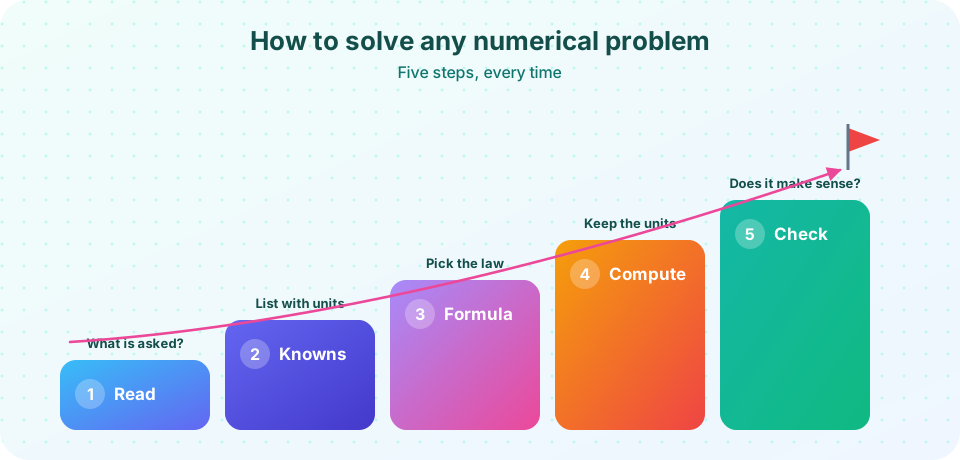
- Work every problem the same way: read, list knowns with units, choose the formula, compute, check.
- Quick estimates catch most errors before they reach a report.
- Fourteen problems across four chapters cover the central equations: Nernst, Faraday, Beer–Lambert,
k,N,Rs, extraction, ppm error, recovery, RSD, z-score, LOD and LOQ.
Next: Glossary
Track your progress
Create a free account to tick off lessons and pick up where you left off on any device.
of Analytical Chemistry lessons completed