


















Lesson 37 of 45 · Mass Spectrometry and Quality Assurance
Mass spectrometry: ions, analyzers and spectra
Learn how mass spectrometers work: EI and ESI ionization, quadrupole, TOF and Orbitrap analyzers, resolution, mass accuracy, isotope patterns and fragmentation.
A mass spectrum is a molecular fingerprint made of numbers. A single injection tells you the mass of a molecule to four decimal places, hints at its elements through isotope patterns, and, if the molecule breaks apart, shows how its pieces fit together. Few techniques pack as much structural information into so little sample.
In this lesson we follow the ions: how they are formed (ionization), how they are sorted (analyzers) and how to read the result, from the molecular ion to its isotopes and its fragments.
What you will learn
- Compare hard (EI) and soft (ESI, MALDI) ionization.
- Describe how a quadrupole, time-of-flight and Orbitrap analyzer work.
- Calculate resolution and mass accuracy in ppm.
- Predict isotope patterns for common elements.
- Use the nitrogen rule and common neutral losses to interpret spectra.
Key terms
Resolution (R): m/Δm, the ability to separate two close masses.
Mass accuracy: the error in measured mass, in ppm: (measured − theoretical)/theoretical × 10⁶.
Base peak: the tallest peak in the spectrum, set to 100 %.
Fragment ion: an ion produced when a molecular ion breaks apart.
Neutral loss: the mass difference between two ions, equal to the fragment that left uncharged.
Ionization
Electron ionization (EI)
In EI, used with gas chromatography, gaseous molecules meet a beam of 70 eV electrons. An electron is knocked out to form a radical cation M⁺•. The excess energy is large, so the ion usually breaks into fragments. This is called hard ionization. The result is a rich spectrum that is highly reproducible between instruments, so libraries such as the NIST library hold hundreds of thousands of EI spectra for matching. The molecular ion can be weak or missing for fragile molecules.
Chemical ionization (CI)
A reagent gas (methane, ammonia or isobutane) is ionized first, and it transfers a proton to the analyte. CI is softer: it often leaves [M+H]⁺ intact.
Electrospray ionization (ESI)
For liquid chromatography, the eluate is sprayed through a needle at several kilovolts. Charged droplets shrink as solvent evaporates until analyte ions escape into the gas phase. ESI is soft and works for polar, nonvolatile molecules, from small drugs to proteins. It gives protonated molecules [M+H]⁺, sodium adducts [M+Na]⁺ and, in negative mode, [M−H]⁻. Large molecules take several charges ([M+nH]ⁿ⁺), which brings a 50 kDa protein into the m/z range of a modest instrument.
Other sources
- APCI (atmospheric pressure chemical ionization) suits less polar compounds.
- MALDI (matrix-assisted laser desorption/ionization) co-crystallizes the sample with a matrix and fires a laser; it is common for proteins, peptides and polymers.
- ICP is for elements (next lesson).
Mass analyzers
| Analyzer | How it sorts | Typical resolution | Strengths |
|---|---|---|---|
| Quadrupole | Four rods with RF and DC voltages let one m/z pass |
Unit resolution (about 1 Da) | Robust, cheap, great for quantitation; scans or monitors selected ions |
| Ion trap | Ions stored in an oscillating field and ejected by m/z |
Unit | Multi-stage MSⁿ fragmentation |
| Time of flight (TOF) | Ions accelerated to the same energy; lighter ions reach the detector first | 10,000–60,000 or more | Fast, wide mass range, accurate mass |
| Orbitrap | Ions orbit a central electrode; frequency gives m/z |
60,000 to over 500,000 | Very high resolution and mass accuracy |
| FT-ICR | Cyclotron frequency in a strong magnet | Over 1,000,000 | Highest resolution; expensive |
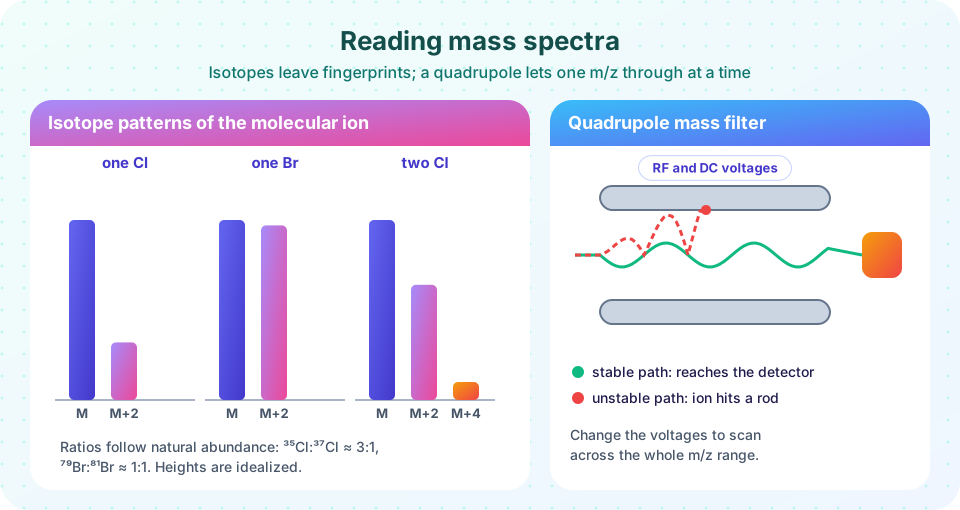
In the quadrupole, opposing rods carry the same voltage U + V cos(ωt), adjacent rods the opposite. For a given ratio of DC to RF, only ions of one m/z have stable trajectories. Others spiral out and strike the rods. Scanning the voltages scans m/z; holding them fixed monitors one ion (selected ion monitoring) with great sensitivity.
In time of flight, an ion of mass m and charge ze accelerated through voltage V has kinetic energy zeV = ½mv². It then drifts over a length L, so the flight time is t = L √(m/(2zeV)). The flight time grows with the square root of m/z.
Resolution and mass accuracy
Resolution R = m/Δm, where Δm is the peak width at half height. To separate two ions that differ by 0.02 Da at m/z 300, you need R ≈ 300/0.02 = 15,000.
Mass accuracy is given in parts per million. If caffeine's [M+H]⁺ has the theoretical value 195.0877 and the instrument reads 195.0880, the error is (195.0880 − 195.0877)/195.0877 × 10⁶ ≈ 1.5 ppm. At 1–3 ppm accuracy, the number of chemical formulas consistent with a mass shrinks to a handful; combined with the isotope pattern, it often points to one formula.
Press Run (or Ctrl + Enter) to see the result here.
Program input · what you'd type while the program runs
Type the answers before you press Run, one per line. Each time the program reads a line (with input()), it gets the next line from this box.
Isotope patterns
The abundance pattern of a cluster is the product of the patterns of its atoms. A useful rule: M+1 from carbon is about 1.08 × (number of C atoms) % of M, because each carbon has a 1.07 % chance of being ¹³C. For a compound with ten carbons the M+1 peak is roughly 11 % of the molecular ion. Sulfur gives M+2 at about 4.4 % per atom, chlorine about 32 % per atom and bromine about 97 % per atom.
Press Run (or Ctrl + Enter) to see the result here.
Program input · what you'd type while the program runs
Type the answers before you press Run, one per line. Each time the program reads a line (with input()), it gets the next line from this box.
Reading a spectrum
- Find the molecular ion at the highest
m/z(apart from isotope peaks). In EI it may be weak. - Apply the nitrogen rule. A molecule with an even nominal mass contains zero or an even number of nitrogen atoms; an odd nominal mass means an odd number of nitrogen atoms. (This holds for the molecular ion
M⁺•of a neutral molecule with C, H, N, O, S and the halogens.) - Read the isotope cluster for Cl, Br and S, and the
M+1for carbon count. - Look at the differences between peaks. Common neutral losses help: 15 (CH₃), 17 (OH or NH₃), 18 (H₂O), 28 (CO or C₂H₄), 29 (C₂H₅ or CHO), 31 (OCH₃), 43 (C₃H₇ or CH₃CO), 44 (CO₂).
- Compare with a library and with a standard run on the same instrument.
Fragmentation is not random. Bonds next to heteroatoms or carbonyl groups break readily, and stable cations (tertiary carbocations, acylium ions, the tropylium ion at m/z 91 for alkylbenzenes) dominate the spectrum.
Detecting the ions
An electron multiplier converts an arriving ion into a shower of electrons, amplifying the signal by a factor of 10⁵ to 10⁸. A computer then counts the pulses per m/z. The detector, like the analyzer, sits in a high vacuum, typically 10⁻⁴ to 10⁻⁸ mbar depending on the instrument.
Common misconceptions
"The tallest peak is the molecular ion." The tallest peak is the base peak. The molecular ion is the one of highest mass, and in EI it can be tiny.
"Higher resolution always means better quantitation." Triple quadrupoles with unit resolution are the standard for quantitation because they are selective and sensitive.
"ESI always gives one peak per compound." It can give several adducts and charge states for the same compound.
Check your understanding
Quick check · 5 questions
of 5 answered You scored / 5 · perfect!
-
1. Which ionization method typically fragments molecules extensively and gives library-matchable spectra?
EI at 70 eV is hard, reproducible and the basis of the NIST EI libraries. -
2. An instrument reads 301.1410 for an ion whose theoretical m/z is 301.1413. What is the error?
(301.1410 − 301.1413)/301.1413 × 10⁶ = −1.0 ppm. -
3. A compound with an M+2 peak about 32 % of M probably contains
³⁷Cl is about 32 % as abundant as ³⁵Cl, giving a 3:1 cluster. -
4. In a time-of-flight analyzer, which ion arrives first?
All ions gain the same kinetic energy, so lighter ions move faster and reach the detector earlier. -
5. A molecular ion at m/z 129 for a CHN compound indicates
By the nitrogen rule, an odd nominal mass means an odd number of nitrogen atoms.
Summary
- Hard ionization (EI) gives fragments; soft ionization (ESI, CI, MALDI) preserves the intact ion.
- Quadrupoles, ion traps, TOF and Orbitrap analyzers trade speed, resolution and cost.
R = m/Δm; mass accuracy in ppm narrows down the possible formulas.- Isotope clusters reveal Cl, Br, S and the carbon count; the nitrogen rule constrains nitrogen.
- Neutral losses and stable fragments guide structure assignment.
Track your progress
Create a free account to tick off lessons and pick up where you left off on any device.
of Analytical Chemistry lessons completed