


















Lesson 45 of 45 · Projects and Practice
Further study: where to go next
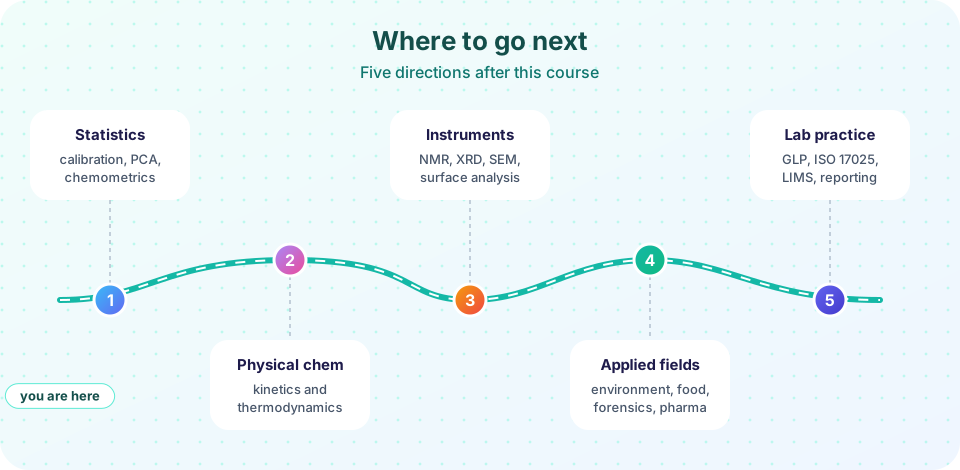
Plan your next steps after this course: statistics, physical chemistry, advanced instruments, applied fields and laboratory practice, with links to related tracks.
You have covered the full arc of modern analytical chemistry: from measurement and calibration to titrations, electrochemistry, spectroscopy, chromatography, mass spectrometry and quality assurance. The next step depends on what you want to do with it. This page maps five directions, with suggestions for what to study and how it connects to other tracks on this site.
What you will learn
- See which topics extend what you learned.
- Choose a study path that fits your goals.
- Find related tracks on the site and practical habits worth building.
Key terms
Chemometrics: applying statistics and data analysis to chemical measurements.
Instrumental analysis: methods that rely on instruments rather than classical wet chemistry.
Surface analysis: techniques that probe the top few nanometers of a material.
LIMS: laboratory information management system, software that tracks samples and results.
GLP: good laboratory practice, quality rules for laboratory studies.
Direction 1: statistics and chemometrics
Every result in this course has an uncertainty, and every calibration is a regression. A deeper grasp of statistics lets you design experiments, compare methods and extract information from large data sets, for example multivariate calibration of spectra or principal component analysis of chromatograms.
- Study probability distributions, confidence intervals, hypothesis tests, weighted regression and analysis of variance in Statistics and Probability.
- Practice data handling with NumPy, pandas and SciPy, the tools used in the calibration code of this course.
- See the broader workflow in Data Science.
Direction 2: physical chemistry
Physical chemistry explains why the methods work. Thermodynamics sets electrode potentials and equilibrium constants, kinetics governs rates in sensors and reactions, and quantum mechanics explains why atoms and molecules absorb light at definite wavelengths.
- Take Physical Chemistry for thermodynamics, kinetics, electrochemistry and spectroscopy in depth.
- Revisit equilibrium and reactions in Chemistry Foundations.
Direction 3: advanced instruments
Several techniques not covered here are common in research and industry:
- NMR spectroscopy for the structure of organic molecules and for quantitation.
- X-ray diffraction and fluorescence for crystalline phases and elemental composition of solids.
- Electron microscopy with microanalysis for particles and surfaces.
- Ion chromatography and capillary electrophoresis for ions and charged biomolecules.
- Thermal analysis (DSC, TGA) for polymers and materials.
Connecting chemistry with materials is a natural next step in Materials Science.
Direction 4: applied fields
The methods of this course are used in many professions:
| Field | Typical samples | Common techniques |
|---|---|---|
| Environmental | Water, soil, air, sediments | ICP-MS, GC-MS, LC-MS/MS, ion chromatography |
| Clinical and toxicology | Blood, urine, tissue | LC-MS/MS, immunoassays, ISEs |
| Pharmaceutical | Raw materials, tablets, biologics | HPLC, UV, dissolution, MS |
| Food and agriculture | Produce, beverages, feed | HPLC, GC, AAS/ICP, NIR |
| Forensics | Drugs, fibers, residues | GC-MS, LC-MS, IR, ICP |
| Industry and energy | Fuels, polymers, batteries | GC, Karl Fischer, ICP, titration |
To work in biological or organic settings, strengthen the chemistry in Biochemistry, Organic Chemistry Basics and Inorganic Chemistry.
Direction 5: laboratory practice and quality
Technique alone does not make a good analyst. Habits do:
- Keep a clear laboratory notebook with dates, lot numbers, calibrations and raw data.
- Learn the safety rules for acids, solvents, compressed gases and high voltage.
- Study ISO/IEC 17025 and, for regulated work, GLP and GMP requirements.
- Learn a LIMS and good data-integrity practices.
- Take part in proficiency tests and read method standards (ISO, ASTM, EPA, pharmacopoeias) critically.
How to continue studying
- Re-run the code of this course with your own numbers; change one parameter at a time.
- Choose one method, such as HPLC or ICP-MS, and read a published method in your field of interest.
- Validate a simple method yourself, if you have access to a laboratory: calibration, recovery, precision and detection limit.
- Teach a topic to someone else; it is the fastest way to find gaps.
Press Run (or Ctrl + Enter) to see the result here.
Program input · what you'd type while the program runs
Type the answers before you press Run, one per line. Each time the program reads a line (with input()), it gets the next line from this box.
Common misconceptions
"Analytical chemistry is just pushing buttons on an instrument." The hard part is choosing a method, controlling the sample, and proving the number is reliable.
"Software removes the need to understand the methods." Software applies a model. You need to know when the model does not fit.
"Once I know the methods, I am done." Instruments and regulations change; the ability to validate and question a method is the lasting skill.
Check your understanding
Quick check · 4 questions
of 4 answered You scored / 4 · perfect!
-
1. Which direction would best prepare you for building multivariate calibrations of spectra?
Multivariate calibration is a statistical technique. -
2. Which area explains why electrode potentials depend on temperature and concentration?
The Nernst equation comes from thermodynamics. -
3. What does LIMS stand for?
A LIMS tracks samples, methods and results in a laboratory. -
4. Which habit is essential in every analytical laboratory?
Complete records make results traceable and defensible.
Summary
- Five directions extend this course: statistics, physical chemistry, advanced instruments, applied fields and laboratory practice.
- Related tracks on this site: Statistics and Probability, Physical Chemistry, Biochemistry and Materials Science.
- Keep practicing with real data, validate what you can, and keep good records.
Back to the course: Analytical Chemistry
Track your progress
Create a free account to tick off lessons and pick up where you left off on any device.
of Analytical Chemistry lessons completed