


















Lesson 40 of 45 · Mass Spectrometry and Quality Assurance
Chapter 8 review: mass spectrometry and quality assurance
Review Chapter 8: a one-picture summary of mass spectrometry, hyphenated MS, method validation and quality control, with practice tools and a ten-question quiz.
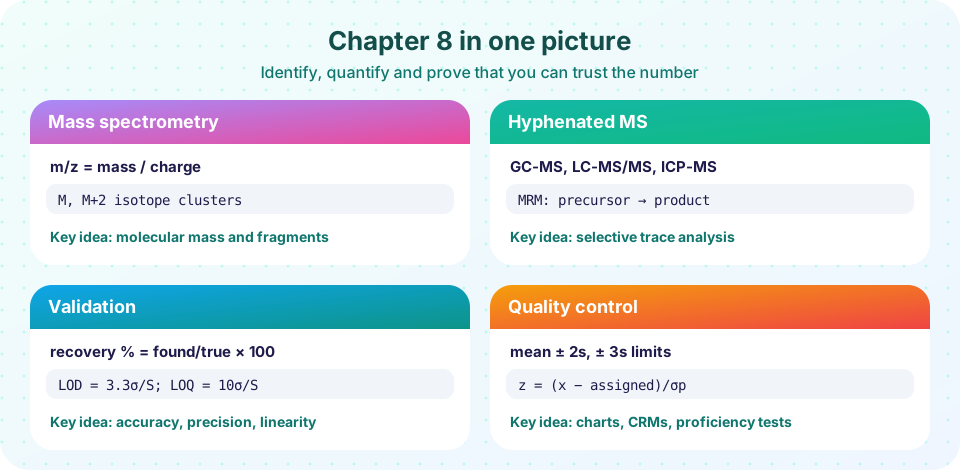
You now know how to weigh ions and how to prove that a measurement deserves trust. This review ties the pieces together. First the picture and the table; then two practice tools; then a ten-question quiz that mixes all four lessons of the chapter.
What you will learn
- Recall the essentials of ionization, analyzers, hyphenated MS and validation.
- Combine uncertainty contributions into an expanded uncertainty.
- Apply the checklist that turns a measurement into a defensible result.
Key terms
m/z: mass divided by charge number.
MRM: monitoring of precursor → product transitions.
LOD / LOQ: 3.3σ/S and 10σ/S.
z-score: (x − X)/σ_p in proficiency testing.
Expanded uncertainty: U = k · u_c, usually with k = 2.
Recap table
| Topic | Remember |
|---|---|
| Ionization | EI is hard and library friendly; ESI is soft and suits LC; MALDI suits large molecules |
| Analyzers | Quadrupole: robust and quantitative; TOF and Orbitrap: high resolution and accurate mass |
| Resolution, accuracy | R = m/Δm; ppm error = (measured − theoretical)/theoretical × 10⁶ |
| Isotope clusters | One Cl: 3:1; one Br: 1:1; carbon M+1 ≈ 1.08 × nC % |
| GC-MS | EI, library matching, SIM raises sensitivity |
| LC-MS/MS | Volatile buffers, MRM with quantifier and qualifier, labelled internal standard |
| ICP-MS | ng/L detection, polyatomic interferences (ArO⁺ on Fe, ArCl⁺ on As) |
| Validation | Selectivity, linearity, accuracy (recovery), precision (%RSD), LOD/LOQ, robustness |
| QC | Blanks, spikes, duplicates, CRMs, Shewhart charts, proficiency tests |
A defensible-result checklist
- Was the method validated for this matrix and range?
- Was the calibration verified in this batch?
- Did the blank stay clean and the spike recover within limits?
- Did the control chart show the process in control?
- Is the result inside the calibrated range, with its uncertainty stated?
- Are samples, standards and raw data traceable and recorded?
Common misconceptions
"A match to the library means a certain identification." The match score is evidence. Check retention time or index and, if the decision matters, confirm with a standard.
"Uncertainty means the analyst made mistakes." Uncertainty describes the unavoidable dispersion of values reasonably attributable to the result; it is a measure of quality, not a confession of error.
Try it
Press Run (or Ctrl + Enter) to see the result here.
Program input · what you'd type while the program runs
Type the answers before you press Run, one per line. Each time the program reads a line (with input()), it gets the next line from this box.
Check your understanding
Quick check · 10 questions
of 10 answered You scored / 10 · perfect!
-
1. Which ionization technique is best for a polar, nonvolatile drug eluting from an HPLC column?
ESI is a soft atmospheric-pressure technique suited to polar, nonvolatile compounds in a liquid flow. -
2. A compound shows peaks at M and M+2 of nearly equal height. It most likely contains
79Br and 81Br are almost equally abundant. -
3. What resolution is needed to separate two ions at m/z 400.000 and 400.020?
R = m/Δm = 400/0.020 = 20,000. -
4. In MRM, a qualifier transition is used to
The qualifier-to-quantifier ratio must match the standards, which protects against false positives. -
5. A matrix spike at 20.0 µg/L gives a result of 22.4 µg/L (the unspiked sample is below the LOD). What is the recovery?
22.4/20.0 × 100 = 112 %. -
6. Which control-chart event requires immediate investigation?
A point beyond ±3s has a probability of about 0.3 % in a stable process. -
7. Which statement about LOD and LOQ is correct?
LOQ (10σ/S) is about three times higher than LOD (3.3σ/S). -
8. What is the main benefit of an isotope-labelled internal standard in LC-MS/MS?
It co-elutes and experiences the same suppression and recovery losses, so the ratio stays valid. -
9. A result is reported as 10.2 ± 0.6 mg/L (k = 2). What does k = 2 indicate?
A coverage factor of 2 gives an interval with approximately 95 % coverage. -
10. Which interference affects arsenic (m/z 75) in ICP-MS?
40Ar35Cl+ has nominal mass 75, the same as arsenic.
Summary
- Mass spectrometry measures ions by m/z; resolution and mass accuracy narrow down formulas, isotopes count atoms.
- Hyphenated methods give selectivity: GC-MS with libraries, LC-MS/MS with MRM, ICP-MS for elements.
- Validation proves fitness for purpose; QC proves it every day; uncertainty puts a number on doubt.
- The last chapter applies everything in projects, practice and a one-page cheat sheet.
Track your progress
Create a free account to tick off lessons and pick up where you left off on any device.
of Analytical Chemistry lessons completed