


















Lesson 11 of 45 · Sampling and Calibration
Chapter 3 overview: sampling and calibration
Preview chapter 3: how a few grams can represent tonnes, how calibration turns signals into concentrations, and how detection limits and matrix effects are handled.
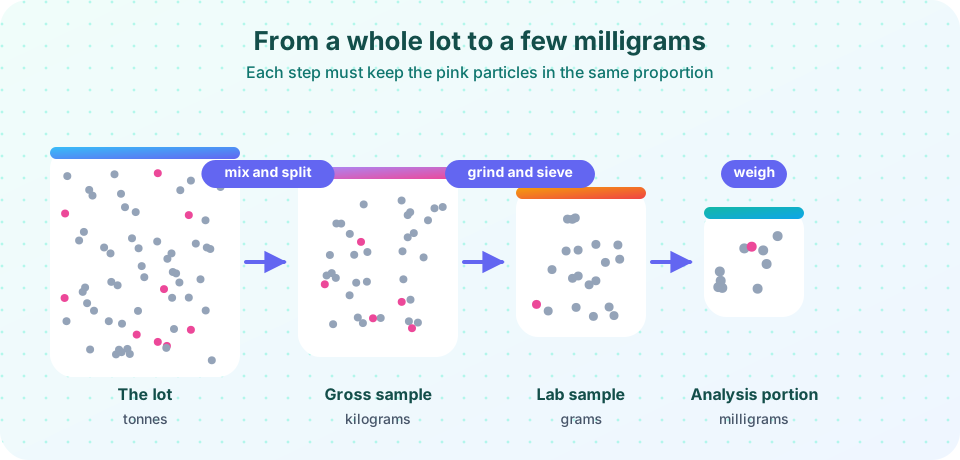
An analysis ends with a number, but it begins with a decision about what the number should describe. A truckload of wheat, a lake, a patient's blood: in each case you can analyze only a tiny fraction. This chapter first shows how to take that fraction so it represents the whole, then how to convert the instrument's signal into a concentration you can defend.
What you will learn
- Why sampling is usually the largest source of error and how to reduce it.
- How external calibration, standard addition and internal standards work.
- How detection and quantification limits are defined.
- How matrix effects distort signals and how to correct for them.
The chapter at a glance
Sample
Calibrate
Correct
Lessons in this chapter
- Sampling heterogeneous materials: sampling variance, particle size and sample mass.
- Calibration and detection limits: least squares, using the line, LOD and LOQ.
- Standard addition and internal standards: handling matrix effects and drift.
- Chapter 3 review: recap and quiz.
Try it
Press Run (or Ctrl + Enter) to see the console output here.
No output.
Check your understanding
Quick check · 3 questions
of 3 answered You scored / 3 · perfect!
-
1. Why is sampling often the largest error source?
Differences between portions of the material produce a sampling variance that can dwarf the measurement variance. -
2. A calibration relates
A calibration function converts the instrument's signal into a concentration. -
3. When is standard addition most useful?
Adding standard to the sample itself makes matrix effects the same for the sample and the additions.
Summary
- Representative sampling comes first; no instrument can fix a poor sample.
- Calibration converts signals into concentrations, with limits of detection and quantification.
- Standard addition and internal standards handle matrix effects and drift.
Track your progress
Create a free account to tick off lessons and pick up where you left off on any device.
of Analytical Chemistry lessons completed