


















Lesson 5 of 45 · Getting Started
Chapter 1 review: getting started
Review the analytical process, concentration units, dilution and glassware with a one-page summary, a recap table and a nine-question quiz.
You now know the shape of an analysis, the language of concentration and the tools that measure mass and volume. This review pulls the chapter together before you move on to the mathematics of error in Chapter 2.
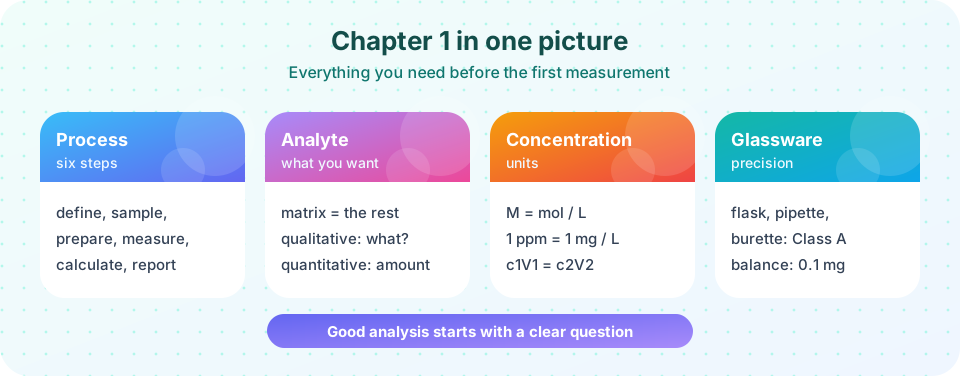
Recap table
| Lesson | Core ideas | Formulas and numbers |
|---|---|---|
| The analytical process | six steps, qualitative versus quantitative, fit for purpose | s_total² = Σ s_i² |
| Solutions and concentration | molarity, ppm, dilution | c = n/V, c1V1 = c2V2, 1 ppm ≈ 1 mg/L |
| Glassware and balances | tolerances, burette reading, weighing | flask ±0.08 mL (100 mL), burette ±0.05 mL (50 mL) |
Try it
Press Run (or Ctrl + Enter) to see the result here.
Program input · what you'd type while the program runs
Type the answers before you press Run, one per line. Each time the program reads a line (with input()), it gets the next line from this box.
Check your understanding
Quick check · 9 questions
of 9 answered You scored / 9 · perfect!
-
1. Which is the correct order of the analytical process?
You cannot choose a sampling plan or a method before the question is defined. -
2. Sampling RSD is 6 % and measurement RSD is 2 %. The combined RSD is closest to
√(36 + 4) = √40 ≈ 6.3 %. -
3. A method that responds to many substances besides the analyte lacks
Selectivity is the ability to respond to the analyte alone. -
4. How many mg of KCl (74.55 g/mol) are in 100.0 mL of 0.0100 M solution?
n = 0.0100 × 0.1000 = 1.00 × 10⁻³ mol; mass = 1.00 × 10⁻³ × 74.55 g = 74.55 mg ≈ 74.6 mg. -
5. 20.0 mL of a 0.500 M solution is diluted to 250.0 mL. The new concentration is
c2 = 0.500 × 20.0 / 250.0 = 0.0400 M. -
6. Which glassware is calibrated 'to deliver'?
Pipettes and burettes are calibrated to deliver; volumetric flasks are calibrated to contain. -
7. Why is a 10 mL pipette preferred over a 1 mL pipette for a quantitative dilution?
The absolute tolerance grows slowly with volume, so the relative error shrinks for larger volumes. -
8. Weighing by difference removes which source of error?
Only the mass leaving the container is counted, so tare and adhering residue cancel. -
9. A result of 9.1 ± 1.5 µg/L is compared with a limit of 10 µg/L. The conclusion is
The interval 7.6 to 10.6 µg/L includes 10, so the result cannot say which side the true value is on.
Summary
- A complete analysis is six steps; sampling and preparation often dominate the error.
- Know your units: molarity, % w/w, ppm ≈ mg/L, and the dilution rule
c1V1 = c2V2. - Use the right glassware, read it carefully and combine tolerances in quadrature.
- Always compare a result with a limit through its uncertainty interval.
Track your progress
Create a free account to tick off lessons and pick up where you left off on any device.
of Analytical Chemistry lessons completed