


















Lesson 22 of 45 · Electrochemical Analysis
Chapter 5 overview: electrochemical analysis
A big-picture tour of electrochemical analysis: potentiometry, voltammetry, coulometry and conductometry, and what each one measures in a cell.
Chemistry and electricity meet whenever electrons move between species. That simple fact gives analysts a powerful toolkit. If you can turn the amount of a substance into a voltage, a current or an electric charge, you can measure it with an instrument that is cheap, small and easy to automate. A pocket pH meter, a blood glucose strip and a coulometric water titrator all work this way.
This chapter introduces the four main electrochemical measurements. Each one asks the cell a different question, and each gives a different kind of answer. Learn what is measured, and the rest follows.
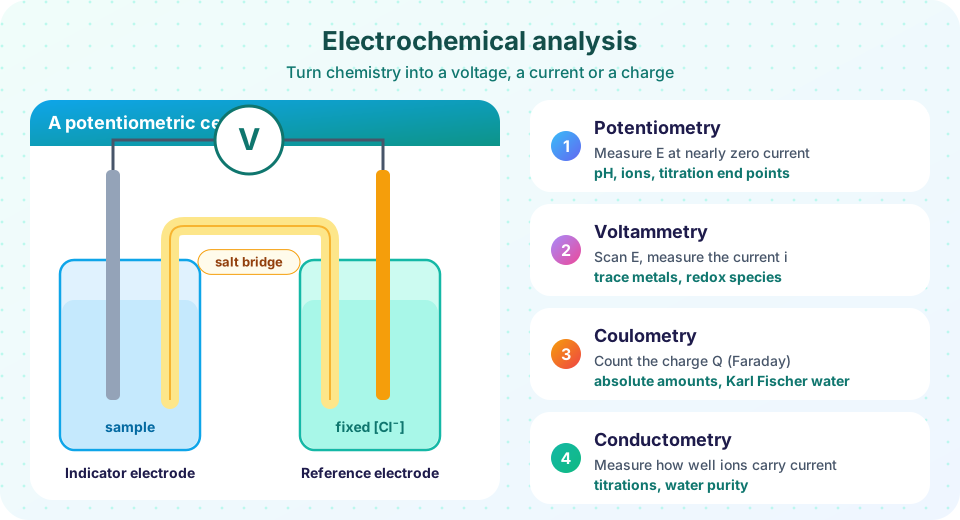
What you will learn
- Describe an electrochemical cell and name its parts.
- Tell the four methods apart by the signal each measures.
- Choose a sensible method for a given analytical question.
- Calculate a cell potential and its free energy from standard potentials.
Key terms
Electrode: a conductor in contact with the solution where electrons enter or leave.
Indicator (working) electrode: the electrode whose response depends on the analyte.
Reference electrode: an electrode with a fixed, known potential.
Salt bridge: an ionic connection that completes the circuit without mixing the solutions.
Faradaic process: a reaction in which electrons really cross the electrode surface.
The electrochemical cell
An electrochemical cell has two electrodes in contact with an electrolyte, joined by an external wire. One electrode hosts an oxidation (the anode) and the other a reduction (the cathode). Electrons flow through the wire; ions flow through the solution and the salt bridge to keep charge balanced.
In analysis we split the two electrodes by job. The indicator electrode feels the analyte. The reference electrode holds its potential steady so that any change in the cell voltage is blamed on the indicator. Common references are the saturated calomel electrode (SCE, +0.241 V versus the standard hydrogen electrode at 25 °C) and the silver/silver chloride electrode (+0.197 V in saturated KCl). Chapter 5 uses these numbers often.
A third electrode, the counter (or auxiliary) electrode, appears when a real current must flow. It carries the current so that the reference does not have to; you will see it in the voltammetry lesson.
Cell potential and free energy
The potential of a cell under standard conditions is the cathode potential minus the anode potential:
E°cell = E°cathode − E°anode
The link to thermodynamics is ΔG° = −n F E°cell, where n is the number of electrons and F = 96,485 C/mol is the Faraday constant. A positive E°cell means a spontaneous reaction. Take the classic Daniell cell, zinc in zinc sulfate joined to copper in copper sulfate. With E°(Cu²⁺/Cu) = +0.34 V and E°(Zn²⁺/Zn) = −0.76 V, we get E°cell = 0.34 − (−0.76) = +1.10 V. For n = 2, ΔG° = −2 × 96,485 × 1.10 ≈ −212 kJ/mol.
Press Run (or Ctrl + Enter) to see the result here.
Program input · what you'd type while the program runs
Type the answers before you press Run, one per line. Each time the program reads a line (with input()), it gets the next line from this box.
Four questions, four methods
Think of the cell as a conversation. You can listen quietly, push and watch what happens, count the electrons, or ask how well ions carry current.
- Potentiometry listens. You measure the cell potential while drawing almost no current. The Nernst equation links that potential to the activity of the analyte. This is how a pH meter and an ion-selective electrode work.
- Voltammetry pushes. You change the potential of a working electrode on purpose and record the current. The current is proportional to concentration, so you can measure micromolar and even nanomolar amounts.
- Coulometry counts. You force a reaction to go to completion and measure the total charge. Faraday's law turns charge into moles, with no calibration curve at all.
- Conductometry asks about ions in bulk. You measure how well the whole solution conducts, which changes as ions are added or removed. It is not selective but it is fast and simple.
Four ways to read a cell
The signal you pick decides the method.
Why use electrochemistry?
Many sensors are electrochemical.
Watch out for
Calibrate often and keep electrodes clean.
Choosing a method
Matching the method to the question saves time. Use this table as a first guess; later lessons explain the reasons.
| Question | Good first choice | Why |
|---|---|---|
| pH of a lake sample | Potentiometry (glass electrode) | Fast, direct, no reagents |
| Fluoride in drinking water | Potentiometry (ion-selective electrode) | Selective, wide range |
| Lead in tap water at µg/L | Stripping voltammetry | Very low detection limits |
| Water in lithium battery solvent | Coulometric Karl Fischer | Absolute, works at µg level |
| End point of an acid-base titration with no indicator | Conductometry or potentiometry | Signal changes sharply at the end point |
Common misconceptions
"A voltmeter measures the potential without disturbing the cell." A real meter draws a tiny current. Modern pH meters have input impedance above 10¹² Ω so that the current is negligible, but with an old low-impedance meter the reading drops.
"Standard potentials apply directly to real samples." They apply at unit activity. Real solutions need the Nernst equation, and concentrations must often be converted to activities.
What each lesson covers
- Potentiometry and ion-selective electrodes: the Nernst equation, reference electrodes, the glass pH electrode, fluoride and other ISEs, and potentiometric titrations.
- Voltammetry, conductometry and coulometry: the three-electrode cell, cyclic voltammetry, stripping analysis, conductometric titrations and Faraday's law.
- Chapter review: one picture of the chapter and ten mixed questions.
Check your understanding
Quick check · 4 questions
of 4 answered You scored / 4 · perfect!
-
1. Which method measures a potential while drawing almost no current?
Potentiometry reads the cell potential at nearly zero current. Voltammetry scans the potential and measures current; coulometry measures charge. -
2. What is E°cell for a cell with cathode +0.80 V and anode −0.76 V?
E°cell = E°cathode − E°anode = 0.80 − (−0.76) = +1.56 V. -
3. What is the job of the reference electrode?
The reference gives a stable, known potential. The counter electrode carries current in voltammetry. -
4. Which method needs no calibration curve because it relies on Faraday's law?
In coulometry, the charge passed gives the amount of substance directly: N = Q / (nF).
Summary
- Electrochemical methods turn chemical amounts into potential, current, charge or conductivity.
- A cell has an indicator electrode, a reference electrode and often a counter electrode.
ΔG° = −nFE°cell; a positive cell potential means a spontaneous reaction.- Potentiometry listens, voltammetry pushes, coulometry counts, conductometry measures bulk ions.
Track your progress
Create a free account to tick off lessons and pick up where you left off on any device.
of Analytical Chemistry lessons completed