


















Lesson 31 of 45 · Separation Methods and Chromatography
Chapter 7 overview: separation methods and chromatography
See the big picture of analytical separations: extraction, solid-phase extraction, distillation and the main types of chromatography, with the key equations.
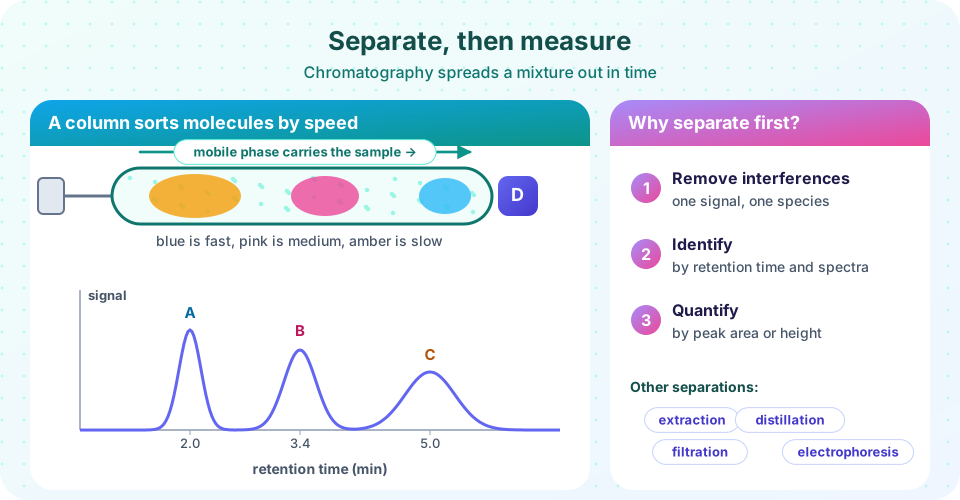
Real samples are messy. Blood holds thousands of compounds, river water carries pesticides alongside natural organic matter, and a perfume is a blend of hundreds of molecules. A detector that responds to everything will give one tangled signal. The classic answer is to separate first and measure second. If each component reaches the detector alone, one signal tells you about one species.
This chapter covers the separation tools of the modern laboratory. We start with simple batch methods such as extraction, then move to chromatography, the most powerful separation technique ever devised. This lesson gives you the map and the core vocabulary.
What you will learn
- Explain why separations are used before measurement.
- Calculate a distribution ratio and the efficiency of an extraction.
- Describe solid-phase extraction in four steps.
- Classify chromatographic methods by mobile phase and by mechanism.
- Read the basic parts of a chromatogram.
Key terms
Mobile phase: the fluid (gas or liquid) that moves through the system.
Stationary phase: the solid, or liquid on a solid, that stays in place.
Distribution ratio (D): total analyte concentration in one phase divided by that in the other.
Retention time (tR): the time from injection to the peak maximum.
Eluent: the mobile phase that carries analytes through the column.
Separation by partition
Most separations rely on partition: a compound spreads itself between two phases that do not mix. The distribution ratio is
D = [analyte]total in phase 2 / [analyte]total in phase 1
If D is large, the compound strongly prefers phase 2. Differences in D between compounds are the engine of every separation in this chapter.
Liquid-liquid extraction
In an extraction, an aqueous sample is shaken with an immiscible organic solvent, and the analyte moves to the layer where it dissolves best. The fraction extracted in one step is
E = D / (D + V_aq / V_org)
Splitting the organic solvent into several portions is much more efficient than one big portion. After n extractions, the fraction left in the aqueous phase is (1 / (1 + D·V_org / V_aq))ⁿ.
For acids and bases the pH matters. A weak acid is extracted into an organic solvent in its neutral form (low pH), and into water when it is ionized (high pH). Back-extraction exploits this to clean up samples.
Press Run (or Ctrl + Enter) to see the result here.
Program input · what you'd type while the program runs
Type the answers before you press Run, one per line. Each time the program reads a line (with input()), it gets the next line from this box.
Solid-phase extraction (SPE)
SPE uses a small cartridge of sorbent, such as C18 silica. It has become the standard sample cleanup step because it uses little solvent and can be automated. A typical reversed-phase SPE has four steps:
- Condition the sorbent with methanol and then water so that it wets properly.
- Load the aqueous sample. The analyte sticks to the sorbent.
- Wash with a weak solvent to remove salts and polar interferences.
- Elute the analyte in a small volume of strong solvent, which also concentrates it.
A 500 mL water sample extracted into 1 mL of eluate is concentrated 500 times, which is how pesticides at ng/L are brought into the range of a detector.
Other batch separations
- Distillation separates liquids by boiling point; it is useful for solvent purification and for isolating volatile analytes such as ammonia or ethanol.
- Filtration and centrifugation remove particles and precipitates.
- Precipitation and masking remove interfering ions chemically.
- Electrophoresis separates charged species by their speed in an electric field; it comes back in the further-study lesson.
Chromatography
Chromatography separates a mixture as it flows through a column packed with, or coated with, a stationary phase. Compounds that interact strongly with the stationary phase move slowly; those that prefer the mobile phase move quickly. After a long enough column the species emerge one by one, and a detector records a chromatogram, a plot of signal against time.
By mobile phase
| Technique | Mobile phase | Typical analytes |
|---|---|---|
| Gas chromatography (GC) | Gas (helium, hydrogen, nitrogen) | Volatile, thermally stable molecules |
| High-performance liquid chromatography (HPLC) | Liquid at high pressure | Most soluble compounds, including polar and large molecules |
| Supercritical-fluid chromatography (SFC) | Supercritical CO₂ | Chiral and nonpolar compounds |
| Thin-layer chromatography (TLC) | Liquid moving up a plate | Quick screening and reaction checks |
By mechanism
- Adsorption on a solid surface (normal-phase silica).
- Partition between a liquid mobile phase and a liquid film bound to a support (reversed phase).
- Ion exchange with charged groups on the stationary phase.
- Size exclusion where big molecules cannot enter the pores and elute first.
- Affinity, based on specific interactions, as with an antibody.
A chromatography run in four steps
Every chromatograph follows these four steps.
What identifies a peak?
Use at least two kinds of evidence.
What quantifies it?
Calibrate with standards each time.
Reading a chromatogram
Three quantities appear in every chromatogram: where a peak is (retention time), how wide it is (width), and how big it is (area or height). The dead time t₀ is the time an unretained compound needs to travel through the column. Retention time minus dead time is the adjusted retention time. Positions identify, areas quantify, and widths tell you about column quality. The next lesson turns these into numbers.
Common misconceptions
"Chromatography identifies compounds by itself." Retention time only suggests an identity. Two compounds can co-elute, so confirm with a second method such as a mass spectrum.
"A bigger peak always means more analyte." Detector response differs from compound to compound. Calibrate for each analyte.
"The mobile phase does the separating." The difference in how strongly each compound is held by the stationary phase relative to the mobile phase does it.
What each lesson covers
- Chromatography theory: retention, efficiency and resolution
- Gas chromatography
- High-performance liquid chromatography
- Chapter review
Check your understanding
Quick check · 4 questions
of 4 answered You scored / 4 · perfect!
-
1. A compound has D = 9 between an organic solvent and water, equal volumes. What fraction is extracted in one step?
E = D / (D + V_aq/V_org) = 9 / (9 + 1) = 0.90. -
2. Why is extracting with three 25 mL portions better than one 75 mL portion?
The residual fraction is raised to the power n, which falls much faster than with a single large portion. -
3. In reversed-phase SPE, what is the purpose of the wash step?
The wash uses a weak solvent that removes salts and polar interferences but leaves the analyte sorbed. -
4. Which technique suits large biomolecules separated by size?
In size exclusion, large molecules cannot enter the pores of the packing and elute first.
Summary
- Separations simplify a sample before measurement; partition between two phases is the common principle.
- Extraction efficiency depends on
Dand the phase volumes; several small extractions beat one large one. - SPE: condition, load, wash, elute, with concentration as a bonus.
- Chromatography is classified by mobile phase (GC, LC, SFC) and by mechanism (adsorption, partition, ion exchange, size exclusion, affinity).
- A chromatogram gives retention times, peak widths and peak areas.
Next: Chromatography theory: retention, efficiency and resolution
Track your progress
Create a free account to tick off lessons and pick up where you left off on any device.
of Analytical Chemistry lessons completed