


















Lesson 20 of 45 · Titrations and Gravimetry
Gravimetric analysis: precipitate, filter, ignite, weigh
Learn how gravimetric analysis turns a weighed precipitate into an amount of analyte, how to get pure crystals, and how to use the gravimetric factor.
Gravimetric analysis is the most direct way to count atoms: turn the analyte into a pure solid of known composition, weigh it, and compute. No calibration curve, no standard solutions, just a good balance and careful technique. It is slow, but when done well it is among the most accurate methods in chemistry, which is why gravimetry is used to certify reference materials.
What you will learn
- List the steps of a precipitation gravimetric analysis and the purpose of each.
- Explain how particle size, co-precipitation and digestion affect purity.
- Calculate analyte mass with a gravimetric factor.
- Know when to heat to constant mass.
Key terms
Precipitate: an insoluble solid formed from solution. Digestion: warming the precipitate in its mother liquor so crystals grow larger and purer. Co-precipitation: unwanted impurities carried down with the precipitate. Ignition: strong heating to convert the precipitate to a stable weighing form. Gravimetric factor (GF): the mass of analyte per unit mass of weighed product.
The steps
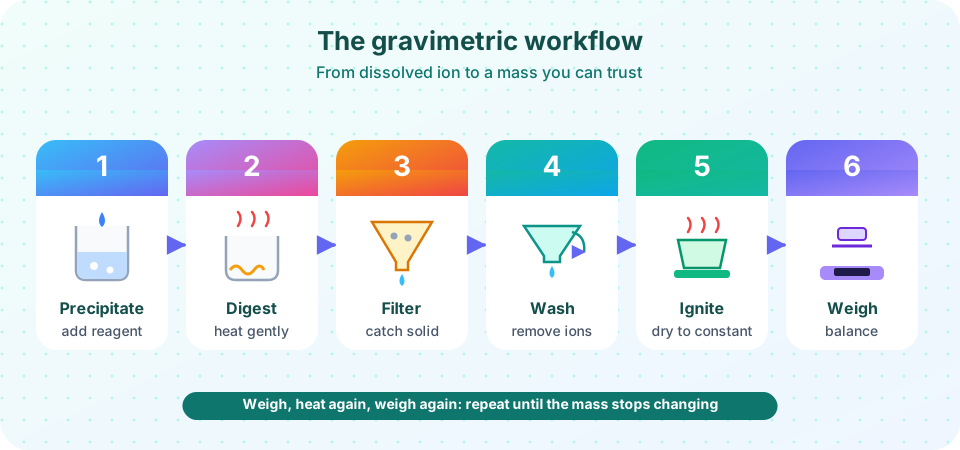
- Precipitate. Add the reagent slowly to a hot, dilute solution while stirring, so the solid forms as larger, purer crystals instead of tiny particles. Low relative supersaturation favors crystal growth over new nuclei.
- Digest. Keep the mixture warm for some time; small crystals dissolve and larger ones grow, releasing trapped impurities.
- Filter. Use ashless filter paper or a sintered-glass crucible. Test that precipitation is complete by adding a drop of reagent to the clear filtrate.
- Wash. Rinse with a suitable wash liquid (often a dilute electrolyte such as dilute ammonium nitrate for silver chloride) to remove soluble impurities without peptization (the precipitate turning colloidal) or dissolving.
- Dry or ignite. Heat until the solid has a definite composition. Silver chloride is simply dried near 110 °C; barium sulfate is ignited at about 800 °C; aluminum hydroxide is ignited to Al₂O₃.
- Weigh. Cool in a desiccator, weigh, heat again, and weigh again. Repeat until two consecutive weighings agree within about 0.3 mg: this is constant mass.
A good precipitate has low solubility (losses below the balance's resolution), is easy to filter, is pure, and has a known composition after drying.
The gravimetric factor
If the weighed product is P and the analyte is A, then mass of A = mass of P × GF, where
GF = (a × M_A) / (b × M_P)
with a and b chosen so that the number of atoms of the analyte element balances.
Example 1: chloride as silver chloride. A 0.5000 g sample containing chloride gives 0.6215 g AgCl (143.32 g/mol). GF = 35.45 / 143.32 = 0.2473. Mass of Cl = 0.6215 × 0.2474 = 0.1537 g, so the sample is 30.75 % Cl.
Example 2: sulfate as barium sulfate. For SO₄²⁻ (96.06 g/mol) weighed as BaSO₄ (233.39 g/mol), GF = 96.06 / 233.39 = 0.4116. A 1.000 g precipitate corresponds to 0.4116 g of sulfate.
Example 3: iron as Fe₂O₃. Two Fe atoms per formula unit: GF = 2 × 55.845 / 159.69 = 0.6994.
The gravimetric factor is why a small relative error in the balance does not matter much when the precipitate is heavy: a 0.1 mg error on 0.6 g is 0.017 %.
Sources of error
- Co-precipitation and occlusion: impurities trapped in the lattice, which make the mass too high.
- Incomplete precipitation or losses on washing: mass too low.
- Incomplete drying or absorbing moisture after drying: variable mass, hence constant-mass checks.
- Colloids: tiny particles that pass through the filter; digest to avoid.
Common misconceptions
"Gravimetry needs no skill because you only weigh." Technique in precipitation decides the purity and so the answer.
"A fast precipitation is better." Fast addition forms tiny, impure crystals; slow, hot, dilute precipitation yields pure, filterable ones.
"One weighing is enough." Only constant mass shows that the solid is dry or fully converted.
Try it
Press Run (or Ctrl + Enter) to see the result here.
Program input · what you'd type while the program runs
Type the answers before you press Run, one per line. Each time the program reads a line (with input()), it gets the next line from this box.
Press Run (or Ctrl + Enter) to see the console output here.
No output.
Check your understanding
Quick check · 5 questions
of 5 answered You scored / 5 · perfect!
-
1. Why is a precipitate digested?
Warming in the mother liquor lets small, impure crystals dissolve and larger crystals grow. -
2. A 1.000 g sample gives 0.5000 g of BaSO₄ (GF for SO₄²⁻ = 0.4116). Percent sulfate is
0.5000 × 0.4116 = 0.2058 g, or 20.58 % of 1.000 g. -
3. Constant mass is reached when
Repeated heating and weighing proves no more water or volatile material is being lost. -
4. Co-precipitation usually makes the result
Trapped impurities add mass to the precipitate. -
5. For Fe weighed as Fe₂O₃ (159.69 g/mol), the gravimetric factor is about
2 × 55.845 / 159.69 = 0.6994.
Summary
- Gravimetry weighs a pure, stable product; purity depends on slow, hot, dilute precipitation and digestion.
- Wash carefully, ignite to a defined composition, and weigh to constant mass.
- Mass of analyte = mass of product × gravimetric factor.
- Co-precipitation and incomplete drying are the main sources of error.
Next: Chapter 4 review
Track your progress
Create a free account to tick off lessons and pick up where you left off on any device.
of Analytical Chemistry lessons completed