


















Lesson 19 of 45 · Titrations and Gravimetry
Complexometric and redox titrations
Learn how EDTA titrations measure water hardness, how permanganate titrations work as self-indicating redox methods, and how back titrations extend titration.
Acid-base reactions are only one kind of chemistry you can count with a burette. Metal ions form stable complexes with chelating agents such as EDTA; oxidizing and reducing agents exchange electrons quickly and completely. Each reaction type needs the same three things: a clean stoichiometry, a fast reaction, and a clear end point.
What you will learn
- Explain how EDTA binds metal ions and how a metal-ion indicator signals the end point.
- Calculate water hardness from an EDTA titration.
- Balance and use the permanganate-iron(II) reaction.
- Solve back-titration problems.
Key terms
Chelating agent (ligand): a molecule that binds a metal ion through several donor atoms. EDTA: ethylenediaminetetraacetic acid, a hexadentate ligand forming 1:1 complexes with most metal ions. Metal-ion indicator: a dye that has one color free and another bound to the metal, such as Eriochrome Black T. Self-indicating: the titrant itself is colored, so no indicator is needed. Water hardness: the total concentration of Ca²⁺ and Mg²⁺, expressed as mg/L of CaCO₃.
EDTA titrations
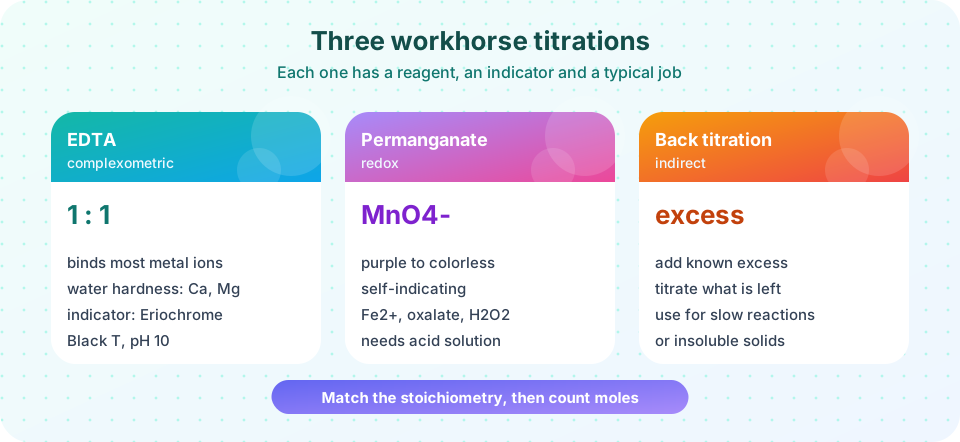
EDTA (written H₄Y, usually used as its disodium salt, Na₂H₂Y) wraps around a metal ion with six donor atoms. For most metals the stoichiometry is 1:1, independent of the charge of the metal ion:
M²⁺ + Y⁴⁻ → MY²⁻
The complex is only stable enough at a suitable pH. Titrations of Ca²⁺ and Mg²⁺ are buffered at pH 10 (an ammonia buffer). The indicator Eriochrome Black T is wine red when bound to Mg²⁺ and blue when free. As EDTA is added it takes metal from the indicator, and at the end point the solution changes from wine red to blue.
Water hardness example
A 50.00 mL water sample at pH 10 needs 12.60 mL of 0.01000 M EDTA to reach the blue end point. Moles of EDTA: 0.01000 × 0.01260 = 1.260 × 10⁻⁴ mol, equal to the moles of Ca²⁺ plus Mg²⁺. Expressed as CaCO₃ (100.09 g/mol): 1.260 × 10⁻⁴ × 100.09 = 0.01261 g in 50.00 mL, so hardness = 0.2522 g/L = 252 mg/L as CaCO₃. Classifications vary by country, but values above about 180 mg/L are generally called "very hard".
Redox titrations
In a redox titration the titrant is an oxidizing or reducing agent, and the end point is when the electrons have been exchanged exactly. Common titrants: potassium permanganate (MnO₄⁻, oxidizing), potassium dichromate, cerium(IV), iodine/thiosulfate (iodometry).
Permanganate and iron(II)
In acid solution:
MnO₄⁻ + 5 Fe²⁺ + 8 H⁺ → Mn²⁺ + 5 Fe³⁺ + 4 H₂O
so the mole ratio is 1 MnO₄⁻ to 5 Fe²⁺. Permanganate is intensely purple, Mn²⁺ is nearly colorless. Each drop of titrant fades as it reacts; the first lasting pale pink tint marks the end point. No separate indicator is needed, so permanganate is self-indicating.
Example. 25.00 mL of iron(II) solution needs 21.40 mL of 0.02000 M KMnO₄. Moles of MnO₄⁻: 0.02000 × 0.02140 = 4.280 × 10⁻⁴ mol; moles of Fe²⁺ = 5 × 4.280 × 10⁻⁴ = 2.140 × 10⁻³ mol; concentration = 2.140 × 10⁻³ / 0.02500 = 0.0856 M.
Cautions: permanganate is not a primary standard (it reacts with traces of organic matter), so standardize it against sodium oxalate. Use sulfuric acid, not hydrochloric acid, because chloride is oxidized by permanganate.
Back titration revisited
For the antacid example in the previous lesson: 0.2500 g of tablet powder reacts with 50.00 mL of 0.1000 M HCl (5.000 mmol). The excess needs 21.30 mL of 0.1000 M NaOH (2.130 mmol). HCl consumed = 5.000 − 2.130 = 2.870 mmol. Since CaCO₃ + 2 HCl → …, CaCO₃ = 1.435 mmol = 143.6 mg, which is 57.45 % of the powder. The same method works for slow reactions, insoluble solids and metal ions with no suitable indicator (add excess EDTA, titrate the excess with Zn²⁺).
Common misconceptions
"EDTA works at any pH." The complex stability and the indicator both depend on pH; always buffer.
"Permanganate needs an indicator." It is self-indicating; a lasting pale pink is the end point.
"The mole ratio is always 1:1." For MnO₄⁻/Fe²⁺ it is 1:5; always balance the equation first.
Try it
Press Run (or Ctrl + Enter) to see the result here.
Program input · what you'd type while the program runs
Type the answers before you press Run, one per line. Each time the program reads a line (with input()), it gets the next line from this box.
Press Run (or Ctrl + Enter) to see the console output here.
No output.
Check your understanding
Quick check · 5 questions
of 5 answered You scored / 5 · perfect!
-
1. How many moles of Fe²⁺ react with one mole of MnO₄⁻ in acid solution?
Manganese gains 5 electrons (Mn from +7 to +2) and each Fe²⁺ loses 1. -
2. Eriochrome Black T changes from wine red to blue at the end point of a hardness titration because
The free indicator is blue; EDTA binds the metal more strongly than the dye does. -
3. 30.00 mL of a sample needs 9.00 mL of 0.0100 M EDTA. Ca²⁺ + Mg²⁺ (mol/L) is
n = 0.0100 × 0.00900 = 9.00 × 10⁻⁵ mol; divided by 0.03000 L = 0.00300 mol/L. -
4. Why is hydrochloric acid avoided in permanganate titrations?
Permanganate would oxidize chloride to chlorine, consuming extra titrant. -
5. A back titration is chosen mainly when
A measured excess ensures complete reaction; the leftover is titrated.
Summary
- EDTA forms 1:1 complexes with most metal ions; buffer the pH and use a metal-ion indicator.
- Water hardness: moles of EDTA = moles of Ca²⁺ + Mg²⁺, reported as mg/L CaCO₃.
- Permanganate is self-indicating; MnO₄⁻ : Fe²⁺ is 1 : 5.
- Back titrations handle slow reactions and insoluble samples.
Next: Gravimetric analysis
Track your progress
Create a free account to tick off lessons and pick up where you left off on any device.
of Analytical Chemistry lessons completed