


















Lesson 43 of 43 · Projects and Practice
Further study in urban planning
Where to go after this course: related subjects on this site, a reading list of classic urban planning books, skills to practice and ways to start a planning career.
You now have a broad foundation: you can read a zoning rule, calculate a cost burden, discuss a street cross-section, explain a flood probability and judge a participation process. This last lesson points the way forward. Planning draws on many fields, so the best next step depends on what interests you most: the people, the places, the systems or the data.
What you will learn
- Choose related subjects to study next.
- Find classic books and sources to deepen your understanding.
- Identify skills that employers and universities value.
- Plan a first practical project.
Key terms
Interdisciplinary: drawing on several fields of knowledge at once.
Primary source: original material, such as a plan document, a census table or a council minute.
Portfolio: a collection of your work that shows what you can do.
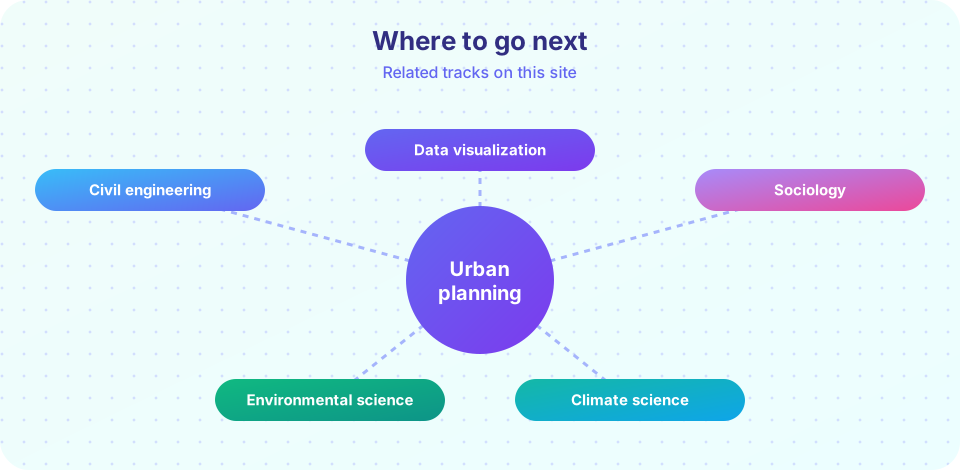
Related subjects on this site
Planning is interdisciplinary, so many other tracks deepen it:
- People and society: Sociology, Political science and Civics and government explain how communities, institutions and power shape planning decisions. Behavioral economics helps you think about why people choose how they travel and where they live.
- Money and markets: Microeconomics and Macroeconomics explain land and housing markets, costs and growth.
- Environment and climate: Environmental science and Climate science give the physical background for the resilience chapter.
- Building and infrastructure: Civil engineering basics and Architecture basics show how streets, drainage and buildings are actually made.
- Data and evidence: School statistics, Statistics and probability and Data visualization strengthen the numbers side of practice.
- Health and place: Public health and epidemiology connects neighborhood design with wellbeing.
- Places of the world: World geography provides context for comparing cities.
A starter reading list
These widely discussed books give different viewpoints. You do not have to agree with any of them; reading them critically is part of the training.
- Jane Jacobs, The Death and Life of Great American Cities (1961): a critique of mid-century planning and a celebration of lively streets.
- Kevin Lynch, The Image of the City (1960): how people form mental maps of places.
- William H. Whyte, The Social Life of Small Urban Spaces (1980): observation of how people really use plazas.
- Jan Gehl, Cities for People (2010): a modern guide to human-scale design.
- Richard Rothstein, The Color of Law (2017): a history of government policies that segregated American housing.
- Donald Shoup, The High Cost of Free Parking (2005): how parking rules shape cities and travel.
- Sherry Arnstein, "A Ladder of Citizen Participation" (1969): a short paper you can read in an afternoon.
Skills to build
- Reading and writing plans. Download your own city's comprehensive plan and zoning map. Summarize it in one page and note three things you would change.
- Data and mapping. Learn spreadsheets first, then a free GIS program, and practice making a clear map of one indicator.
- Communication. Practice explaining a technical idea to a 12-year-old and to a council member; good planners do both.
- Observation. Spend an hour counting and noting how people use one street or plaza, as Whyte did, and write up what you see.
- Listening. Attend a local planning meeting or watch a recording, and note who speaks and who does not.
Paths from here
Many planners hold a degree in planning, geography, architecture, engineering, public policy or environmental studies, and many universities offer master's programs in urban and regional planning. Professional bodies in different countries (for example the American Planning Association, the Royal Town Planning Institute in the UK and the Planning Institute of Australia) provide accreditation, codes of ethics and resources. Jobs include city and regional government, transport agencies, consultancies, non-profits, community organizations and developers. Volunteering with a neighborhood association, a transit advocacy group or a local planning board is an excellent way to learn.
A last project
Choose a place you know, such as your school, your neighborhood or a town you have visited. Create a three-page "planning portrait": a map with indicators (density, walkshed, green space), a short history, a list of three problems with evidence, and one proposal with a scoring matrix and a plan for engagement. If you can finish it, you have already done what junior planners do.
Common misconceptions
"You need to be an artist to be a planner." Planning uses drawing, but also writing, data, law, economics and conversation.
"Planners decide everything." They analyze, propose and facilitate; elected officials, courts, residents and developers also shape outcomes.
"Learning stops with the course." Cities change, rules change and so does the evidence. Keep reading and observing.
Check your understanding
Quick check · 4 questions
of 4 answered You scored / 4 · perfect!
-
1. Why is planning called interdisciplinary?
Planning combines knowledge from many subjects. -
2. Which activity follows William Whyte's method?
Whyte filmed and counted real use of public space. -
3. What is a primary source?
Primary sources are original records or documents. -
4. Which is a good first practical project?
Applying the tools to a real place builds skill.
Summary
- Planning connects to society, economics, environment, engineering, data and health.
- Read widely and critically; start with the classics and a primary source from your own city.
- Build skills in reading plans, mapping, communicating, observing and listening.
- A planning portrait of a local place is a strong first project.
Back to the course home page: Urban Planning
Track your progress
Create a free account to tick off lessons and pick up where you left off on any device.
of Urban Planning lessons completed