


















Lesson 35 of 43 · Planning Practice and Data
Plans and participation
Learn what goes into a comprehensive plan, how Arnstein's ladder rates public participation, which engagement methods work, and how to compare options with a scoring matrix.
A city plan is a promise written down: here is where we want to be in twenty years, and here is how we will get there. But a plan nobody believes in sits on a shelf. The difference between a plan that shapes streets and a plan that gathers dust often lies in how it was made, especially whether the people it affects had a real say.
In this lesson you will look inside a typical plan, learn a classic way of judging participation, survey the methods planners use to hear from residents, and practice comparing options with a transparent scoring matrix.
What you will learn
- Describe the parts of a comprehensive plan and how plans are adopted.
- Explain Arnstein's ladder and classify examples.
- Compare participation methods and their biases.
- Use a weighted scoring matrix to evaluate options.
- Recognize common conflicts such as NIMBY and YIMBY positions.
Key terms
Comprehensive plan (master plan): a long-range document guiding a city's growth, land use, transport, housing and services.
Stakeholder: any person or group affected by, or able to affect, a decision.
Charrette: an intensive, collaborative design workshop, often lasting several days.
Participatory budgeting: a process in which residents decide how to spend part of a public budget.
NIMBY and YIMBY: "not in my back yard" and "yes in my back yard," shorthand for opposing or supporting new development nearby.
Inside a comprehensive plan
A comprehensive plan usually covers 15 to 25 years and combines several parts that build on each other:
- Vision: a short statement of the future the community wants.
- Existing conditions: data on population, housing, jobs, land use, transport and environment.
- Goals and objectives: goals are broad ("a safe, walkable city"); objectives are measurable ("reduce traffic deaths by half within ten years").
- Policies and actions: the rules, projects and programs that serve the objectives.
- Implementation and monitoring: who does what, with what money, and how progress is tracked.
Legal status varies by country. In some places the plan is a binding framework to which zoning and spending must conform; in others it is advisory. Planners propose, and elected councils or boards usually adopt, after public hearings. Large projects may also require an environmental impact assessment, which studies likely effects and alternatives before approval.
Arnstein's ladder of participation
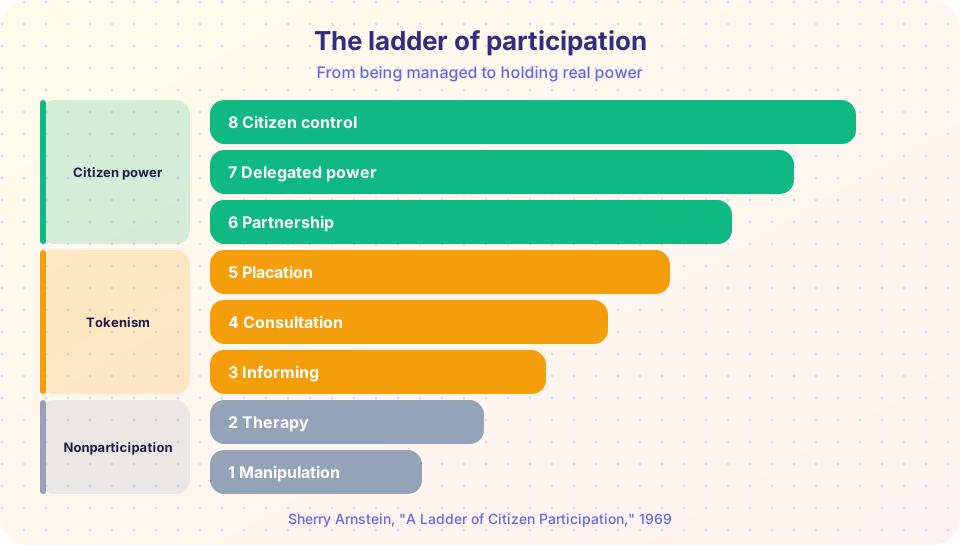
In 1969, Sherry Arnstein, an American planner and policy advisor, published "A Ladder of Citizen Participation," one of the most cited papers in the field. She described eight rungs of increasing citizen power in three groups:
- Nonparticipation: manipulation and therapy, where officials claim to involve people but mainly aim to educate or pacify them.
- Tokenism: informing (one-way communication), consultation (asking opinions without promising to act on them) and placation (a few citizens advise but power holders decide).
- Citizen power: partnership (power is shared through joint committees), delegated power (citizens hold the majority of seats or decisive authority over a program) and citizen control (citizens govern a program or institution directly).
Arnstein's point was blunt: participation without redistribution of power lets those in charge claim that everyone took part while nothing changes. Her ladder is a simplification, and later writers note that not every project should sit at the top rung (a highly technical decision may suit consultation), but it is a handy test. If a city says it "engaged the community," ask what rung that really was and whether the input changed the result.
Methods and their biases
Common methods include public hearings, open houses, surveys, workshops, charrettes, advisory committees, pop-up events in parks or markets, interviews, and online platforms and mapping tools. Participatory budgeting, which began in Porto Alegre, Brazil, in 1989 and spread to thousands of cities, gives residents direct authority over a share of spending.
Every method favors some people. Evening hearings attract homeowners, older residents and organized groups; people working night shifts, caring for children or lacking reliable transit are missing. Online surveys reach people with internet access and time. Researchers who study who attends planning meetings in the United States often find that participants are older, more likely to own homes and more likely to oppose new housing than the wider population, which means hearings alone can misrepresent a community. Good practice mixes methods, meets people where they are (in languages they speak, at times and places that suit them, with childcare and food) and compares participants with census data to see who is missing.
NIMBY, YIMBY and the public interest
Planning disputes often pit neighbors against newcomers. Opposition to a project is not always selfish: residents may be worried about traffic, noise, or displacement, and these concerns can be legitimate. Supporters may point to the needs of renters, workers and future residents who do not yet live in the area and so are not in the room. A good process makes those absent voices visible, with data and outreach, and weighs local impacts against regional needs. A weak process lets whoever shouts loudest win.
Comparing options with a scoring matrix
When there are several options, planners often use multi-criteria evaluation. List the criteria (cost, safety, emissions, equity, ease of building), give each a weight that reflects its importance, score each option on each criterion, and multiply and add. The method does not remove disagreement, but it makes it visible: if you disagree about the weights, the matrix shows how the ranking changes. Weights should be set openly, ideally with community input, and tested for sensitivity.
Common misconceptions
"A public hearing means the public was heard." A hearing can sit on the lower rungs of the ladder if comments cannot change the plan.
"Planners decide where everything goes." Planners analyze and recommend; elected officials, courts, developers and residents all shape outcomes.
"The weights in a matrix are objective." They reflect values; different weights can produce different winners.
Try it
Explore the ladder: pick a real-world participation activity and see which rung it matches, with a reason.
Now build a weighted scoring matrix for three options for a main street. Change the weights and watch the ranking move. The scores are invented for the exercise.
Press Run (or Ctrl + Enter) to see the result here.
Program input · what you'd type while the program runs
Type the answers before you press Run, one per line. Each time the program reads a line (with input()), it gets the next line from this box.
Check your understanding
Quick check · 5 questions
of 5 answered You scored / 5 · perfect!
-
1. Which part of a comprehensive plan states measurable aims?
Objectives turn broad goals into measurable targets. -
2. On Arnstein's ladder, officials asking opinions without promising action is
Consultation is a tokenism rung because it does not guarantee influence. -
3. Why can public hearings misrepresent a community?
Time, access and interest skew who shows up. -
4. What is participatory budgeting?
It began in Porto Alegre in 1989 and has spread widely. -
5. In a scoring matrix, what do the weights represent?
Weights are value judgments, so they should be set openly and tested.
Summary
- Plans move from vision to goals, objectives, policies and monitoring.
- Arnstein's ladder separates token gestures from real power.
- Every engagement method has biases; mix methods and check who is missing.
- Weighted matrices make trade-offs and value choices visible.
- Good process hears absent voices, not just the loudest.
Next: Data, GIS and indicators
Track your progress
Create a free account to tick off lessons and pick up where you left off on any device.
of Urban Planning lessons completed