


















Lesson 34 of 43 · Planning Practice and Data
Chapter 8 overview: Planning practice and data
Preview chapter 8: the planning cycle, how planners involve the public, and how data, surveys, projections and GIS maps support decisions.
Until now you have studied what planners plan for: homes, streets, parks and resilient places. This chapter looks at how the work is done. Real planning is not drawing a perfect city on an empty map. It happens in committees, public meetings, spreadsheets and map software, under legal rules, budgets and deadlines, with people who disagree.
Three skills run through everyday practice: following a clear process, working with the people affected, and using data honestly. Master those and you can tackle almost any planning question, from a neighborhood bus stop to a regional growth plan.
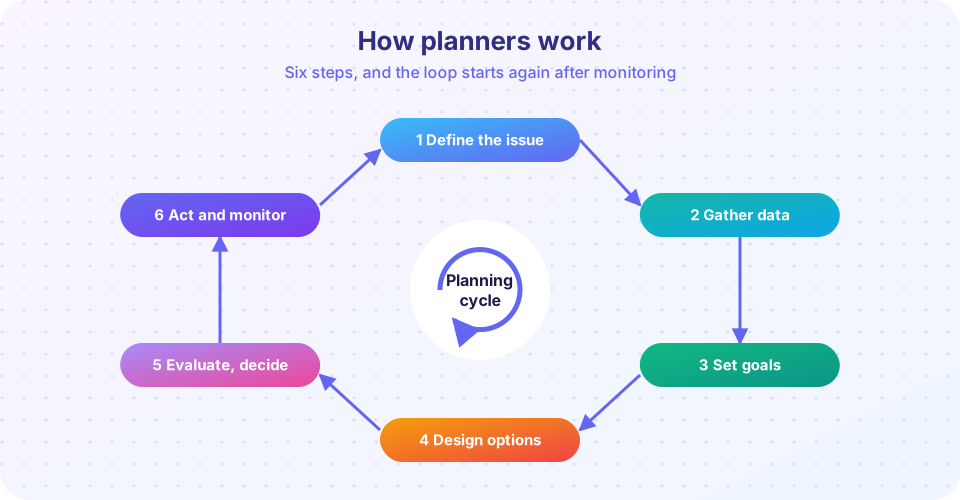
The planning cycle
Choose and act
People
Data
What each lesson covers
- Plans and participation: what a comprehensive plan contains, how decisions are made, Arnstein's ladder of participation, methods from workshops to participatory budgeting, and how to compare options fairly.
- Data, GIS and indicators: census and survey data, map layers and overlay analysis, population projections, and the main ways data can mislead.
- Chapter review: a recap table and a ten-question quiz.
Professional ethics in one paragraph
Planners work for the public, not for a single client. Professional codes, such as the one adopted by the American Institute of Certified Planners, ask planners to serve the public interest, give people the information they need to participate, and pay special attention to the needs of those who have the least power. When you evaluate a planning decision, ask three questions: Is the process open? Is the evidence honest? Does the outcome treat people fairly? The rest of the chapter gives you tools to answer them.
What a planner does in a week
Planners rarely design a whole city; they spend most of their time on smaller tasks that add up. In a typical week a local planner might review a development application against the zoning rules and write a recommendation, answer questions from residents at a counter or online, prepare a map of crash locations for a safety project, attend an evening meeting to present options for a bus lane, update population estimates for a school district, and draft a section of a long-range plan. Many of these tasks involve a mix of the three skills in this chapter: following a process, working with people, and handling data.
Why process matters
A clear process protects a plan from two common failures. The first is solutionism, where a favorite answer is chosen before the problem is understood. The second is paralysis, where endless study delays any decision. A good process sets stages with deadlines: define the issue, collect only the data you need, state goals, draw several options, compare them against stated criteria and decide in a public meeting. It also builds in a review so that mistakes lead to learning.
How to use this chapter
Read the participation lesson with a real example in mind, such as a local project you have heard about. Ask which rung of the ladder it reached. Read the data lesson with a spreadsheet or map open if you can, and try computing a density or a projection with numbers for your own town. Skills that you practice on familiar places become much easier to apply to new ones.
Check your understanding
Quick check · 3 questions
of 3 answered You scored / 3 · perfect!
-
1. What happens after a plan is implemented?
The cycle repeats: results are monitored and inform the next round. -
2. Whom do planners primarily serve according to professional codes?
Planning ethics center on public interest and fair process. -
3. Which three skills run through planning practice?
These are the themes of the chapter.
Summary
- Planning is a repeating cycle from defining the issue to monitoring results.
- Practice depends on process, participation and data.
- Professional ethics emphasize public interest, open process and fairness.
Next: Plans and participation
Track your progress
Create a free account to tick off lessons and pick up where you left off on any device.
of Urban Planning lessons completed