


















Lesson 6 of 43 · History of Cities
A Brief History of Cities: Overview
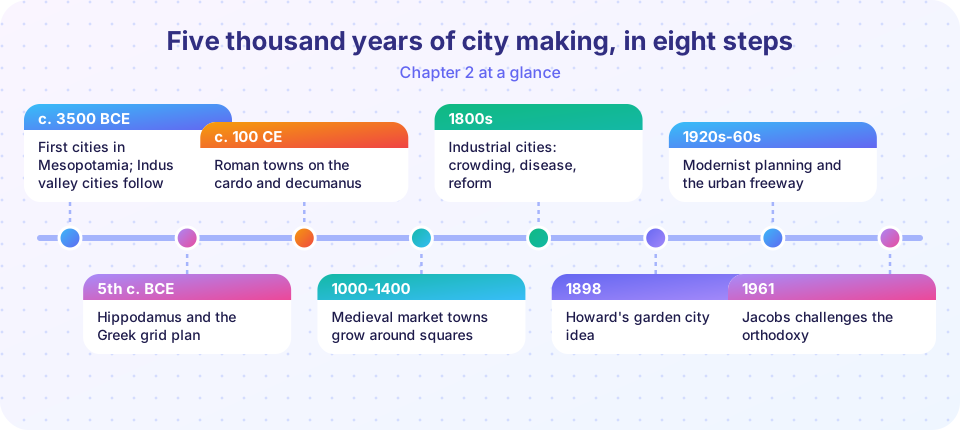
A roadmap to chapter 2: five thousand years of city making, from planned grids and organic towns to industrial crises, modernism and the critics who answered it.
Cities are among humanity's oldest inventions, and planning is almost as old. The first towns in Mesopotamia were already organized around temples, granaries and canals. Every era since has asked the same questions: how should streets be laid out, who decides, how do we bring in water and take out waste, and who gets to live near the best places? This chapter follows the answers through time.
History matters for a practical reason. Many arguments in planning today, about density, cars, public housing or neighborhood character, repeat arguments from the past, often with the same slogans. Knowing the story helps you tell what is genuinely new from what is being rediscovered, and what went wrong the last time.
What you will learn
- How the story of cities divides into major eras.
- What each lesson of this chapter covers.
- Why history helps you read planning arguments today.
The big picture
Three themes run through the chapter.
Planned versus grown. Some cities follow a design laid out in advance, with straight streets, defined plots and public squares. Others grow by accretion, shaped by terrain, trade and custom. Neither is better by nature. Planned grids gave order and speed; organic towns gave adaptability and character.
Crisis and reform. Modern planning was born in crisis. When the Industrial Revolution packed workers into overcrowded, unsanitary cities, disease and fire pushed governments to act. Sanitation law, building codes, parks and zoning were all responses. This pattern, a crisis followed by regulation, repeats today with housing costs and climate risk.
Vision versus voice. Great planning visions, from baroque boulevards to modernist towers, have often been imposed from above. Critics eventually argued that cities work through the daily lives of ordinary people, and that residents deserve a voice in decisions. The tension between expert vision and community voice never fully disappears.
Cities begin
The medieval world
The industrial city
Visions
The reaction
Roadmap of the chapter
- Ancient and medieval cities. Early cities, the Greek and Roman grid, medieval market towns and other traditions, with a focus on what we can still learn from them.
- The industrial city and the birth of modern planning. Crowding and cholera, the sanitary reformers, Haussmann's Paris, Olmsted's parks, Howard's garden cities and the first zoning laws.
- Modernism and its critics. Le Corbusier and CIAM, Robert Moses, urban renewal, and the critical responses of Jacobs, Lynch, Davidoff and Arnstein.
- Chapter 2 review. A recap, a one-picture summary and a ten-question quiz.
How to read this chapter
History can feel like a list of dates. To make it stick, ask three questions of each period: What problem were people trying to solve? What tool did they use? What did it cost, and who paid? The answers show how ideas travel. Haussmann's boulevards solved congestion and fear of revolt but displaced many poor Parisians; garden cities solved crowding but required land and capital that most could not mobilize; modernist estates delivered clean, light homes but sometimes isolated residents from jobs and neighbors.
Keep in mind, too, that this chapter tells mostly a European and North American story because that is where much of the formal planning profession began. Cities in Asia, Africa and the Americas have rich traditions of their own: the grid of Chinese imperial capitals, the courtyard cities of the Islamic world, the ceremonial centers of Mesoamerica and the market towns of West Africa. Where space allows, the lessons point to them.
Try it
This small timeline explorer lets you click events and read a one-sentence lesson from each. It is a study aid with simplified summaries.
Check your understanding
Quick check · 4 questions
of 4 answered You scored / 4 · perfect!
-
1. Which theme describes how modern planning law, such as sanitation and building codes, first arose?
Overcrowded, unsanitary industrial cities produced disease and fire, pushing governments to regulate. -
2. Which two ideas do 'planned versus grown' contrast?
Some cities followed a deliberate layout; others grew organically around terrain and trade. -
3. Why does the chapter encourage you to ask 'who paid?' of each historical period?
Each major planning idea solved some problems at a cost, often borne by particular groups. -
4. Which lesson of this chapter covers Haussmann and Howard?
Haussmann's Paris and Howard's garden city are part of the industrial city and reform lesson.
Summary
- The story of cities mixes planned and organic growth, crisis and reform, and expert vision versus community voice.
- Chapter 2 covers early cities, the industrial city, and modernism and its critics.
- Asking what problem, what tool and who paid makes history useful.
Track your progress
Create a free account to tick off lessons and pick up where you left off on any device.
of Urban Planning lessons completed