


















Lesson 13 of 43 · Land Use and Zoning
How Zoning Works
Understand zoning: its legal basis, district types, setbacks and height limits, permits and variances, how systems differ worldwide and the debate over reform.
If you want to build something on a piece of land, the first question a planner asks is: "What is the zoning?" Zoning is the system that answers it. A zoning code divides a city into districts and sets rules for each: which uses are allowed, how tall a building may be, how far from the property line it must stand and how much parking it needs. It is the most widely used tool for controlling private development, and it is also one of the most debated.
This lesson explains how zoning is built and administered, how to read a zoning rule, what happens when a project does not fit, how zoning differs between countries, and what reformers are proposing.
What you will learn
- The legal basis for zoning and the landmark case behind it.
- District types and the standards each one sets.
- How permits, conditional uses and variances work.
- How other systems differ and what zoning reform proposes.
Key terms
Setback: the minimum distance a building must stand back from a property line.
As of right: a use or building that is allowed automatically if it meets the rules, with no discretionary approval.
Conditional use: a use allowed only after a review, often with conditions.
Variance: permission to depart from a dimensional rule because of a hardship specific to the lot.
Rezoning: changing the district a parcel is in, which usually needs a public hearing and a vote.
Legal basis
In the United States, zoning rests on the police power, the government's authority to protect public health, safety and welfare. Cities do not own the land they zone. Instead they regulate how owners may use it, within the limits of the constitution. Early challenges argued that zoning took property without payment, but in Village of Euclid v. Ambler Realty Co. (1926) the Supreme Court upheld it. The Court compared a factory next to homes to a "pig in the parlor", in the sense that something harmless in the right place can be a nuisance in the wrong one, and it accepted that cities could separate uses. This is why traditional use-based zoning is called Euclidean zoning.
State governments pass laws allowing cities to zone, and many require that zoning follow a comprehensive plan. Other countries rest planning control on national law, as we saw in Chapter 1: in England, development rights are controlled by the state and planning permission is needed; in Japan, national law sets a fixed menu of zoning categories used everywhere.
Anatomy of a zoning code
A typical code contains four main parts.
- Districts and a map. Common families are residential (from low-density house districts to apartment districts), commercial, industrial, mixed-use, and special districts for parks, institutions or historic areas. The zoning map assigns a district to every parcel, as in the picture at the start of the chapter.
- Use rules. For each district, a table lists which uses are permitted, which are conditional or need a special permit, and which are prohibited.
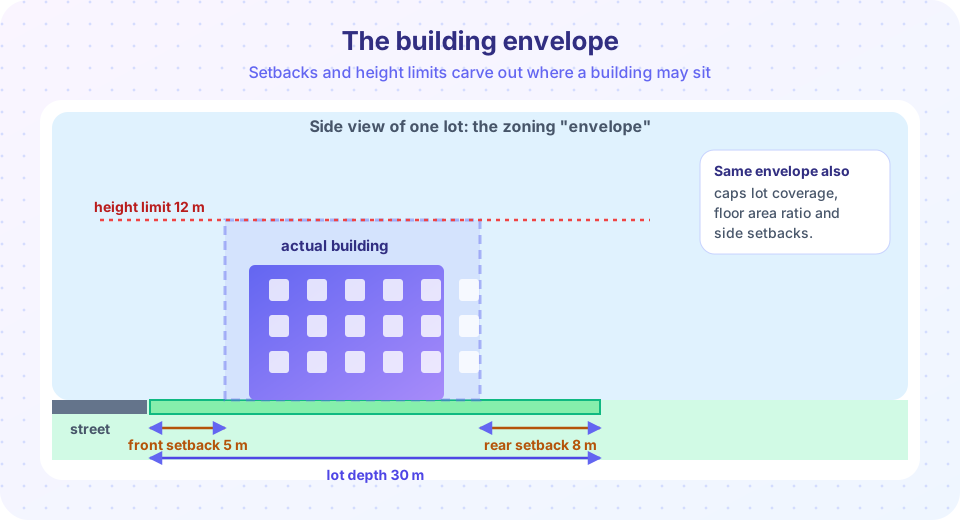
- Dimensional standards. These shape the building envelope: minimum lot size, maximum height, setbacks (front, side and rear), maximum lot coverage, maximum floor area ratio and sometimes maximum density in dwellings per hectare.
- Supplementary rules. Parking requirements, signs, landscaping, fences and design standards.
Example rule set
A hypothetical residential district might say: minimum lot size 400 m²; maximum height 11 m; front setback 5 m, side setback 2 m, rear setback 8 m; maximum lot coverage 40 percent; and one parking space per home. To check a proposal, you compare every number in the proposal with every number in the code. The Try it widget below does this.
Permits, conditional uses, variances and rezoning
- As-of-right development. If a proposal meets every rule, the city must issue a building permit. This gives predictability.
- Conditional or special use permits. Certain uses, such as a day care in a residential area, may be allowed after a public hearing, with conditions about hours, traffic or noise.
- Variances. If a lot has a special hardship, such as an unusual shape, that makes a rule unreasonable, the owner can ask a board of appeals to depart from a dimension. Variances are not supposed to be used to change a use or to give owners extra value.
- Rezoning. To change the district, an owner or the city applies, planning staff review it, a commission recommends, and the council decides after a hearing. Rezonings can be contentious because neighbors worry about change.
- Nonconforming uses. Buildings that existed before a rule changed may continue ("grandfathered"), but typically cannot be expanded.
- Overlay districts and planned developments. An overlay adds extra rules on top of the base district, for example for floodplains or historic areas. A planned unit development lets a developer negotiate a custom set of rules for a large site, in exchange for providing public benefits.
What zoning is for and what it costs
Supporters of zoning point to several benefits: it prevents the worst conflicts, such as a smelter beside a school; it protects light, air and open space; it can reserve land for jobs and parks; and it gives owners confidence about what will be built next door. Critics point to several costs. By setting low maximum densities and large minimum lot sizes, zoning can restrict how much housing can be built, which in high-demand areas raises prices. Requiring each use to be in its own district creates long trips and car dependence. Large parking minimums raise building costs and take land. And in the United States, exclusionary zoning, which uses minimum lot sizes or bans on apartments to keep out lower-income households, has had a segregating effect. The New Jersey Supreme Court's 1975 Mount Laurel decision held that developing municipalities must provide a realistic opportunity for low- and moderate-income housing, which led to the state's affordable housing policy.
Different systems
- Rules-based (US): if you meet the code, you may build, which is predictable but can be rigid.
- Discretionary (England): each application is judged against the plan and policies, which is flexible but slower and less predictable.
- National menu (Japan): a small, fixed set of national zone types is applied locally. Japan has twelve national categories (after a 2018 revision), which regulate uses and bulk in broad, nested classes; many commentators credit this with allowing mixed neighborhoods and steady housing production.
- No zoning (Houston, Texas): Houston has no conventional zoning ordinance, though it has subdivision rules, parking requirements and private deed restrictions that do much of the same work.
Reform trends
Many cities are reconsidering their codes. Common reforms include:
- Allowing more housing types in residential districts. Minneapolis adopted a 2040 plan, effective from 2020, which removed single-family-only zoning citywide; Oregon and some other states passed laws requiring cities to allow duplexes and similar housing in many neighborhoods.
- Removing parking minimums. Buffalo, New York, became one of the first major American cities to remove minimums citywide in 2017, and others have followed.
- Upzoning near transit. Allowing more homes near stations and bus lines.
- Form-based codes. Regulating building form and street relationship rather than separating uses (see the next lesson).
The evidence from reforms is still emerging, and results depend on how reforms are designed and on local markets. Supporters say reform is necessary for affordability and climate goals; skeptics worry about displacement, neighborhood character and whether the extra supply benefits those who need it most. Chapter 5 returns to these debates.
Common misconceptions
"Zoning is a plan." A zoning code is a regulation that implements the plan. A comprehensive plan sets goals, and zoning provides binding rules.
"A variance is a loophole for anything." Variances are for hardships tied to the land, not to change uses or to raise profit.
"Cities without zoning are lawless." Houston has other tools, and many cities worldwide control land with different instruments, such as discretionary planning permission.
Try it
First, a model of the envelope. Adjust the setbacks and height limit and see how the buildable volume changes. The lot is 20 m wide and 30 m deep.
Second, a zoning compliance checker. It compares a proposal with the example rule set from this lesson and lists violations.
Press Run (or Ctrl + Enter) to see the result here.
Program input · what you'd type while the program runs
Type the answers before you press Run, one per line. Each time the program reads a line (with input()), it gets the next line from this box.
Check your understanding
Quick check · 5 questions
of 5 answered You scored / 5 · perfect!
-
1. Which case upheld zoning as a valid use of the police power in the US?
Village of Euclid v. Ambler Realty Co. (1926) upheld comprehensive zoning. -
2. A variance is meant to be used for:
Variances provide relief from dimensional rules when a lot has a particular hardship. They should not change the use or just add value. -
3. A building was legal when built but violates a new height limit. It is called:
Nonconforming buildings may continue but usually cannot be expanded in ways that increase the violation. -
4. Which country uses a fixed national menu of zoning categories?
Japan's national law sets standard zone categories used by every city. -
5. Which reform did Buffalo, New York, adopt in 2017?
Buffalo was among the first major American cities to remove citywide parking minimums.
Summary
- Zoning rests on the police power, confirmed in Euclid v. Ambler (1926); a code has districts, use rules, dimensional standards and supplementary rules.
- Proposals are as-of-right, conditional, or need a variance or rezoning; nonconforming buildings are grandfathered.
- Systems differ: rules-based in the US, discretionary in England, a national menu in Japan, and no conventional zoning in Houston.
- Reforms include more housing types, no parking minimums, upzoning near transit and form-based codes; results are still being studied.
Track your progress
Create a free account to tick off lessons and pick up where you left off on any device.
of Urban Planning lessons completed