


















Lesson 9 of 43 · History of Cities
Modernism and Its Critics
Study modernist planning, Le Corbusier, CIAM and Robert Moses, urban renewal, and the critics who answered: Jane Jacobs, Lynch, Davidoff and Arnstein's ladder.
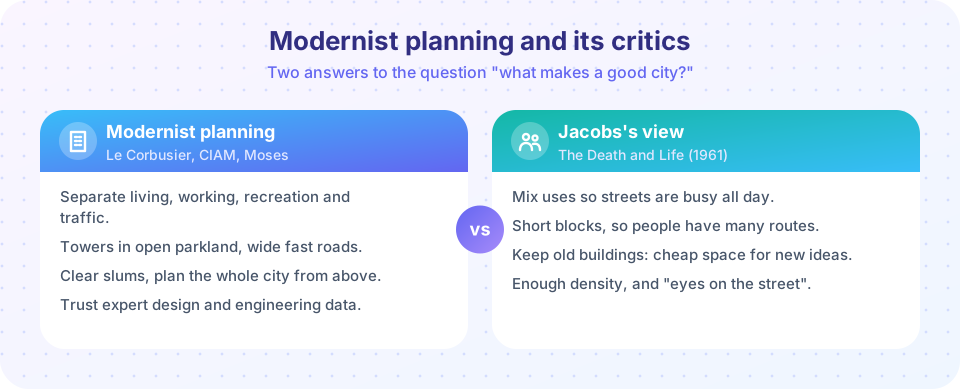
By the 1920s, many architects and planners believed that the industrial city was beyond repair and that the answer was to start again with science, steel, concrete and the car. They imagined cities of clean, light apartments in towers surrounded by parkland, with fast roads separating traffic from homes. For about forty years, this modernist vision dominated planning schools, government programs and many large projects around the world.
It also provoked a rebellion. By 1961 a journalist and neighborhood activist named Jane Jacobs published a book that challenged the orthodoxy, and a wave of critics, scholars and residents followed. This lesson tells both halves of the story and tries to be fair to each, because modernism produced real achievements and real harm, and its critics were sometimes right and sometimes too sweeping.
What you will learn
- The main ideas of modernist planning and where they came from.
- What Le Corbusier, CIAM and Robert Moses did.
- Why urban renewal and public housing projects attracted criticism.
- What Jacobs, Lynch, Davidoff and Arnstein argued.
- How New Urbanism and later approaches responded.
Key terms
Modernism: a twentieth-century movement in architecture and planning that favored rational design, new materials, functional zones and a break with tradition.
CIAM: the International Congresses of Modern Architecture (1928 to 1959), which spread modernist planning ideas.
Urban renewal: government programs, especially in the 1950s and 1960s, that cleared "blighted" areas to rebuild them.
Eyes on the street: Jacobs's phrase for the natural surveillance provided by people going about their daily lives.
Participation: involving citizens in planning decisions.
The modernist vision
The modernist argument had a strong logic. Nineteenth-century slums were dark, crowded and unhealthy, so planners should build for light, air, sun and green space. Industry and homes should be kept apart to protect health. Cars and trains were the future, so cities should be designed for speed. And planning should be scientific, based on measurable human needs rather than historical habit.
The Swiss-French architect Le Corbusier (Charles-Edouard Jeanneret) put these ideas into dramatic form. His 1925 Plan Voisin proposed to demolish a large part of central Paris north of the Seine and replace it with cross-shaped towers in open parkland, linked by highways. His Radiant City (La Ville Radieuse, 1930s) imagined uniformly arranged towers, rationally placed. He wrote that a house is "a machine for living in," and he praised the straight line as the mark of civilization.
In 1928 Le Corbusier and others founded CIAM. Its 1933 meeting produced the Athens Charter, published in 1943, which listed four functions of the city: dwelling, work, recreation and circulation, and argued that they should be separated into distinct zones. This idea of functional zoning became the foundation of much postwar planning and zoning.
Modernism in practice
Brasilia. In 1956 Brazil decided to build a new capital in the interior. The plan, by Lucio Costa, with buildings by Oscar Niemeyer, was laid out in the shape of an airplane (or a bird), with monumental axes, residential superblocks and separated functions. It opened in 1960 and is a UNESCO World Heritage site. It is admired for its architecture and criticized for its distances, its reliance on cars and the informal settlements that grew around it because workers could not afford to live in the planned city.
Chandigarh. Le Corbusier planned this Indian city from the early 1950s, with a grid of "sectors" and a monumental capitol complex.
Public housing towers. In many countries, governments built large estates of towers or slabs on cleared land. Some worked well. Others suffered from isolation, poor maintenance and concentration of poverty. In St. Louis, the Pruitt-Igoe complex (completed in the mid-1950s) became a symbol of failure when the city began demolishing it in 1972, though historians now stress many causes, including funding cuts, population loss and segregation, rather than architecture alone.
Robert Moses. In New York, Moses held many public posts and, over decades from the 1920s to the 1960s, built parkways, bridges, parks, housing and expressways on a scale few have matched. His supporters point to the public works, such as Jones Beach and Triborough Bridge. His critics, notably Robert Caro in The Power Broker (1974), emphasize that his highways, including the Cross Bronx Expressway, displaced many thousands of residents and cut apart neighborhoods, with a disproportionate impact on low-income and minority communities.
Urban renewal. In the United States, the Housing Act of 1949 and later laws gave cities federal money to buy and clear areas judged "blighted" and sell the land for redevelopment. Many neighborhoods were demolished, and a disproportionate share were Black communities, leading some residents to call it "Negro removal," a phrase attributed to the writer James Baldwin in 1963. Much of what was built in the cleared areas was never fully replaced with homes.
The critics
Kevin Lynch published The Image of the City in 1960, studying how people actually perceive cities, as we saw in Chapter 1. He showed that legible places, with clear paths, landmarks and districts, matter for people's well-being.
Jane Jacobs published The Death and Life of Great American Cities in 1961. Drawing on her own life in Greenwich Village, New York, and her observations of other neighborhoods, she argued against clearance and separation of uses. A good city street, she said, needs four conditions: a mix of primary uses so that people are around at different hours; short blocks so that there are many ways to walk; buildings of varied age and condition so that low-rent space remains for new ventures; and enough density of people. When these exist, streets are watched by residents and shopkeepers, which Jacobs called "eyes on the street," and neighborhoods become safe and lively without needing police to patrol every corner. She also helped lead the campaign that stopped Moses's plan for a Lower Manhattan expressway.
Jacobs has her critics. Some scholars argue that she generalized from a few affluent, older neighborhoods; that she gave too little attention to housing affordability and the role of regional planning; and that her emphasis on preserving old buildings can raise rents. Others note that some of her ideas, such as mixing uses and short blocks, are now mainstream and supported by research. Reading her as a challenge to the method of top-down clearance, rather than a rulebook, is probably the most useful way.
Paul Davidoff, in "Advocacy and Pluralism in Planning" (1965), argued that planners should openly represent the interests of particular groups, not pretend to neutrality. Sherry Arnstein, in "A Ladder of Citizen Participation" (1969), described eight rungs of participation, from manipulation at the bottom to citizen control at the top, grouped into non-participation, tokenism and citizen power. Her ladder is still used to judge whether a process is genuine or just for show.

Later movements built on these critiques. Communicative or collaborative planning, associated with scholars such as Patsy Healey and John Forester in the 1980s and 1990s, treats planning as structured dialogue among stakeholders. New Urbanism, with its Congress founded in 1993, promoted walkable, mixed-use neighborhoods based on traditional models; its early landmark was the town of Seaside, Florida (begun 1981, designed by Andres Duany and Elizabeth Plater-Zyberk). New Urbanism has its own critics, who say that some projects became exclusive and car-dependent in practice.
A balanced judgment
It would be easy to write modernism off as a mistake, and equally easy to dismiss its critics as nostalgic. A fairer view is that modernist planning solved some real problems, such as sanitation, daylight and housing shortages, and that it also showed the dangers of designing for people instead of with them, of ignoring existing communities and of trusting a single model. The lasting lessons are to respect existing neighborhoods, to test big ideas on a small scale, and to share power with the people who live in a place.
Common misconceptions
"Modernist housing always failed." Many modernist estates, in cities from Singapore to Vienna, are successful and popular. Outcomes depended on funding, management, location and who lived there.
"Jacobs was against all planning." She opposed clearance and rigid separation, but she called for planning that supports diversity, density and local life.
"Robert Moses was only a villain." He built public works that millions of people still use, and he also displaced communities and favored cars over transit. Both are on the record.
Try it
The first demonstration models Jacobs's point about mixed uses and hours. Choose the uses on a block and see how many hours of the day the street has "eyes". The numbers are simplified, illustrative occupancy hours, not measurements.
The second example classifies participation activities on Arnstein's ladder. It encodes the eight rungs and three groups.
Press Run (or Ctrl + Enter) to see the console output here.
No output.
Check your understanding
Quick check · 5 questions
of 5 answered You scored / 5 · perfect!
-
1. The Athens Charter (published 1943) listed four city functions to be separated. Which set is correct?
CIAM's Athens Charter named dwelling, work, recreation and circulation as the four functions. -
2. Which is NOT one of Jacobs's four conditions for a lively street?
Jacobs argued for mixed primary uses, short blocks, varied building ages and enough concentration of people. -
3. On Arnstein's ladder, 'placation' belongs to which group?
Informing, consultation and placation are the three tokenism rungs. -
4. What did Davidoff argue in 1965?
Davidoff's advocacy planning held that values are unavoidable, so planners should represent groups, especially those with little power. -
5. Which statement about Brasilia is accurate?
Costa's plan and Niemeyer's architecture produced Brasilia, inaugurated in 1960.
Summary
- Modernist planning aimed at light, air, speed and scientific order, and separated dwelling, work, recreation and circulation.
- Le Corbusier, CIAM and Robert Moses made the vision real in plans, towers, expressways and urban renewal, with real achievements and real damage to communities.
- Lynch, Jacobs, Davidoff and Arnstein challenged top-down method and argued for legibility, diversity, advocacy and citizen power.
- Later approaches such as communicative planning and New Urbanism built on those critiques and have their own critics.
Next: Chapter 2 Review
Track your progress
Create a free account to tick off lessons and pick up where you left off on any device.
of Urban Planning lessons completed