


















Lesson 10 of 43 · History of Cities
Chapter 2 Review: History of Cities
Review chapter 2: early cities, grids and market towns, the industrial city and reform, modernism and its critics. A recap table, one-picture summary and ten-question quiz.
You have now travelled from the first cities of Mesopotamia to the arguments of the 1960s. This review ties the chapter together. The picture below shows the story in four steps, the table lists names and dates to remember, and the quiz mixes questions from all three lessons.
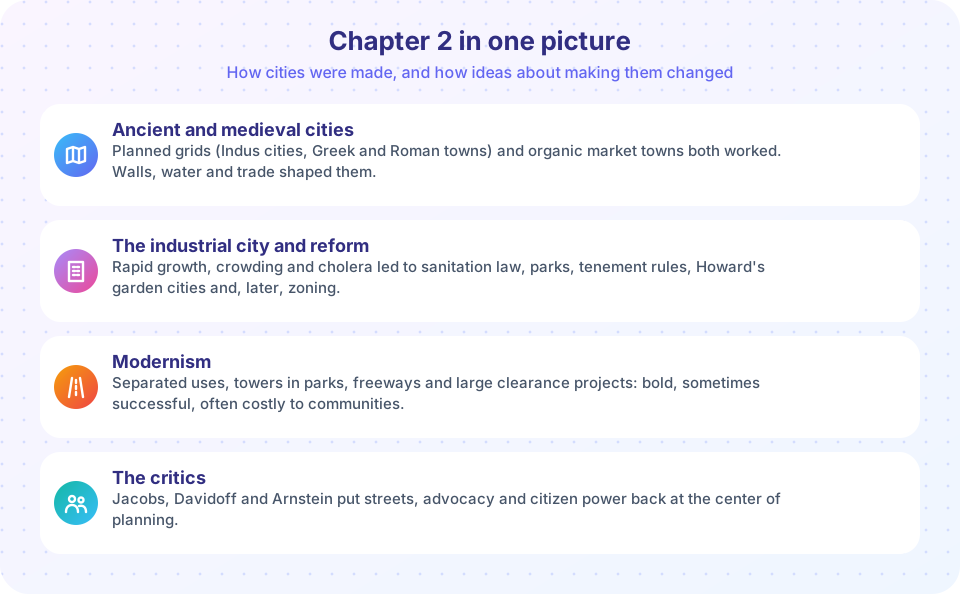
Recap table
| Era | Key ideas and people | Remember |
|---|---|---|
| Early cities | Uruk; Harappa and Mohenjo-daro | Surplus, water, drains, grid-like streets |
| Greece and Rome | Hippodamus; cardo, decumanus, forum; Vitruvius | Grids are fast and fair to lay out |
| Medieval | Market squares, charters, bastides | Organic and planned towns coexisted |
| Industrial city | Chadwick 1842; Snow 1854; Bazalgette | Disease drove public health law |
| Big visions | Haussmann; Cerda 1859; Olmsted 1858 | Boulevards, grids and parks, with costs |
| Garden city | Howard 1898; Letchworth 1903 | Three magnets, green belt, community land |
| Zoning | New York 1916; Euclid v. Ambler 1926 | Light, air, property value; troubled link to race |
| Modernism | Le Corbusier; Athens Charter; Moses; Brasilia | Four functions, separated; urban renewal |
| Critics | Lynch 1960; Jacobs 1961; Davidoff 1965; Arnstein 1969 | Legibility, mixing, advocacy, citizen power |
Three lessons from history
- Every tool is a response to a problem, and creates new ones. Sewers solved cholera, expressways solved congestion, towers solved crowding, and each had side effects that the next generation had to handle.
- Plans that ignore people fail, even when the logic is good. The thread from Haussmann to urban renewal to Jacobs is a story of expertise needing community knowledge.
- Planned and organic are not opposites. The best-loved places often combine a clear structure, such as a grid or a great square, with the gradual adaptation of many hands.
Try it
Match each person with their idea in this quick quiz game. Click a person, then click the idea you think belongs to them.
Check your understanding
Quick check · 10 questions
of 10 answered You scored / 10 · perfect!
-
1. Which early civilization is known for covered drains and a rough grid in cities such as Mohenjo-daro?
Harappa and Mohenjo-daro had drains along grid-like streets, around 2600 to 1900 BCE. -
2. In a Roman town, the cardo ran:
The cardo ran roughly north to south; the decumanus east to west. -
3. John Snow's 1854 map was important because it:
Snow mapped deaths around Broad Street and traced them to a pump, a famous use of survey data. -
4. Who won the 1859 plan for the Eixample extension of Barcelona?
Cerda's grid with chamfered corners shaped the Eixample, and he coined the word 'urbanizacion'. -
5. Howard's garden city was meant to be:
Howard proposed a town of about 32,000 people with a permanent agricultural belt on community-owned land. -
6. The first comprehensive citywide zoning law in the US was passed in:
New York's 1916 Zoning Resolution was the first comprehensive zoning law of an American city. -
7. Which Supreme Court case upheld zoning in 1926?
Village of Euclid v. Ambler Realty Co. (1926) upheld zoning as a valid exercise of the police power. -
8. Which four functions did the Athens Charter want separated?
CIAM's charter listed dwelling, work, recreation and circulation. -
9. Jane Jacobs's 'eyes on the street' refers to:
Jacobs argued that busy, mixed-use streets are watched informally, which makes them safer. -
10. On Arnstein's ladder, which rung is in the 'citizen power' group?
Partnership, delegated power and citizen control make up the top three rungs, called citizen power.
Summary
- Early cities were planned or organic, and both traditions served well.
- Industrial crisis created sanitary reform, big public works, garden cities and zoning.
- Modernism offered a bold, separated, car-oriented vision with real costs to communities.
- Critics, from Lynch to Arnstein, restored attention to people, streets and participation.
Track your progress
Create a free account to tick off lessons and pick up where you left off on any device.
of Urban Planning lessons completed