


















Lesson 8 of 43 · History of Cities
The Industrial City and the Birth of Modern Planning
How crowded industrial cities led to sanitary reform, Haussmann's Paris, Olmsted's parks, Howard's garden city and the first zoning laws that created modern planning.
In 1801, Manchester in England was a market town of perhaps 75,000 people. By 1851 it had more than 300,000. Factories, rail lines and rows of cheap brick houses spread over fields in a few decades, and most of it was built with no water supply, no sewers and no rules. Similar stories played out in Birmingham, Lyon, Berlin, Chicago and New York. Cities had been growing for thousands of years, but never this fast.
The consequences were deadly, and they produced the first modern responses: public health law, engineered sewers, city parks, building and housing codes, planned suburbs and, finally, zoning. This lesson follows that chain of crisis and reform, which is the origin of planning as a profession.
What you will learn
- What problems rapid industrial growth created.
- How sanitary reform and public health law began.
- What Haussmann, Cerda and Olmsted contributed.
- What the garden city movement proposed.
- How zoning started in the early twentieth century.
Key terms
Sanitary reform: nineteenth-century efforts to provide clean water, sewers and clean housing to prevent disease.
Tenement: a multi-family urban building, usually crowded, often built cheaply for workers.
Garden city: a planned, self-contained town of limited size, surrounded by a green belt, combining town and country.
Green belt: a ring of protected open land around a city to limit sprawl.
Zoning: dividing a city into districts with different rules for use and building size.
Crowding, disease and the case for action
Industrial workers crowded close to factories because they could not afford to commute. Houses were built back to back, with shared privies and open drains. In many districts there was no clean water at all. Cholera, typhoid and tuberculosis spread, and life expectancy in some industrial towns fell well below that of the countryside.
The turning point came when investigators measured what everyone could see. In England, Edwin Chadwick, a lawyer and civil servant, published his Report on the Sanitary Condition of the Labouring Population of Great Britain in 1842. It showed that disease rates were highest where drainage and water were worst, and argued that engineering, rather than charity, was the cure. The first Public Health Act (1848) followed. In 1854 the physician John Snow mapped cholera deaths in London's Soho district and traced them to a single contaminated pump in Broad Street. The map is an early, famous use of spatial data in public health, and it is still the best-known illustration of why surveys matter in planning. In the 1860s the engineer Joseph Bazalgette built London's great intercepting sewers, which carried waste away from the Thames and are still in use in part today.
Housing rules came next. In New York, the "dumbbell" tenement design promoted by the 1879 law squeezed families into narrow lots with tiny airshafts, and later reformers such as Jacob Riis exposed the conditions in photographs. The Tenement House Act of 1901 required larger courts, windows in every room and toilets in each apartment. Britain passed the Housing, Town Planning, etc. Act in 1909, the first British law to mention town planning explicitly.
Haussmann's Paris
In 1853 Emperor Napoleon III appointed Georges-Eugene Haussmann as prefect of the Seine. Over the next seventeen years Haussmann reshaped Paris: wide straight boulevards cut through the medieval fabric, new sewers and an aqueduct system, parks such as the Bois de Boulogne and uniform apartment buildings with regulated heights and facades. The new streets improved traffic, light and ventilation and created the Paris familiar from postcards.
They also served political aims. Wide avenues made it easier to move troops and harder to build barricades, and the project displaced tens of thousands of poor residents from central districts. Historians therefore disagree about its legacy: a model of great public works and urban beauty, and a warning about demolition and displacement. Many cities, from Vienna with its Ringstrasse to Buenos Aires and Cairo, copied the boulevard idea.
Cerda and Olmsted
The Spanish engineer Ildefons Cerda won the plan for the extension of Barcelona in 1859. His Eixample ("extension") used a grid of square blocks with chamfered, cut-off corners to improve visibility and air, wide streets and planned parks and services. Cerda also coined the word urbanizacion in his 1867 treatise, giving the field its name.
In the United States, Frederick Law Olmsted and Calvert Vaux won the 1858 competition to design Central Park in New York with their "Greensward" plan. Olmsted argued that parks were a public health necessity, "lungs" for a crowded city, and that they should be open to all classes. He went on to design parks and parkways in Boston, Buffalo, Chicago and elsewhere, and he helped establish landscape architecture as a profession.
Howard's garden city
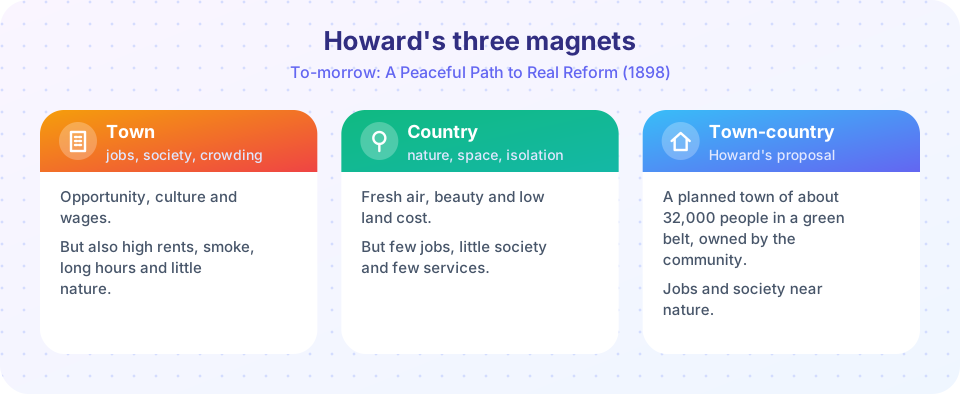
The English stenographer and inventor Ebenezer Howard published To-morrow: A Peaceful Path to Real Reform in 1898 (reissued in 1902 as Garden Cities of To-morrow). His central idea was the three magnets: the town draws people with jobs and society but is crowded and expensive; the country offers nature and low rents but little work; a town-country combination would offer the best of both.
Howard proposed a town of about 32,000 people on land owned by the community, ringed by a permanent agricultural belt, with homes, industry and shops in balanced proportions. When a town reached its planned size, a new one would be founded nearby, linked by rail, forming a "social city." Two garden cities were actually built: Letchworth (founded 1903) and Welwyn Garden City (1920), both north of London. The movement spread widely and inspired English new towns after 1946, American planned communities and suburban plans across the world. In practice, many "garden suburbs" copied the greenery but not the community land ownership or the self-contained jobs, so they became commuter suburbs.
The City Beautiful and the first zoning
The 1893 World's Columbian Exposition in Chicago, with its white neoclassical buildings and grand axes, inspired the City Beautiful movement. Daniel Burnham and Edward Bennett's Plan of Chicago (1909) proposed a lakefront of parks, boulevards and rail connections, and it showed the value of a comprehensive plan for a whole city. Critics said the movement cared more for monumental appearance than for housing and jobs.
Meanwhile cities needed practical tools to protect light, air and property values. Germany had long divided cities into zones with different building rules. In the United States, New York City's 1916 Zoning Resolution was the first comprehensive citywide zoning law, prompted in part by the giant Equitable Building (1915), whose bulk cast shadows over neighbors. It set limits on building height and required setbacks as buildings rose, producing the stepped "wedding cake" skyscrapers of the 1920s, and it divided the city into districts for residence, business and unrestricted uses. In 1924 the US Department of Commerce published a model Standard State Zoning Enabling Act, and in the 1926 case Village of Euclid v. Ambler Realty Co. the US Supreme Court upheld the constitutionality of zoning as a valid use of the police power. Zoning spread quickly across American cities. We study it in Chapter 3. One dark thread of early zoning is race: some cities tried to zone by race, and the Supreme Court struck this down in Buchanan v. Warley (1917), yet other tools, such as restrictive covenants and later lending practices, continued segregation in practice. We return to this in Chapter 5.
Common misconceptions
"Garden cities were just green suburbs." Howard's plan combined permanent green belts, communal land ownership and local jobs. The leafy suburbs that copied the style usually kept only the greenery.
"Haussmann simply improved Paris." His works brought sanitation, traffic and light, and also displaced many poor residents and served political control. Both statements are true.
"Zoning was invented to separate every use." The first zoning laws protected light, air and property values and separated some uses, especially industry. Strict separation of homes from shops grew later.
Try it
First, a quick calculation of how fast Manchester grew in the early nineteenth century. The figures are rounded estimates, so treat the result as a rough order of magnitude.
Press Run (or Ctrl + Enter) to see the result here.
Program input · what you'd type while the program runs
Type the answers before you press Run, one per line. Each time the program reads a line (with input()), it gets the next line from this box.
The second widget is Howard's argument as a simple scorer. Move the sliders to give each factor a value from 0 to 10 for each place type, and see which magnet wins. The default scores are the author's illustration of Howard's claim, not data.
Check your understanding
Quick check · 5 questions
of 5 answered You scored / 5 · perfect!
-
1. John Snow's 1854 cholera map in London traced deaths to:
Snow mapped deaths in Soho and traced them to a single pump, an early example of using spatial data in public health. -
2. Which pair is correctly matched?
Olmsted and Vaux won the 1858 Central Park competition with the Greensward plan. Cerda planned the Eixample, Howard proposed garden cities, Haussmann rebuilt Paris. -
3. What did Howard's 'town-country' combine?
Howard argued a planned town of limited size in a green belt could offer jobs, society and nature together. -
4. Which case upheld zoning as a valid use of the police power in the United States?
Euclid v. Ambler (1926) upheld the constitutionality of comprehensive zoning. Buchanan v. Warley (1917) struck down racial zoning. -
5. Which statement about Haussmann's Paris is best?
Historians weigh both its achievements and its costs, especially the displacement of poor residents.
Summary
- Rapid industrial growth outpaced water, sewers and housing; disease forced public action.
- Chadwick, Snow and Bazalgette established sanitary reform; tenement and housing laws followed.
- Haussmann, Cerda and Olmsted showed what large public works and parks could do, and what they could cost.
- Howard's garden city proposed a planned, community-owned town-country; Letchworth and Welwyn were built.
- New York's 1916 zoning resolution and Euclid v. Ambler (1926) launched modern zoning, with a troubled link to race.
Track your progress
Create a free account to tick off lessons and pick up where you left off on any device.
of Urban Planning lessons completed