


















Lesson 26 of 43 · Public Space and Design
Chapter 6 overview: Public space and design
Preview chapter 6: how streets, plazas and parks work as the shared rooms of a city, and how planners design them for safety, comfort and everyday life.
Private homes and offices are only half of a city. The other half is the space between them: sidewalks, streets, squares, parks, waterfronts and the steps outside a shop. These are the places where strangers meet, children play, markets happen and protests gather. Planners call them public space, and most people use them every day without noticing the many decisions that shaped them.
This chapter explains how that space is designed and why small choices matter. Where the bench faces, how wide the sidewalk is, how fast cars are allowed to go and how far you must walk to reach a tree can decide whether a place feels welcoming, safe, healthy and fair.
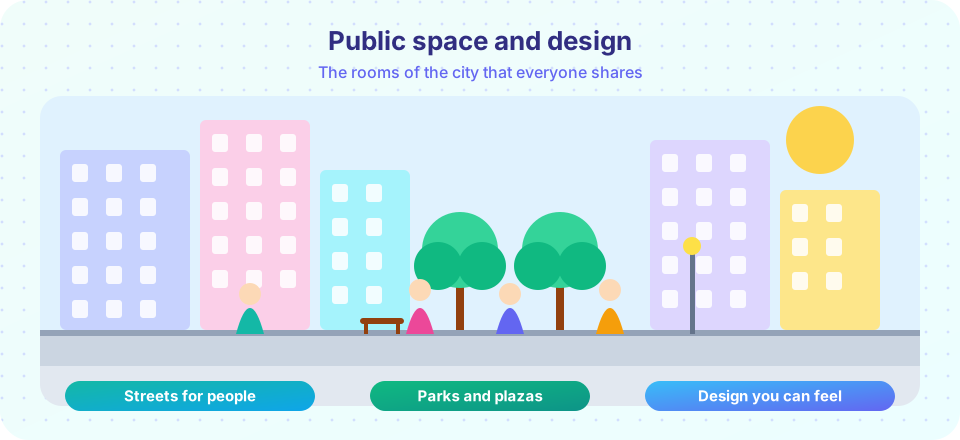
Public space is a shared room
Design for people
Who is it for?
Green networks
What each lesson covers
- Streets and human scale: the ideas of Jane Jacobs, Jan Gehl and William Whyte, how a street's width is divided among walking, biking, transit and cars, and why speed is the most important design variable.
- Parks and green networks: how planners measure access to green space, how trees cool cities, and how a network of parks and green streets works better than isolated parks.
- Chapter review: a one-picture summary and a ten-question quiz.
A way of looking
Before you read further, try an exercise that planners use. Pick a public place you know well, such as the street outside your school. Stand in the middle of it, or picture yourself there, and ask: who is here, and who is missing? A street without children or older adults is telling you something about safety or comfort. Then look at what people do: do they only pass through, or do they stop, sit and talk? The difference between a corridor (a place you cross) and a place (somewhere you stay) is at the heart of urban design.
Planners and designers often describe good public space with a few simple qualities: it is accessible, it is comfortable, it is safe, it has things to do, and it is sociable. These words sound obvious, but they are surprisingly hard to achieve, and the lessons ahead show concrete ways to measure them.
Why public space is a planning priority
Public space is where many of the benefits of a city become visible. A well-designed street lets a child walk to school safely; a bench in the shade lets an older neighbor rest on the way to the shop; a plaza lets a market, a concert or a protest happen without anyone needing permission from a private owner. Because public space is open to everyone, it is also a measure of fairness: when neighborhoods differ sharply in the quality of their streets, trees and parks, that difference tells you something about who the city has invested in.
Public space is also a working part of the city's machinery. Streets carry water pipes, power lines and drains under the pavement and traffic above it. Trees and parks cool the air and soak up rain. Sidewalks bring customers to shops. Planners therefore judge public space by several measures at once: how safe and comfortable it is, how many people use it, what it costs to build and maintain, and what it does for the environment.
Three habits of a design observer
The lessons in this chapter reward careful looking, so develop these habits now. First, count and note rather than guess: how many people are walking, sitting, cycling or standing still in a place, and who they are. Second, measure with your body: pace out a sidewalk, time a crossing, check whether a bench is comfortable. Third, ask why: if a plaza is empty, was it designed without seating, shade or reasons to stop? Observation turns design from taste into evidence.
Check your understanding
Quick check · 3 questions
of 3 answered You scored / 3 · perfect!
-
1. What is public space?
Public space includes the streets, squares and parks that everyone can use. -
2. What is the difference between a corridor and a place?
Corridors are for passing through; places invite people to stop. -
3. Which qualities describe good public space?
These five qualities appear in many urban design frameworks.
Summary
- Public space is the shared network of streets, parks and plazas.
- Small design choices affect safety, comfort, health and fairness.
- Good places are accessible, comfortable, safe, active and sociable.
- Ask who is present and who is missing when you evaluate a place.
Next: Streets and human scale
Track your progress
Create a free account to tick off lessons and pick up where you left off on any device.
of Urban Planning lessons completed