


















Lesson 30 of 43 · Sustainability and Resilience
Chapter 7 overview: Sustainability and resilience
Preview chapter 7: how cities cut emissions through compact design and transit, and how they prepare for floods, heat and storms in a changing climate.
Cities occupy a small share of the planet's land but account for most of its energy use and a large share of its greenhouse gas emissions. They are also where the consequences of a changing climate land hardest: floods in low-lying neighborhoods, heat waves in crowded blocks, storms that cut power for millions. For planners, climate is therefore not a separate subject. It affects where homes are built, how people travel, what streets are made of and how buildings are heated.
This chapter introduces the two halves of climate action in cities. Mitigation means reducing the causes: cutting emissions. Adaptation means reducing the harm from changes that are already under way. Together with fair recovery after disasters, these make up what planners call resilience.
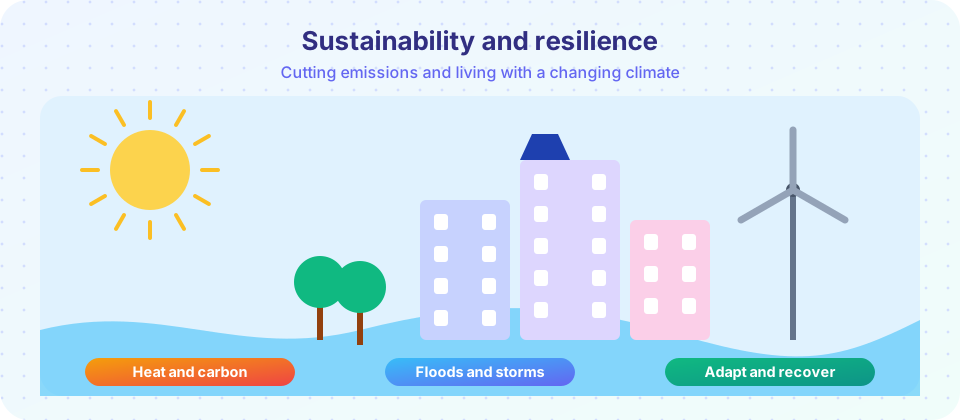
Two jobs for a city
Cut carbon
Prepare for impacts
Fair recovery
What each lesson covers
- Climate and urban form: where urban emissions come from, how density, mixed use and transit change them, the 15-minute city idea and its critics, and a calculator for commute emissions.
- Hazards and adaptation: how flood probabilities work, what stormwater runoff does on paved land, famous adaptation projects, and why vulnerable people need targeted protection.
- Chapter review: a recap table and a ten-question quiz.
A note on uncertainty
Climate projections come with ranges, not single numbers, and local effects depend on geography. A coastal city faces sea-level rise; an inland city may face drought and heat; a mountain city may face wildfire smoke. As you read the examples, notice that good planners do not wait for perfect certainty. They design for a range of futures, choose measures that help in several scenarios (shade helps in every heat wave) and review plans as new data arrive.
Why the city scale matters
Climate change is a global problem, but it is solved and suffered locally. Cities control many of the levers that decide emissions: the rules for how buildings are heated and insulated, where homes and jobs are placed, which streets get buses and bike lanes, and how electricity is bought. They also decide how well their residents cope with extremes: whether a flood has somewhere to go, whether a heat wave finds shade and cooling centers, and whether every neighborhood receives warnings and help.
Because the same neighborhood can be both a source of emissions and a place at risk, planners look for measures that deliver several benefits at once. A tree-lined street cools air, soaks up rain and makes walking pleasant. A compact neighborhood near transit reduces driving and keeps services close, which helps people cope when roads are blocked. The lessons that follow return to this idea of co-benefits, and to the principle that those who are most vulnerable must be at the center of the plan, not an afterthought.
Vocabulary to learn first
Mitigation and adaptation are the two big terms. Hazard, exposure and vulnerability describe risk. Annual exceedance probability is the formal name for the chance of an event in a year. Runoff is rain that flows over land instead of soaking in. Embodied carbon is the emissions hidden in building materials. If you can explain each of these in your own words after the next two lessons, you will be well prepared for the chapter review.
Check your understanding
Quick check · 3 questions
of 3 answered You scored / 3 · perfect!
-
1. What is the difference between mitigation and adaptation?
Mitigation cuts emissions; adaptation prepares for changes already happening. -
2. Which is an example of mitigation?
Transit that cuts car travel reduces emissions. -
3. Why do planners design for ranges of futures?
Projections are ranges, so flexible measures that help in many scenarios are valuable.
Summary
- Cities concentrate energy use and climate risk.
- Mitigation cuts emissions; adaptation reduces harm; resilience includes fair recovery.
- Local risks differ: floods, heat, drought, storms, wildfire.
- Plan for uncertainty with flexible, multi-benefit measures.
Next: Climate and urban form
Track your progress
Create a free account to tick off lessons and pick up where you left off on any device.
of Urban Planning lessons completed