


















Lesson 40 of 43 · Projects and Practice
Practice problems with worked answers
Twelve urban planning practice problems on cost burden, AMI, segregation, walking distance, FAR, flood risk, runoff, projections, scoring and design, with worked answers.
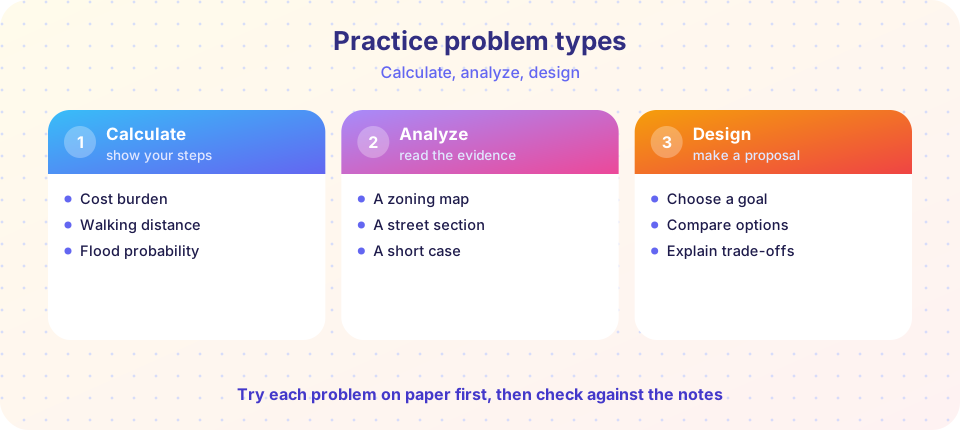
Reading about planning builds understanding, but practice builds skill. This lesson gives you twelve problems that mix calculation, analysis and design. Try each one on paper before you look at the answers, and write down your reasoning. If you get stuck, the answer section shows the steps, and each problem names the lesson to revisit.
What you will learn
- Apply the chapter formulas to fresh numbers.
- Analyze a short case with evidence and values separated.
- Create and defend a small design proposal.
- Check your own work using a calculator.
Key terms
Worked answer: a solution that shows each step, not just the final number.
Sanity check: a quick test that a result is plausible, such as comparing it with a known benchmark.
Trade-off: a situation where gaining one benefit costs another.
Calculation problems
Problem 1 (affordability). A household earns 3,600 per month and pays 1,350 for housing. What share of income is that, and is the household cost-burdened? Review: Housing affordability.
Problem 2 (AMI). The area median income is 96,000 per year. Using the 30 percent rule, what monthly housing cost is affordable at 60 percent of AMI?
Problem 3 (segregation). A city has four tracts with these (group A, group B) populations: (80, 20), (60, 40), (20, 80), (40, 60). Compute the dissimilarity index. Review: Segregation and redlining.
Problem 4 (walking). A school is 1,050 meters from a home. At a walking speed of 1.4 m/s, how many minutes does the walk take? Review: Streets and human scale.
Problem 5 (FAR). A lot of 2,000 square meters is allowed a floor area ratio of 2.5. If each home needs 80 square meters of gross floor area, how many homes fit, rounding down?
Problem 6 (flood probability). A 25-year flood has a 4 percent annual chance. What is the chance of at least one in 20 years? Review: Hazards and adaptation.
Problem 7 (runoff). A site of 8 hectares has a runoff coefficient of 0.7. During a 60 mm/h storm, find the peak flow with Q = C × i × A / 360. Green infrastructure lowers C to 0.5. By what percent does the peak flow fall?
Problem 8 (projection). A town of 80,000 grows at 1.8 percent per year. Estimate its population after 15 years. Review: Data, GIS and indicators.
Analysis problems
Problem 9 (scoring). Three criteria have weights: safety 3, cost 1, equity 2. Option X scores 4, 2, 5 on safety, cost and equity. Option Y scores 5, 4, 3. Which option wins by weighted average? Then say what happens if cost weight rises to 4. Review: Plans and participation.
Problem 10 (participation). A city holds a workshop, collects residents' comments on sticky notes, and then continues with its own plan. Which rung of Arnstein's ladder is this, and what would move it up?
Design problems
Problem 11 (street budget). An 18-meter street must fit two sidewalks of 3.0 m, two protected bike lanes of 1.8 m and two travel lanes of 3.0 m. How much width is left, and what would you use it for?
Problem 12 (proposal). A 2-hectare site next to a rail station is vacant. In about 150 words, propose a land-use mix, one housing policy tool, one resilience measure and one engagement method. Name the main trade-off.
Try it
Run the checker to see all the numeric answers computed, then compare with your own work.
Press Run (or Ctrl + Enter) to see the result here.
Program input · what you'd type while the program runs
Type the answers before you press Run, one per line. Each time the program reads a line (with input()), it gets the next line from this box.
Now check your own numeric answers. Enter them and press Check. The tolerance allows for rounding.
Worked answers
Problem 1. 1,350 / 3,600 = 0.375, so 37.5 percent. That is above 30 percent but below 50 percent, so the household is cost-burdened but not severely.
Problem 2. 60 percent of 96,000 is 57,600 per year. Thirty percent of that is 17,280 per year, or 1,440 per month.
Problem 3. Totals: A = 200, B = 200. The terms |a/A − b/B| are 0.30, 0.10, 0.30 and 0.10, which add to 0.80. D = 0.5 × 0.80 = 0.40, a moderate level of separation.
Problem 4. 1,050 / 1.4 = 750 seconds, which is 12.5 minutes.
Problem 5. Floor area = 2,000 × 2.5 = 5,000 square meters. 5,000 / 80 = 62.5, so 62 homes.
Problem 6. Chance = 1 − 0.96^20 ≈ 1 − 0.442 = 0.558, about 56 percent.
Problem 7. Q = 0.7 × 60 × 8 / 360 = 336 / 360 ≈ 0.93 m³/s. With C = 0.5, Q = 240 / 360 ≈ 0.67 m³/s. The fall is about 29 percent.
Problem 8. 1.018^15 ≈ 1.307, so about 80,000 × 1.307 ≈ 104,500 people.
Problem 9. X: (3×4 + 1×2 + 2×5) / 6 = 24 / 6 = 4.00. Y: (3×5 + 1×4 + 2×3) / 6 = 25 / 6 ≈ 4.17. Y wins narrowly. With cost weight 4, X = (12 + 8 + 10) / 9 = 3.33 and Y = (15 + 16 + 6) / 9 = 4.11, so Y wins by more. Y beats X in both cases because it scores better on safety and cost, so the ranking is robust to this change.
Problem 10. This is consultation, a tokenism rung. To move up, the city could share decision power, for example by giving a residents' committee a vote on the final design, publishing how comments changed the plan, or delegating a part of the budget.
Problem 11. The fixed uses take 6.0 + 3.6 + 6.0 = 15.6 meters, leaving 2.4 meters. Options include a planting strip with street trees on one side, a parking or loading lane on one side, or wider sidewalks. A good answer names the trade-off: trees and shade versus curb space for deliveries.
Problem 12. A strong answer might propose mixed-use buildings of four to six stories with ground-floor shops, 15 to 20 percent affordable homes secured through inclusionary zoning with a density bonus, a park that doubles as stormwater storage above the flood level, and pop-up engagement events at the station. The main trade-off could be between more homes and more open space, or between cost and the share of affordable units. Judge your answer by whether it links each choice to a goal and acknowledges the trade-off.
Check your understanding
Quick check · 4 questions
of 4 answered You scored / 4 · perfect!
-
1. Why show every step in a worked answer?
Steps make reasoning visible and checkable. -
2. What is a sanity check?
For example, a walk of 1 km taking 2 minutes would fail the check. -
3. If a calculation gives 62.5 homes, what should you report for a lot that fits whole homes?
Round down: you cannot build half a home. -
4. In a design problem, what makes an answer strong?
Justification and honest trade-offs matter more than length.
Summary
- Calculation, analysis and design problems train different skills.
- Check results with sanity checks and by changing assumptions.
- A robust ranking stays the same when weights change; a fragile one does not.
- Always name the trade-off in a design answer.
Next: Glossary
Track your progress
Create a free account to tick off lessons and pick up where you left off on any device.
of Urban Planning lessons completed