


















Lesson 20 of 43 · Transportation and Mobility
Chapter 4 Review: Transportation and Mobility
Review chapter 4: land use and transport, complete streets and speed, public transit and frequency, traffic and induced demand. A recap table and a ten-question quiz.
Chapter 4 treated transport as a system: streets, transit and traffic, all tied to land use. Use this review to check the key numbers and ideas.
Recap table
| Topic | Remember |
|---|---|
| System | Land use and transport shape each other; aim for accessibility, not only mobility |
| Streets | Two jobs: movement and place; allocate a fixed width among users |
| Speed | Energy grows with speed squared; severe-injury risk rises steeply above about 30 km/h |
| Vision Zero | Sweden, 1997: the system is responsible for safety |
| Complete streets | Sidewalks, protected bike lanes, transit priority, traffic calming, trees |
| Transit modes | Walk, bike, bus, BRT, tram, metro; each suits different demand and cost |
| Waiting | Average wait = headway / 2; frequency is the most valuable feature |
| Stop spacing | Close stops: short walks, slow rides; far stops: the reverse |
| Traffic models | Four steps: generation, distribution, mode choice, assignment |
| Delay | BPR: t = t0 (1 + 0.15 (v/c)^4); steep near capacity |
| Induced demand | New lanes attract new trips; VKT grows about in proportion (Duranton and Turner, 2011) |
| Remedies | Pricing, parking management, alternatives, land use |
Worked review problems
- A bus line runs every 12 minutes. Average wait = 6 minutes. If the headway is cut to 6 minutes, the wait falls to 3 minutes.
- A road has t0 = 8 minutes, capacity 2,000 veh/h and volume 2,000. Then t = 8 × (1 + 0.15 × 1) = 9.2 minutes. At volume 3,000, v/c = 1.5 and t = 8 × 1.759 = 14.1 minutes.
- A car at 60 km/h has (60 / 30)² = 4 times the energy it has at 30 km/h.
Try it
A flashcard deck for the main terms and numbers of the chapter. Click a card to flip it.
Check your understanding
Quick check · 10 questions
of 10 answered You scored / 10 · perfect!
-
1. A bus line runs every 30 minutes. What is the average wait for random arrivals?
Average wait is half the headway: 15 minutes. -
2. Which variable is most important for pedestrian safety on a street?
Crash energy and injury risk rise steeply with speed. -
3. What is accessibility?
Accessibility can be improved by moving things closer, not only by faster travel. -
4. Which is the third step of the four-step travel model?
The order is generation, distribution, mode choice, route assignment. -
5. In the BPR function, travel time at v/c = 1 is how many times free-flow time?
t = t0 (1 + 0.15 x 1) = 1.15 t0. -
6. Which country adopted Vision Zero in 1997?
The Swedish parliament adopted Vision Zero in 1997. -
7. Which pair is a plausible reason new highway lanes fill up?
Behavior shifts at many levels: route, time, mode, destination and land use. -
8. Which is a strength of BRT?
BRT gives rail-like performance at lower cost, if it has dedicated space. -
9. Which describes Jarrett Walker's coverage versus ridership choice?
A fixed budget cannot do both fully, so planners must choose a balance. -
10. A designed 'woonerf' is:
Woonerven were developed in the Netherlands in the 1970s and prioritize people at walking pace.
Summary
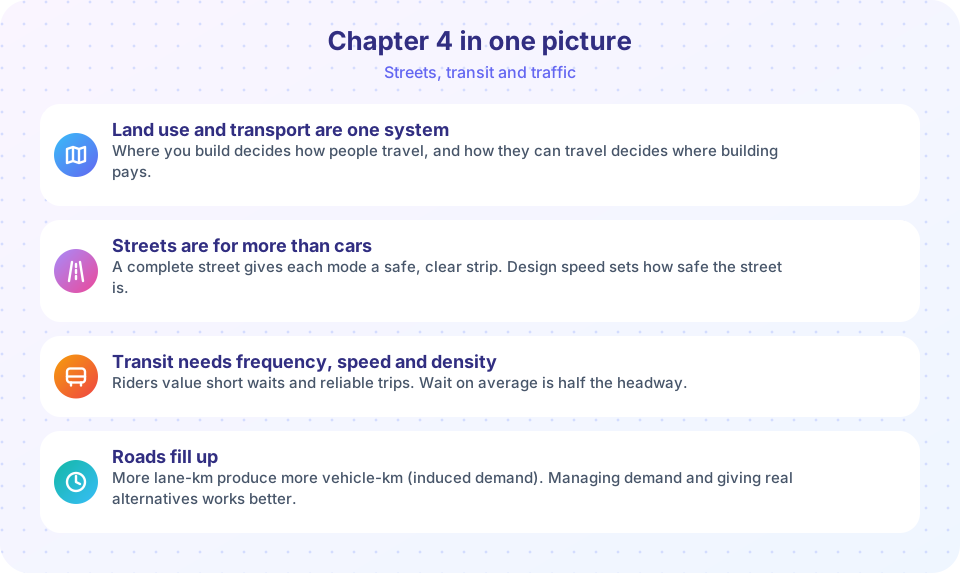
- Land use and transport form one system aimed at accessibility.
- Street design, above all speed, determines safety; complete streets share space among users.
- Frequent, fast, simple transit beats thin, wide coverage when ridership is the goal.
- Roads fill up because of induced demand; pricing, alternatives and land use do more to cut congestion.
Track your progress
Create a free account to tick off lessons and pick up where you left off on any device.
of Urban Planning lessons completed