


















Lesson 24 of 43 · Housing and Equity
Housing policy tools
A balanced tour of housing policy tools: upzoning, inclusionary zoning, vouchers, social housing, land trusts and rent regulation, with real examples and trade-offs.
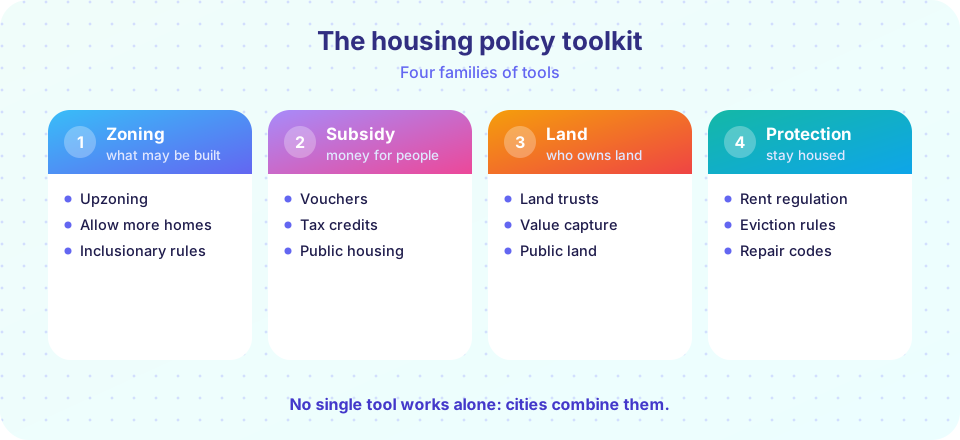
Once you understand why housing is costly and unequal, the next question is what a city can actually do about it. There is no single lever. Planners work with a toolkit, and each tool has a different target: some help the supply of homes grow, some help households pay the rent they face, some protect people from being pushed out, and some change who owns the land.
This lesson tours the main tools with real examples, then makes the trade-offs visible with two small calculators. As with every contested topic, treat claims about "what works" carefully: results depend on the city, the design of the policy and how long you wait to measure it.
What you will learn
- Describe the main housing policy tools and what each one targets.
- Give real examples of each from different countries.
- Compare supply-side and demand-side approaches.
- Explain common trade-offs and critiques.
- Calculate simple versions of a voucher payment and a zoning capacity.
Key terms
Upzoning: changing rules to allow more homes (more units, more height, or more types) on land.
Inclusionary zoning (IZ): a rule requiring or encouraging new developments to include some below-market units.
Housing voucher: a subsidy that helps a household pay private-market rent.
Social housing: housing owned or controlled by public or non-profit bodies, with rents set below market.
Community land trust (CLT): a non-profit that owns land and sells or leases the buildings on it to keep the homes permanently affordable.
Zoning and supply tools
Upzoning targets the supply of homes. Many cities historically reserved most residential land for detached single-family houses. Changing that rule lets owners and builders add duplexes, townhouses and small apartment buildings. Examples include Auckland, New Zealand, which adopted its Unitary Plan in 2016 to allow more homes across large parts of the city; Minneapolis, which adopted a 2040 plan that ended single-family-only zoning citywide; and Oregon, which required larger cities to allow "middle housing" such as duplexes and fourplexes. Researchers study results carefully, because many things change at once. Early studies from Auckland suggest more building activity and slower rent growth than comparable cities, but the effects take years and rest on other conditions such as interest rates.
Related tools lower the cost of building: allowing accessory dwelling units (backyard cottages and basement apartments), reducing minimum parking requirements, shortening permit timelines, and permitting smaller lots. These tools make homes cheaper to produce but do not by themselves guarantee that new homes will be affordable to the lowest-income households.
Inclusionary zoning adds a social goal: a typical rule says that in a new building, 10 to 20 percent of units must be rented at levels affordable to households at a set percentage of AMI. Cities often offer a density bonus (permission to build more) in exchange. IZ can produce mixed-income buildings without much public money, but it works only where land values are high enough that developers can absorb the requirement. If the requirement is too strict, building can slow or stop, which reduces supply of all kinds. Designing the percentage and the bonus well is more important than the label.
Subsidy tools
A housing voucher helps a low-income household pay rent in the private market. In the United States, the Housing Choice Voucher program (often called Section 8) typically lets a household pay about 30 percent of its income toward rent, with the voucher covering the difference up to a local payment standard. Vouchers give families choice about where to live and they do not require building new homes, but they work only if landlords accept them and if enough rental housing exists. In tight markets, many voucher holders struggle to find a place to use the voucher, and in many areas the program is not available to everyone who qualifies, so waiting lists are long.
Tax credits are the biggest source of new subsidized rental housing in the United States: the Low-Income Housing Tax Credit lets investors reduce their tax bills in exchange for funding apartments that stay affordable for a long period. Other countries use grants, low-interest loans or direct public construction.
Public and social housing are the most direct supply tools. Vienna is the best-known example: beginning in the 1920s, the city built large municipal apartment blocks, and today a large share of residents, in the order of half, live in city-owned or city-supported housing with mixed incomes. Singapore's Housing and Development Board (founded 1960) built flats on public land that most residents now own on long leases; roughly four in five residents live in HDB housing. Both systems rely on public land, steady funding and policies that keep them open to a wide share of the population rather than only the poorest. In the United States, public housing has been aimed at the poorest households and has often been underfunded, which helps explain its mixed reputation; the Pruitt-Igoe complex in St. Louis, built in the 1950s and demolished from 1972, became a symbol of that failure, though historians point to funding, maintenance and surrounding disinvestment as causes along with design.
Land and ownership tools
A community land trust separates ownership of land from ownership of the building. The trust owns the land permanently; a household buys the home at a below-market price and agrees to resale rules that keep the home affordable for the next buyer. The model is used in places such as Burlington, Vermont, where the Champlain Housing Trust is among the largest in the United States. CLTs protect public investment: the subsidy stays in the home instead of vanishing at the first sale. Critics note that homeowners earn less equity than they would in an open market, which is the trade for permanent affordability.
Land value capture lets a city recover part of the increase in land value created by public decisions, such as a new rail station or a rezoning. Tools include special taxes, development fees, and selling extra building rights, as São Paulo does with its sales of additional building rights. The revenue can pay for infrastructure or affordable homes. Cities that own land, such as Singapore or Vienna, can use it as a long-term resource for housing.
Protection tools
Rent regulation limits how much landlords can raise rents, and often how they can end tenancies. In many forms it protects sitting tenants from sudden increases and displacement. Economists tend to be cautious about strict, long-lasting rent control: a widely cited study of San Francisco found that regulation helped covered tenants stay in their homes, while some owners of covered buildings reduced the rental supply, which may have raised rents elsewhere. Newer "rent stabilization" laws typically allow annual increases tied to inflation and exempt new construction. Eviction protections, tenant right-to-counsel programs and repair standards address a different problem: keeping people housed and safe in the homes that exist.
Choosing and combining tools
Supply-side tools (upzoning, building) expand the number of homes. Demand-side tools (vouchers) increase what households can pay. Protection tools shield current residents. A city with a large supply gap and many low-income renters will probably need all three: building enough homes, helping the poorest households pay, and preventing displacement while the supply catches up. Whether a given tool fits depends on the local market: land values, existing stock, politics, and state law.
Common misconceptions
"Building new market-rate housing never helps affordability." Evidence suggests that adding supply tends to moderate rents over time, especially at the regional level, though it may not reach the poorest households without subsidies.
"Vouchers and public housing are the same thing." Vouchers support rent in private buildings; public housing is owned by a public agency.
"Rent control either always works or never works." Results depend on the design: exemptions, annual caps, and what happens to supply.
Try it
The first example estimates what an inclusionary rule costs a developer and how a density bonus can offset it. All numbers are invented, and real pro formas include many more factors.
Press Run (or Ctrl + Enter) to see the console output here.
No output.
The second example calculates a voucher payment and shows how many homes different zoning rules allow on one lot. Both are simplified calculators.
Press Run (or Ctrl + Enter) to see the result here.
Program input · what you'd type while the program runs
Type the answers before you press Run, one per line. Each time the program reads a line (with input()), it gets the next line from this box.
Check your understanding
Quick check · 5 questions
of 5 answered You scored / 5 · perfect!
-
1. Which tool most directly targets the supply of homes?
Upzoning changes rules to allow more homes; vouchers help households pay; eviction protections keep people housed. -
2. In a community land trust, what stays permanently with the trust?
The trust owns the land, which lets resale rules keep homes affordable. -
3. What is a common risk of an inclusionary zoning rule set too strictly?
If the requirement exceeds what projects can absorb, building can slow and total supply falls. -
4. How does Vienna's social housing differ from US public housing historically?
Vienna's system serves a broad share of residents, which supports mixed neighborhoods and political support. -
5. Why do planners often combine tools?
Supply, subsidy, land and protection tools target different gaps.
Summary
- Supply tools (upzoning, fewer barriers) add homes; subsidies (vouchers, tax credits) help households pay; land tools keep homes affordable; protection tools prevent displacement.
- Inclusionary zoning needs careful design: percentage, incentives and local market strength.
- Vienna and Singapore show large-scale social and public housing with broad access.
- Rent regulation protects current tenants but design affects supply.
- Most cities need several tools together.
Next: Chapter review
Track your progress
Create a free account to tick off lessons and pick up where you left off on any device.
of Urban Planning lessons completed