


















Lesson 42 of 43 · Projects and Practice
Urban planning cheat sheet
A one-page recap of urban planning: key ideas from all nine chapters, the formulas for cost burden, AMI rent, walking time, flood chance, runoff and projections.
This page is meant to be printed, bookmarked or reread the night before a test. It gathers the big ideas of the course on one page, lists the formulas with their units, and includes a calculator that runs each of them. Nothing here is new; it is the course folded into a smaller shape.
What you will learn
- Recall the main idea of each chapter.
- Use the formulas with correct units.
- Spot which formula fits which question.
Key terms
Formula sheet: a short list of equations with what each symbol means.
Rule of thumb: a simple guideline that works most of the time, but not always.
Unit check: confirming that a result has the units you expect.
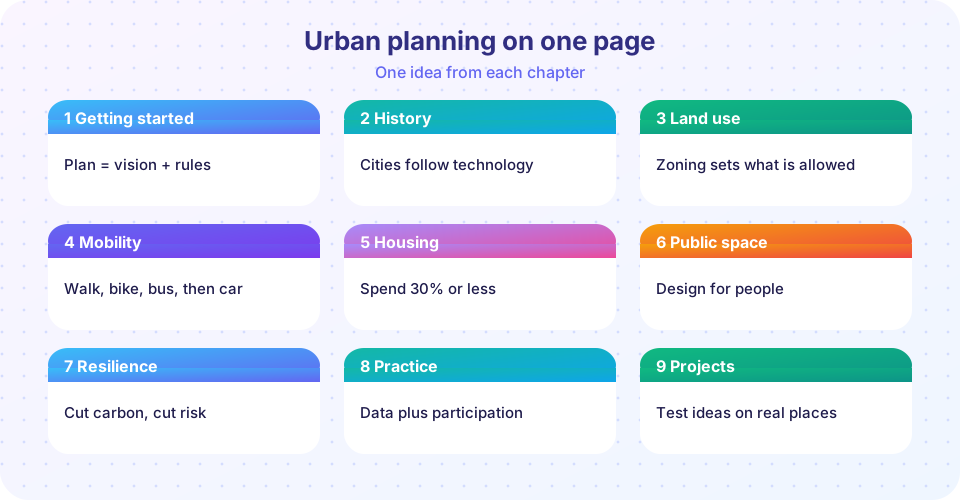
Big ideas by chapter
| Chapter | Big idea |
|---|---|
| 1. Getting started | Planning shapes the use of land, movement and public space to serve people's long-term needs. |
| 2. History of cities | Cities follow technology and politics: walking cities, rail, the automobile, and recent returns to walkable form. |
| 3. Land use and zoning | Zoning rules decide what may be built where, and so shape density, cost and character. |
| 4. Transportation and mobility | Land use and transport are two sides of one system; shorter trips and more choices lower car dependence. |
| 5. Housing and equity | Housing cost, history and policy are tied together; no single tool fixes the problem. |
| 6. Public space and design | Design streets and parks for people; speed and reach matter most. |
| 7. Sustainability and resilience | Cut emissions and reduce risk at once; look for co-benefits. |
| 8. Planning practice and data | Process, participation and honest data. |
| 9. Projects and practice | Test ideas on real places and state your assumptions. |
Formulas and rules of thumb
| Topic | Formula or rule | Units and notes |
|---|---|---|
| Cost burden | housing cost / gross income |
Over 30% is burdened; over 50% is severe |
| Affordable rent | AMI × share × 0.30 / 12 |
Per month; share is 0.5 for 50% of AMI |
| Dissimilarity index | D = 0.5 × Σ abs(a/A − b/B) |
0 even, 1 fully separate |
| Walking time | distance / 1.4 m/s |
About 80 m per minute; 10 minutes is about 800 m |
| Floor area ratio | FAR = floor area / lot area |
Homes about equal floor area divided by home size |
| Flood chance | P = 1 − (1 − p)^n |
p is annual chance, n is years |
| Peak runoff | Q = C × i × A / 360 |
Q in m³/s, i in mm/h, A in hectares |
| Population growth | P(t) = P0 × (1 + r)^t |
Doubling time is about ln 2 / ln(1 + r) |
| Weighted score | Σ (weight × score) / Σ weights |
Weights express values |
| Greening | 3 trees in view, 30% canopy, green space within 300 m | Rule of thumb |
Rules to keep in your head
- A good plan has a vision, objectives with indicators, actions and monitoring.
- Arnstein's ladder: manipulation, therapy, informing, consultation, placation, partnership, delegated power, citizen control.
- Risk = hazard × exposure × vulnerability.
- Mitigation cuts causes; adaptation reduces harm.
- Five Ds: density, diversity, design, destination accessibility, distance to transit.
- Ask of any dataset: who collected it, what does it measure, who is missing, how old is it?
Common misconceptions
"Formulas give exact answers." They rest on assumptions; always report them and check with a sanity test.
"One chapter's tool solves a problem alone." Real problems cross housing, transport, design and risk.
"Rules of thumb are laws." The 30 percent rule and the 3-30-300 targets are guides, not standards.
Try it
The calculator below runs each formula. Change the inputs to build intuition for how the results respond.
Press Run (or Ctrl + Enter) to see the console output here.
No output.
Check your understanding
Quick check · 5 questions
of 5 answered You scored / 5 · perfect!
-
1. Which formula gives the chance of at least one flood over n years?
Independent yearly chances combine as 1 minus the chance of no flood each year. -
2. What is the affordable rent at 80% of an AMI of 90,000 using 30% of income?
0.8 x 90,000 = 72,000; x 0.30 = 21,600; / 12 = 1,800. -
3. What does 'mitigation' mean?
Mitigation addresses causes; adaptation addresses impacts. -
4. About how far is a 10-minute walk?
At about 80 m per minute, 10 minutes is 800 m. -
5. Which of these is a rule of thumb, not a law?
The 30% guideline is a convention, not a rule of nature or law.
Summary
- Each chapter has one big idea; together they cover people, land, movement, homes, space, climate and practice.
- Formulas turn questions into numbers, but they rest on assumptions.
- Remember Arnstein's ladder, the risk equation and the five Ds.
- Rules of thumb guide, but do not replace, judgment.
Next: Further study
Track your progress
Create a free account to tick off lessons and pick up where you left off on any device.
of Urban Planning lessons completed