


















Lesson 39 of 43 · Projects and Practice
Case studies from six cities
Six city case studies in urban planning: Curitiba, Bogota, Barcelona, Vienna, Singapore and Copenhagen, with the problem, the move, the results and the lessons and limits.
Reading about principles is useful, but planners learn most from real places. A case study shows a problem, a decision, a result and the context that made it work (or not). It also trains you in a skill you will use for life: judging which lessons travel to another place and which do not.
In this lesson you will read six short case studies. Each follows the same pattern, so you can compare them: the problem, the move, what happened, and a caution about what to remember when you borrow the idea. Details are summarized from widely reported accounts; when numbers are rounded or approximate, the text says so, and you should check current figures before quoting them.
What you will learn
- Describe the problem and move in six well-known planning cases.
- Connect each case to ideas from earlier chapters.
- Explain what is and is not transferable to other cities.
- Apply a simple transferability check to a new idea.
Key terms
Bus rapid transit (BRT): a bus system with dedicated lanes, stations with level boarding and fast fare collection, giving rail-like service at lower cost.
Ciclovía: a program that closes streets to cars on set days so people can walk, cycle and play.
Superblock: a group of city blocks where through traffic is kept to the edges and the inner streets are for people.
Social housing: housing with below-market rents provided by public or non-profit bodies.
Transferability: how well an idea from one place works in another with different conditions.
1. Curitiba, Brazil: transit leading growth
Problem. In the 1960s Curitiba was growing fast and had little money for a subway.
Move. Under architect-mayor Jaime Lerner and a planning institute, the city organized growth along a few straight corridors and, from the 1970s, ran express buses in dedicated lanes along them. Later it added tube-shaped stations that allow boarding at the level of the bus floor and pay-before-boarding. Zoning allowed taller buildings near the corridors and lower buildings elsewhere.
Result. The system became a model for bus rapid transit in many countries and carries a large share of the city's trips. Land use and transport were planned together, which was the key idea.
Caution. Curitiba's costs were modest, but success depended on steady political leadership and coordinated zoning. Cities that copied only the bus lanes without land use saw smaller benefits. Over time, crowding and funding strain have also tested the system.
2. Bogotá, Colombia: streets for people on Sundays and every day
Problem. Many residents lacked cars, yet streets were designed around them, and public space and safe transport were scarce.
Move. Since 1974, the Ciclovía has closed major streets to traffic on Sundays and holidays so that people can walk, run and cycle; it now covers more than 100 kilometers in the city and draws large crowds. In the late 1990s and early 2000s the city under mayor Enrique Peñalosa built the TransMilenio bus rapid transit system (opened 2000), added bike paths and parks, and restricted car use at peak times.
Result. The Ciclovía became a global model for "open streets," and TransMilenio expanded access to the city center. Both are celebrated for showing that low-cost measures can change how people use the city.
Caution. TransMilenio faces severe crowding and criticism, and open streets operate for a limited number of hours. Success depended on citizen support and ongoing funding.
3. Barcelona, Spain: superblocks
Problem. Dense central neighborhoods suffered from traffic noise, air pollution and a shortage of public space.
Move. Barcelona's 19th-century grid, the Eixample designed by Ildefons Cerdà, is made of regular blocks. Planners grouped nine blocks into a "superblock" (superilla): through traffic stays on the perimeter streets, while inner streets are redesigned with slow traffic, trees, play areas and seating. The first pilot opened in Poblenou in 2016, with later versions in other neighborhoods.
Result. Pilot areas gained public space and saw reduced traffic inside the blocks; the city reports local improvements in noise and air quality and a stronger neighborhood life, though results vary by site.
Caution. The approach drew protest from some residents and businesses worried about access and parking, and critics ask whether traffic and costs shift to surrounding streets. Public engagement and monitoring were essential.
4. Vienna, Austria: housing as public infrastructure
Problem. After the First World War, Vienna had a severe housing shortage and unhealthy, overcrowded tenements.
Move. In the 1920s, "Red Vienna" built tens of thousands of municipal apartments, known as Gemeindebauten, such as the long Karl-Marx-Hof (completed 1930), funded by taxes on luxury goods and housing. The city has kept investing, and today more than 200,000 municipal apartments exist, plus many subsidized, non-profit homes, so that a large share of residents live in affordable housing with mixed incomes.
Result. Vienna regularly ranks near the top of international livability lists, and its rents are low relative to many European capitals. The city also uses a developer competition system to guarantee quality and affordability in new projects.
Caution. The system rests on decades of public land ownership, steady funding and national and city policies. It would be hard to copy overnight, and eligibility rules and waiting lists mean it does not meet every need.
5. Singapore: planning on a small island
Problem. In the 1960s, Singapore had slums, overcrowding and a shortage of land.
Move. A powerful planning system with long-range concept plans, strong land-use control and the Housing and Development Board (created in 1960) built large numbers of apartment estates. The state acquired land, and many households bought long-term leases of HDB flats, often with the help of a national savings scheme. Policies such as ethnic integration limits for each block aimed to mix communities. The city also invests heavily in greenery and transit and has promoted a "city in a garden" image.
Result. The great majority of residents live in public housing, and the city is known for clean, orderly public space and efficient transit.
Caution. The model relies on strong state power over land and on a small city-state with high income, so it is not easily transferable. Critics also note limits on political participation and the cost of homes relative to income.
6. Copenhagen, Denmark: a bicycle city by design
Problem. In the 1960s and 70s, cars were taking over the city and the cycling share was falling.
Move. Copenhagen had adopted a "finger plan" in 1947 to focus growth along rail lines. In 1962, it converted the main shopping street, Strøget, into a pedestrian street, a step Jan Gehl later studied. From the 1970s, with strong citizen pressure, the city built a network of protected bike lanes, bridges and traffic signals timed for cyclists.
Result. Cycling is now a main way to commute, and close to half of trips to work or study in the city are made by bike, according to the city's own surveys. The change came gradually through consistent investment over decades.
Caution. Flat terrain, a mild climate, high fuel taxes and a culture of cycling help. Cities with hills or heat need design adjustments, such as e-bikes, shading and better transit links.
How to judge transferability
When you meet a famous example, run a quick check. First, name the problem and see whether your city has it. Second, list the conditions that made the solution work: money, land ownership, legal powers, politics, geography, culture. Third, count which conditions you share. Fourth, look for the smallest version you could pilot, and plan how you would measure success. A pilot (like Barcelona's first superblock or Bogotá's Sunday closures) lets people test an idea cheaply before committing.
Common misconceptions
"Best practice works anywhere." Context matters, and the same measure can fail where conditions differ.
"Success is the work of one hero planner." Famous mayors helped, but each case needed institutions, citizens and long-term funding.
"Famous cities have no problems." Every case above has critics and unresolved issues.
Try it
Match each city to its signature idea. Click a city, then the idea you think belongs with it.
Next, test how transferable an idea is to a hypothetical city. Answer true or false for each condition and read the score. This is a thinking aid with made-up weights, not a prediction.
Press Run (or Ctrl + Enter) to see the console output here.
No output.
Check your understanding
Quick check · 5 questions
of 5 answered You scored / 5 · perfect!
-
1. What was the key idea behind Curitiba's transit success?
Zoning and bus lanes were coordinated along the corridors. -
2. What is a ciclovía?
Bogotá's Ciclovía began in 1974 and inspired open-streets programs worldwide. -
3. What does a Barcelona superblock do?
Nine blocks are grouped so inner streets are calmer. -
4. Why is Vienna's housing system hard to copy quickly?
The system took decades to build and depends on policy and funding. -
5. What is the best first step when considering a famous idea for your city?
Transferability depends on the problem and the conditions that made it work.
Summary
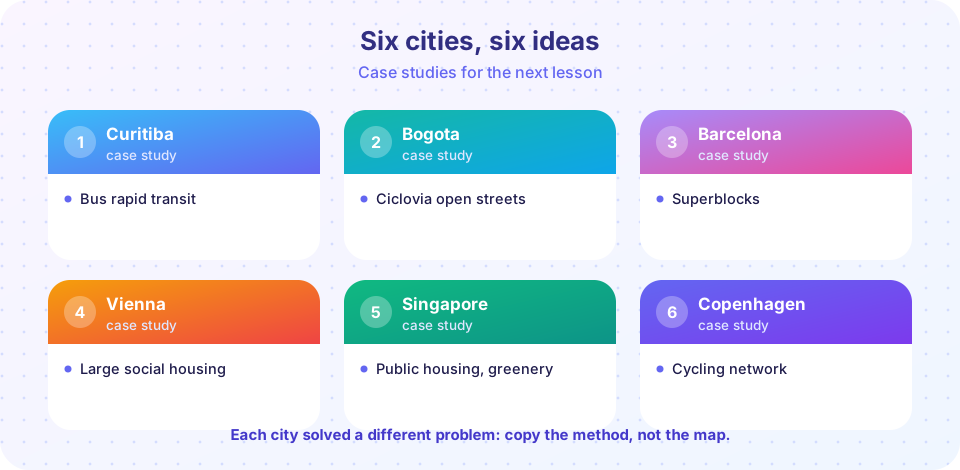
- Each case pairs a problem with a move: transit with land use, open streets, superblocks, public housing, strong land control, a bicycle network.
- Context, institutions and long-term commitment drove success.
- Every case has critics and limits.
- Use a transferability check and small pilots before copying an idea.
Next: Practice problems
Track your progress
Create a free account to tick off lessons and pick up where you left off on any device.
of Urban Planning lessons completed