


















Lesson 5 of 43 · Getting Started
Chapter 1 Review: Getting Started
Review chapter 1: what planning is, scales, tools and actors, and how to read a place. A recap table, one-picture summary and a ten-question mixed quiz.
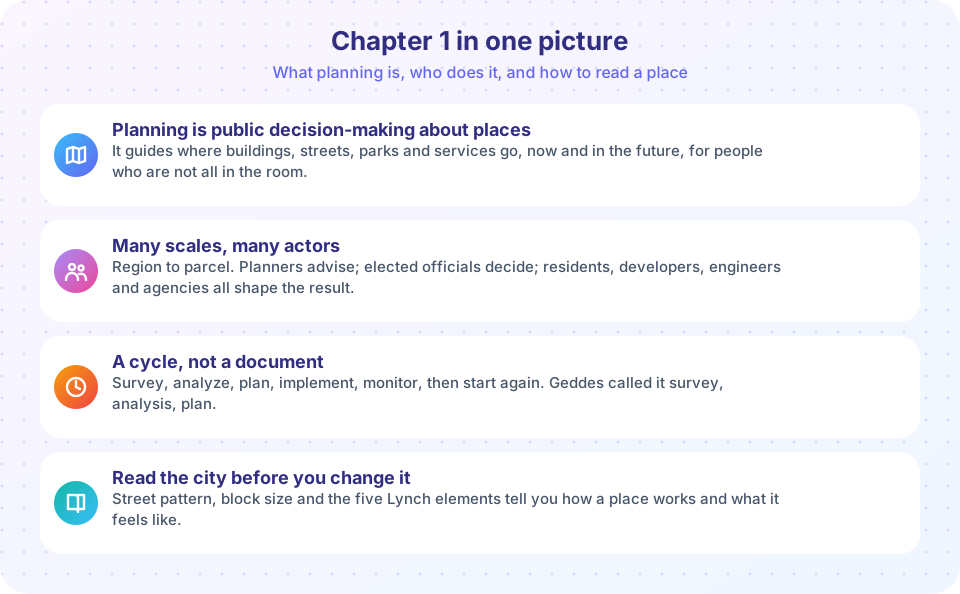
Chapter 1 gave you the foundations: what planning is for, how it works at different scales, who takes part and how to read the form of a city. This review pulls the chapter together in one picture, one table and one longer quiz. If you miss a question, follow the link to the lesson and reread that section.
Recap table
| Idea | Key points | Lesson |
|---|---|---|
| Definition | Public process guiding land, buildings, infrastructure and services | What is urban planning? |
| Why plan | Externalities, public goods, coordination, fairness | What is urban planning? |
| Planning cycle | Survey, analyze, plan, implement, monitor (Geddes, 1915) | What is urban planning? |
| Schools of thought | Rational comprehensive, incrementalism (Lindblom, 1959), advocacy (Davidoff, 1965) | What is urban planning? |
| Scales | Region, city, district, block, parcel | Scales, tools and actors |
| Tools | Plans, zoning, subdivision rules, capital programs, incentives, taxes, direct provision | Scales, tools and actors |
| Actors | Planners, officials, residents, developers, engineers, agencies | Scales, tools and actors |
| Street patterns | Grid, organic, cul-de-sac; block size and connectivity | Reading a city |
| Lynch's elements | Paths, edges, districts, nodes, landmarks (1960) | Reading a city |
Three habits to carry forward
- Ask who is affected. Every planning decision has winners and losers, and good planners name them out loud.
- Start with what is there. Survey before you design: look at the street pattern, the blocks, the people.
- Treat plans as hypotheses. A plan is a prediction that must be checked and revised, which is why monitoring closes the loop.
Try it
Test your recall with a flashcard deck. Click a card to flip it.
Check your understanding
Quick check · 9 questions
of 9 answered You scored / 9 · perfect!
-
1. Which is NOT one of the four market problems that justify planning in this chapter?
The four problems were externalities, public goods, coordination and fairness. Population change is a planning input, not a market failure. -
2. Which step of the planning cycle includes counting traffic and asking residents what they need?
Survey collects facts about the place and its people. -
3. A tax on vacant land is best described as a:
Taxes and fees steer private decisions by changing costs, and are separate from regulations like zoning. -
4. Which scale usually deals with building permits and setbacks?
Parcel-scale work covers what may be built on one lot: height, setbacks and parking. -
5. Which statement about incrementalism is correct?
Lindblom (1959) described 'muddling through' as realistic decision-making. -
6. A 5x5 square grid has how many intersections (nodes)?
A 5 by 5 grid of intersections has 5 times 5 = 25 nodes. -
7. Which pattern forces many car trips onto a few arterial roads?
Dead ends and loops feed local traffic into a few collector roads, concentrating trips there. -
8. Which Lynch element is a railway cutting that separates two districts?
Edges are linear breaks that are not paths, such as shores, walls, rail lines or highways. -
9. Davidoff's 1965 argument was that planners should:
Davidoff argued that planning always involves values, so planners should represent particular groups' interests, especially those lacking power.
Summary
- Planning guides land, infrastructure and services through a public, repeating process.
- It works at nested scales and uses a toolkit of regulation, incentives and provision.
- Many actors share power, and systems differ across countries.
- Reading a place means looking at its street pattern, blocks, space and Lynch elements, and at how people actually use it.
Track your progress
Create a free account to tick off lessons and pick up where you left off on any device.
of Urban Planning lessons completed