


















Lesson 2 of 43 · Getting Started
What Is Urban Planning?
Learn what urban planning is, why cities need it, the main types of planning, the survey-analysis-plan cycle and the big debates about how planners should work.
Imagine a field outside a growing city. In ten years it could hold a warehouse district, a shopping mall, a park with homes around it, or a mix of all three. Someone has to decide, and the decision will last for generations: buildings can stand for a century, and a street layout can survive for a thousand years. Urban planning is how a society makes such decisions deliberately, with rules, maps, forecasts and public debate.
This lesson defines planning, explains why markets alone cannot do the job, introduces the planning cycle, and surveys the branches of the profession. By the end you should be able to explain planning to a friend without using the word "zoning" even once.
What you will learn
- A working definition of urban planning and what it includes.
- Why cities need planning even when private markets work well.
- The planning cycle and the main branches of planning.
- Three schools of thought about how planners should work.
Key terms
Externality: a cost or benefit that falls on people who were not part of a decision, such as noise from a factory or the pleasure of a neighbor's garden.
Public good: something everyone can use that is hard to charge for, such as street lighting or a clean river.
Comprehensive plan: a long-term document, often called a master plan or general plan, that sets a vision and policies for a whole city.
Infrastructure: the networks that support a city: roads, water, sewers, power, transit and data.
Land use: the activity that a parcel of land is used for, or allowed to be used for.
A working definition
There is no single official definition, but this one covers most of the field: urban planning is the public process of guiding how land, buildings, infrastructure and services are arranged in cities and regions so that places work well for the people who use them, now and in the future.
Each part of the definition matters. It is a public process, so it involves law, budgets, voters and debate, not only technical skill. It guides rather than dictates: in most countries planners shape what private owners and builders do rather than build everything themselves. It covers land, buildings, infrastructure and services, from a bus route to a school site. And it looks to the future, which makes it as much about forecasting and values as about the present.
Why cities need planning
Free markets are remarkably good at many things, but they fail in predictable ways when it comes to land. Economists point to four problems.
- Externalities. A builder who puts up a tall block may block a neighbor's sunlight. A factory may pollute a river. These costs land on others, so the builder has little reason to count them. Equally, a well-kept shopfront benefits the whole street without payment.
- Public goods. Roads, parks, drainage and street lamps are used by everyone, and nobody can easily be made to pay for exactly their share. Private firms underprovide them, so the public sector steps in.
- Coordination. A road is useful only if it connects to other roads. A neighborhood needs water, power, schools and transit to arrive in the right order. Many separate owners rarely coordinate this unaided.
- Fairness. Markets allocate land to the highest bidder. Without any guidance, low-income households may be pushed to the edges or into unsafe places, and shared goals such as safety and health might lose out.
History shows what happens without guidance. In the early nineteenth century, industrial cities in Britain grew faster than their water and sewer systems, and repeated cholera outbreaks followed. We return to this in Chapter 2. Modern cities face different pressures: housing costs, congestion, heat waves, flooding. The reasoning is the same.
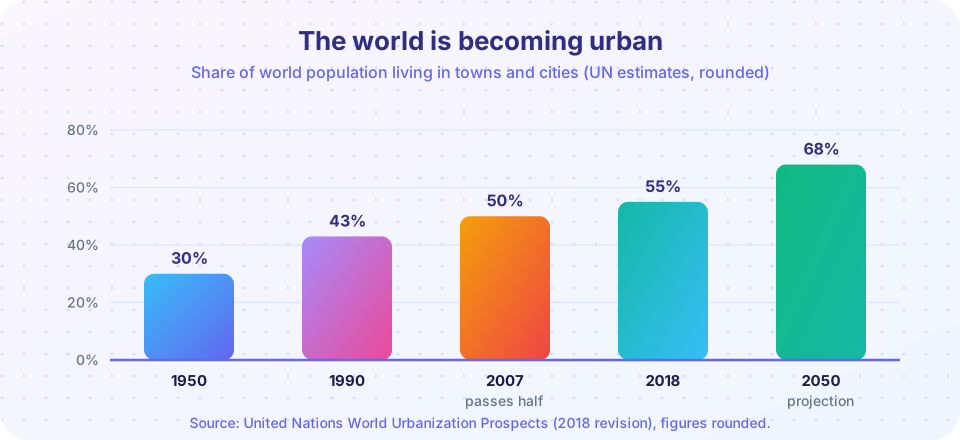
The scale of urban growth makes planning urgent. Cities in Asia and Africa are adding millions of residents each year, and many of them will live in neighborhoods that do not yet exist. Whether those neighborhoods have water, transit and safe streets depends on decisions being made now.
The planning cycle
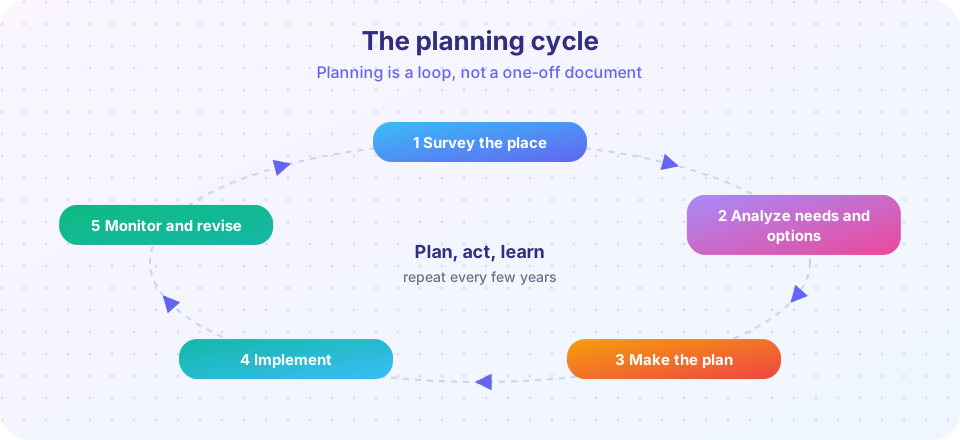
Patrick Geddes, a Scottish biologist and town planner, summed up good practice in a famous three-word formula from his 1915 book Cities in Evolution: survey, analysis, plan. Modern practice extends it into a loop of five steps.
- Survey. Collect facts: population, jobs, land use, traffic counts, housing prices, hazards, and what residents say they need.
- Analyze. Find the problems and compare options. A forecast might show that the city needs 20,000 homes in ten years; an analysis asks where they could go and what each choice costs.
- Plan. Choose a direction and write it down: goals, maps, policies, projects and a budget.
- Implement. Turn plan into action: adopt rules such as zoning, build projects, offer incentives, coordinate agencies.
- Monitor and revise. Measure what happened. Did traffic fall? Did the new homes get built? The answers feed the next round.
The loop matters because nobody can predict the future well. Forecasts miss, technology shifts and values change, so plans are updated, typically every five to ten years for a comprehensive plan.
Branches of planning
Planning is a family of specialties that overlap.
| Branch | Main question | Example output |
|---|---|---|
| Land use and comprehensive planning | Where should homes, jobs and parks go? | General plan, zoning map |
| Transportation planning | How will people and goods move? | Transit network, street plan |
| Housing and community development | Who can afford to live here? | Housing strategy, affordable-housing rules |
| Environmental planning | How do we protect nature and cut risk? | Flood plan, climate action plan |
| Economic development | How do we create good jobs? | Business-district strategy |
| Urban design | What should places look and feel like? | Design guidelines for a square or street |
| Regional planning | How do cities and towns work together? | Regional growth strategy |
Most real projects mix several branches. Building a new tram line, for example, is transport planning, but its success depends on land use around stops, housing near stations and design of the streets leading to them.
How should planners work? Three schools
Planning theory is really a debate about method and values. Three positions are worth knowing.
The rational comprehensive model. In the mid-twentieth century, planners often imagined a scientific sequence: define goals, list every alternative, predict each consequence, choose the best. It is logical, but real cities are too complex, information is incomplete and goals conflict.
Incrementalism. The political scientist Charles Lindblom argued in 1959, in an essay called "The Science of Muddling Through", that real decision-makers make small, adjustable changes and learn as they go. Critics say this can lock in the status quo and avoid large problems; supporters say it is realistic and safer.
Advocacy and participatory planning. In 1965 Paul Davidoff argued in "Advocacy and Pluralism in Planning" that planners are never neutral: their choices favor some groups. He urged planners to represent the interests of those without power, as lawyers represent clients. This idea led to community planning and to formal participation processes, discussed in Chapter 8.
Most planners today blend these: data and systematic analysis, a willingness to adjust, and open engagement with the public.
Common misconceptions
"Planners decide everything." In most places planners advise. Elected officials adopt plans, private owners build, and residents can appeal or vote. Planners are one voice among many.
"Planning means zoning." Zoning is one important tool, but plans also cover transport, parks, utilities, housing and the environment. Many planners never write a zoning rule.
"Planning means control from above." Good planning is a conversation. The history of top-down projects, which we meet in Chapter 2, is largely a story of what goes wrong when that conversation is skipped.
Try it
The first model shows why growth rates matter so much to planners. Even modest annual growth doubles a city in a generation, and the housing and infrastructure needs double with it.
Press Run (or Ctrl + Enter) to see the result here.
Program input · what you'd type while the program runs
Type the answers before you press Run, one per line. Each time the program reads a line (with input()), it gets the next line from this box.
The second widget lets you step through the planning cycle. It is a teaching aid, not a model of any real city.
Check your understanding
Quick check · 5 questions
of 5 answered You scored / 5 · perfect!
-
1. A factory pollutes a river used by a town downstream, and the factory owner pays nothing for the damage. What is this an example of?
An externality is a cost imposed on people who are not part of the decision. It is one reason planning and regulation exist. -
2. Who coined the survey, analysis, plan formula, and in which book?
Patrick Geddes summarized good planning practice as survey, analysis, plan in Cities in Evolution (1915). -
3. Why is planning described as a cycle?
Forecasts and conditions change, so results are monitored and plans are revised, typically every five to ten years. -
4. Charles Lindblom's 1959 essay argued that real decision-makers mostly:
Lindblom called this 'muddling through' or incrementalism, contrasting it with the rational comprehensive ideal. -
5. Paul Davidoff's advocacy planning said that planners should:
Davidoff (1965) argued that planning always involves values, so planners should openly advocate for groups, as lawyers do for clients.
Summary
- Urban planning is the public process of guiding how land, buildings, infrastructure and services are arranged, with a view to the future.
- Markets alone struggle with externalities, public goods, coordination and fairness, which is why planning exists.
- The planning cycle runs survey, analyze, plan, implement, monitor, then repeats.
- Planning has many branches, and real projects combine them.
- Three schools shape practice: rational comprehensive, incrementalist and advocacy or participatory planning.
Next: Scales, Tools and Actors
Track your progress
Create a free account to tick off lessons and pick up where you left off on any device.
of Urban Planning lessons completed