


















Lesson 21 of 43 · Housing and Equity
Chapter 5 overview: Housing and equity
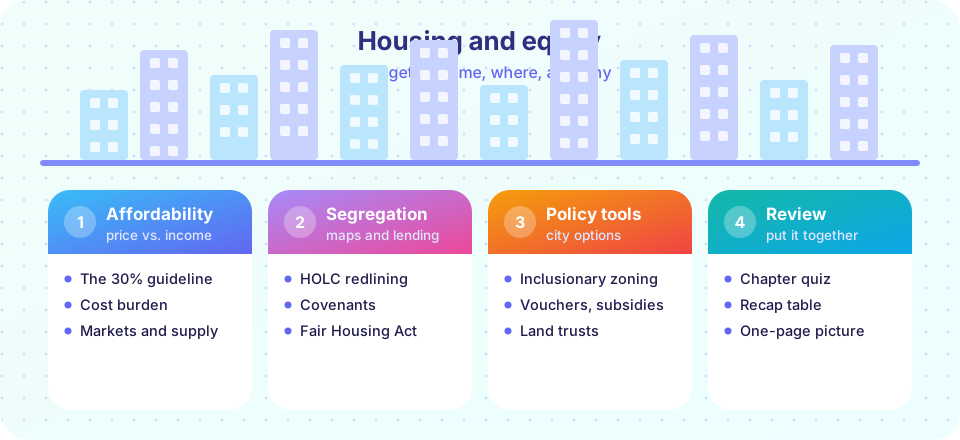
A map of the housing chapter: why homes cost what they do, how maps and laws divided cities, and the policy tools planners use to widen access to good housing.
Housing is the largest thing most people ever pay for, and it decides almost everything else about daily life: which school a child attends, how long the trip to work takes, how much clean air and green space is nearby, and how safe a neighborhood feels. That is why planners treat housing as the center of the profession rather than a side topic. A city can have excellent trains and beautiful parks, and still fail if ordinary people cannot afford to live near them.
This chapter has two threads that keep crossing. The first is affordability: the simple question of how much of a household's income goes on a roof. The second is equity: the harder question of who gets access to which homes and neighborhoods, and why. You will see that the two are tied together. Many of today's price patterns grow out of choices made decades ago about where different groups were allowed to live.
Why housing matters
Affordability
Equity
Tools
What each lesson covers
- Housing affordability and markets: how to measure cost burden, what area median income means, and why supply and demand work differently for homes than for most goods.
- Segregation and redlining: the lending maps, covenants and renewal projects that shaped American cities, a look at other countries, and a way to measure segregation with a number.
- Housing policy tools: inclusionary zoning, vouchers, public and social housing, community land trusts, rent regulation and upzoning, with the evidence for and against each.
- Chapter review: a recap table, a one-page picture and a ten-question quiz.
How to read this chapter
Housing debates are often angry, and the evidence is more mixed than slogans suggest. As you read, practice what good planners do: separate what the data show from what people value. Whether a city should prioritize building more homes, protecting current tenants, or both is a values question. How many homes a rule would produce, or how much rent a household pays, is a measurable question. Keep the two apart and you will argue more clearly than most commentators.
Also notice that the same housing term can mean different things in different countries. "Social housing" in Vienna is a broad, mixed-income system open to a wide share of residents, while "public housing" in the United States has historically been aimed at the poorest households. When a lesson compares places, it names the context so you can compare fairly.
Three questions to carry through the chapter
Planners who work on housing return to the same three questions again and again, and you will meet them in every lesson that follows.
- How many homes, and of what kind? Supply is about quantity, but also about variety: apartments, townhouses, small houses, homes for large families, homes for older adults, and homes with accessible features. A city that only allows one type of home can have plenty of buildings and still lack the right homes for the people who need them.
- At what price, and for whom? A price is only high or low relative to income. The same rent that is easy for one household is impossible for another, so planners describe affordability in terms of income bands rather than a single number.
- In which places, and with what history? Two neighborhoods with the same rents can offer very different access to schools, jobs, clean air and safety. Understanding how those differences arose is the key to fixing them.
A short preview of the vocabulary
You will meet terms such as cost burden (spending more than 30 percent of income on housing), area median income (the middle of the regional income range), redlining (lending decisions drawn on a map), upzoning (allowing more homes on land) and community land trust (a non-profit that holds land for the long term). Each is defined where it first appears, and the glossary at the end of the course collects them all. If a term feels unfamiliar, pause and reread its definition before moving on; later lessons assume you know it.
Check your understanding
Quick check · 3 questions
of 3 answered You scored / 3 · perfect!
-
1. Why do planners treat housing as central to their work?
Where people live determines their access to opportunities, which is why housing sits at the center of planning. -
2. Which pair of ideas runs through the whole chapter?
The chapter links how much housing costs (affordability) with who can live where (equity). -
3. Which statement is a values question rather than a measurable one?
Choosing between goals is a matter of values; the other two can be measured.
Summary
- Housing shapes access to almost every other part of urban life.
- The chapter covers affordability, the history of segregation, and the policy toolkit.
- Separate measurable facts from value judgments when you discuss housing.
- Terms like "public" and "social" housing differ between countries.
Track your progress
Create a free account to tick off lessons and pick up where you left off on any device.
of Urban Planning lessons completed