


















Lesson 1 of 43 · Getting Started
Course Map: Welcome to Urban Planning
Start here: who the urban planning course is for, what each of the nine chapters covers, how to study it, and a short self-check to choose where to begin.
More than half of the world's people now live in towns and cities, and by the middle of this century the share is expected to be about two thirds. Every one of those places was shaped by decisions: where a street runs, how tall a building may be, where the bus stops, which land becomes a park. Urban planning is the craft and public process of making those decisions on purpose rather than by accident.
This course is a complete, friendly introduction to that craft. It follows an international view of the subject, so the examples come from many countries and the ideas apply almost anywhere. You do not need any earlier knowledge of cities, maps or law. If you can read a chart and are curious about why your own neighborhood looks the way it does, you are ready.
What you will learn
- What urban planning is, who does it and at what scales.
- How cities grew and why ideas about planning changed over time.
- How land use, zoning, density and land value fit together.
- How streets, transit and traffic behave, and why more roads rarely cure congestion.
- How housing, equity, public space, sustainability and data shape a plan.
- How to read a place, run simple calculations and critique a real plan.
Key terms
Urban planning: the public process of guiding how land, buildings, streets and services are arranged in towns, cities and regions.
Land use: what a piece of land is used for, such as housing, shops, industry, schools or parks.
Zoning: a legal tool that divides a city into districts with rules about use, size and shape of buildings.
Mobility: how people and goods move around, by walking, cycling, transit, car and freight.
Stakeholder: any person or group affected by, or able to influence, a planning decision.
Who this course is for
The course suits three kinds of learner. Students of about 14 to 18 can use it alongside geography, civics, economics or environmental science, and it gives a head start to anyone considering a degree in planning, architecture, geography, engineering or public policy. Adult learners, such as a resident who wants to understand a rezoning notice or a volunteer on a neighborhood committee, will find the tools they need to read a plan and speak up with confidence. Professionals from other fields, for example a software developer who moves into a civic technology team, can use it as a primer on the vocabulary.
There are no prerequisites. A few lessons use simple arithmetic, such as percentages, areas and ratios, and some interactive examples use short Python or JavaScript programs. You never have to write code: you can run each example, change a number and watch the result. If a lesson sparks questions about statistics, the site has separate tracks on statistics and probability and on world geography that pair well with this one.
How the course is organized
The nine chapters build on each other, but each also stands alone, so you can jump to the topic you need.
Chapters 1 and 2
Chapters 3 and 4
Chapters 5 and 6
Chapters 7 and 8
Chapter 9
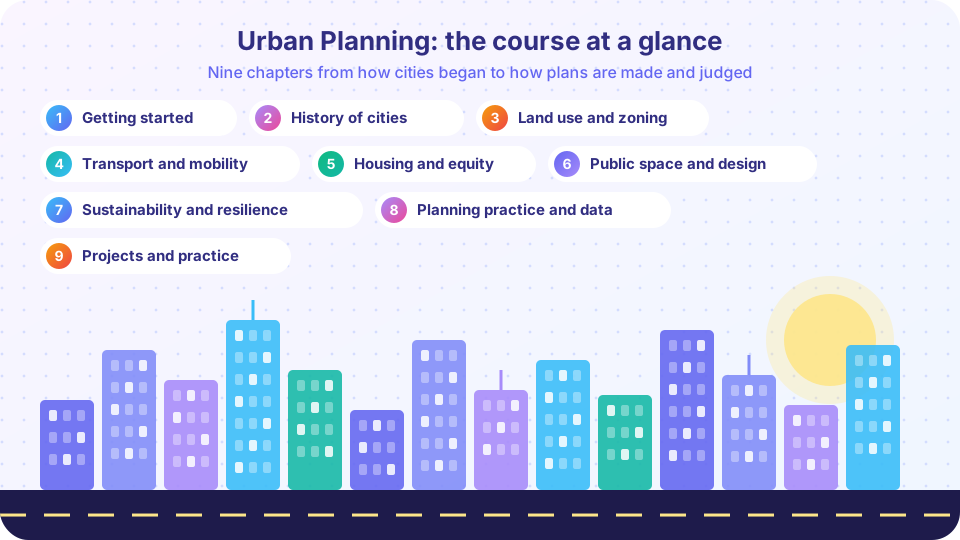
Chapter 1 gives you the vocabulary and a way of seeing. Chapter 2 tells the story of cities and of planning itself, because almost every present-day argument has a historical root. Chapters 3 and 4 cover the two systems that planners influence most directly: land and movement. Chapter 5 asks who benefits and who pays, which is the heart of equity. Chapter 6 turns to the places people actually experience on foot. Chapter 7 treats climate, energy and hazards. Chapter 8 shows how a plan is produced, with data, maps and public participation. Chapter 9 puts it together in projects.
How to study
- Read with a place in mind. Pick one neighborhood you know well, ideally your own, and test each idea on it. Where does it fit and where does it fail?
- Run every example. The interactive blocks are small models. Change one input at a time and predict the result before you press Run.
- Do the quiz before the summary. Retrieval from memory is the most reliable way to remember. If you miss a question, read the explanation and try again tomorrow.
- Keep a notebook of terms. Planning has a lot of vocabulary, and the chapter review lessons give you a list to check against.
- Look up real documents. Many cities publish their comprehensive plan and zoning map online. Reading a real one after each chapter turns theory into skill.
A note on balance
Planning is full of real disagreements. Is it better to protect existing neighborhoods or to allow more building? Should a city spend on roads or on transit? How much should residents decide, and how much should experts? This course presents the main positions, names the people and evidence behind them, and flags what is well established and what is still debated. It does not tell you what to believe. It gives you what you need to form and defend a view of your own.
Try it
The first widget recommends a starting chapter from your main interest. It is a simple demonstration of a recommendation rule, not a test.
The second example is a self-rating scorer. It prints the areas you rated lowest so that you know where to spend your time.
Press Run (or Ctrl + Enter) to see the console output here.
No output.
Check your understanding
Quick check · 4 questions
of 4 answered You scored / 4 · perfect!
-
1. Which statement best describes urban planning?
Planning is the public process of guiding the arrangement of places. Architecture designs buildings, and taxes are one tool among many. -
2. Roughly what share of the world's population lives in urban areas today?
The world passed 50 percent urban around 2007, and UN estimates put it in the mid-50s percent in the late 2010s. -
3. What is a stakeholder?
Stakeholders include residents, workers, businesses, developers, agencies and officials: everyone with something at stake. -
4. Why does this course tell you to test each idea on a real neighborhood?
Applying ideas to a familiar place is a form of retrieval and application practice, which improves memory and understanding.
Summary
- Urban planning is the public process of deciding how places are arranged, at many scales and with many participants.
- The course has nine chapters: getting started, history, land use and zoning, transport, housing and equity, public space, sustainability, practice and data, and projects.
- Study with a real place in mind, run the examples, quiz yourself and read real planning documents.
- The course gives balanced views on contested questions and trusts you to decide.
Next: What Is Urban Planning?
Track your progress
Create a free account to tick off lessons and pick up where you left off on any device.
of Urban Planning lessons completed