


















Lesson 29 of 43 · Public Space and Design
Chapter 6 review: Public space and design
Review chapter 6 with a one-picture summary, a recap table on streets, human scale, parks and green networks, and a ten-question mixed quiz.
This chapter showed that public space is designed, not accidental. Streets, parks and plazas express choices about who comes first: people on foot, people in cars, children, older adults, shoppers, wildlife. Use this page to consolidate those choices before moving on to sustainability, where the same streets and trees take on new roles in cooling and flood protection.
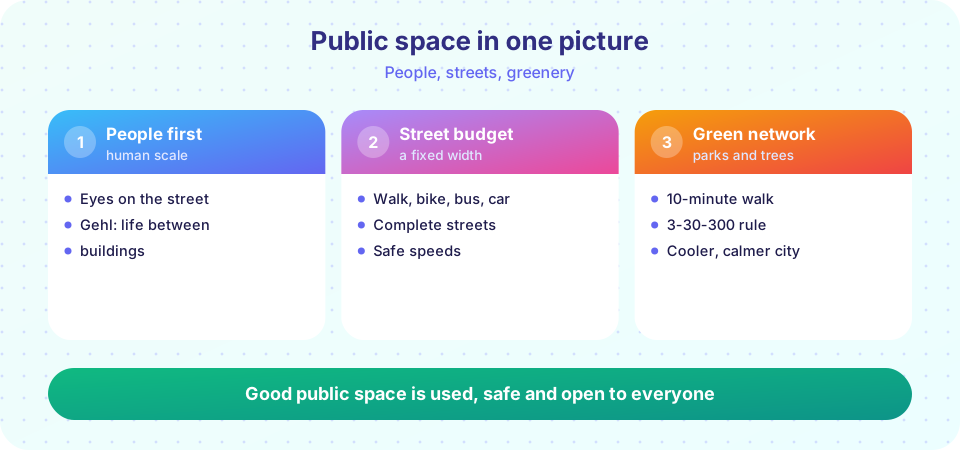
The chapter in one table
| Idea | What to remember | Lesson |
|---|---|---|
| Eyes on the street | Activity and watchful neighbors make streets safer (Jacobs) | Streets |
| Life between buildings | People respond to eye-level detail (Gehl) | Streets |
| Small urban spaces | Seating, sun, trees, food and choice draw people (Whyte) | Streets |
| Cross-section | A fixed width is divided among walking, biking, parking and lanes | Streets |
| Speed | Injury risk rises steeply with vehicle speed | Streets |
| Walkshed | Area reachable on foot; 10 minutes is about 800 m | Parks |
| 3-30-300 | 3 trees in view, 30% canopy, green space within 300 m | Parks |
| Green network | Parks, corridors and green streets linked together | Parks |
Putting the lessons together
Imagine a new neighborhood street. First you decide who it is for, using the 8-80 test: would an 8-year-old and an 80-year-old feel safe and comfortable? Then you allocate the cross-section: sidewalks wide enough for two people to pass and for trees, a protected bike lane, safe crossings, lanes narrow enough to keep speeds low. Finally you plug the street into the wider green network: trees along the edge, a pocket park at the corner, a link to the river path. Every decision is a trade-off, and the best designs make the trade-offs explicit and fair.
Common mistakes to avoid
- Treating human scale as a style. It is a way of fitting places to bodies and walking speed, not a look. A modern glass building can be human scale if its ground floor is active and its entrances are frequent.
- Quoting speed numbers without context. Injury risk figures come from specific studies and vary by vehicle type and age of the pedestrian. Say "about" and name the source type when you use them.
- Counting green space without asking who can reach it. A large park at the edge of a city can raise the total per person while leaving most residents far away. Always pair totals with a walkshed.
- Forgetting maintenance. Trees, benches and plazas need funding after the ribbon cutting. A design that cannot be maintained will fail.
- Assuming one design suits everyone. Children, older adults, people with disabilities, workers and visitors may want different things from the same place. Observation and engagement reveal those differences.
A sample analysis
Take any street you know and describe it in four sentences. First, name who uses it and who is absent. Second, give the cross-section: how the width is divided among walking, biking, parking and driving. Third, say what you notice about speed and crossings. Fourth, name the nearest green space and estimate how long the walk takes. Then propose two changes and one trade-off. If you can do this fluently, you have the core skills of the chapter.
Check your understanding
Quick check · 10 questions
of 10 answered You scored / 10 · perfect!
-
1. Who wrote The Death and Life of Great American Cities?
Jacobs published it in 1961 and introduced eyes on the street. -
2. Which of Whyte's findings is correct?
Movable chairs let people choose where to sit, which drew users. -
3. In a street cross-section, giving more width to travel lanes usually means
The total width between buildings is fixed. -
4. A pedestrian walks 1.4 m/s. About how far in 10 minutes?
1.4 m/s times 600 s is 840 m. -
5. Why do cities lower urban speed limits to 30 km/h?
Lower speeds mean far lower chances of serious injury. -
6. What does 'the 8-80 test' ask?
If it works for the youngest and oldest, it likely works for everyone. -
7. Which is NOT part of the 3-30-300 rule?
The 300 refers to meters to the nearest green space. -
8. Trees cool cities mainly through
They shade surfaces and release water vapor. -
9. What is green gentrification?
It links park investment to rising housing prices. -
10. Why prefer a green network to isolated parks?
Connected corridors spread access and ecological benefits.
Summary
- Public space design starts with people: who uses it, who is missing and how it feels at human scale.
- A street's width is a budget; speed and safe crossings matter most.
- Parks must be reachable: measure walksheds, canopy and distance.
- Equity matters in green space as it does in housing.
Track your progress
Create a free account to tick off lessons and pick up where you left off on any device.
of Urban Planning lessons completed