


















Lesson 2 of 46 · Getting Started
What Is Sociology?
Learn what sociology is, how it differs from psychology and economics, the micro and macro levels of analysis, and why a society is more than the sum of its people.
Imagine watching a city from a tall building. You cannot see anyone's thoughts. Yet you can see rush hours, empty office blocks at night, crowds heading for a stadium and quiet streets on a holiday. Nobody planned these patterns, and no single person is in charge of them. They emerge from millions of people whose lives are tied together by jobs, families, schools, laws and customs.
Sociology is the scientific study of human society, social relationships and the patterns they form. It asks how social forces shape what we do, what we believe and what chances we get, and how, in turn, people keep making and changing those forces.
What you will learn
- A working definition of sociology and what "social" means.
- How sociology differs from psychology, economics and anthropology.
- The difference between micro-level and macro-level analysis.
- Why social patterns are more than the sum of individual choices.
- What counts as evidence in sociology, and why values still matter.
Key terms
Social pattern: a regularity in how many people behave or fare, such as marriage ages or school completion rates.
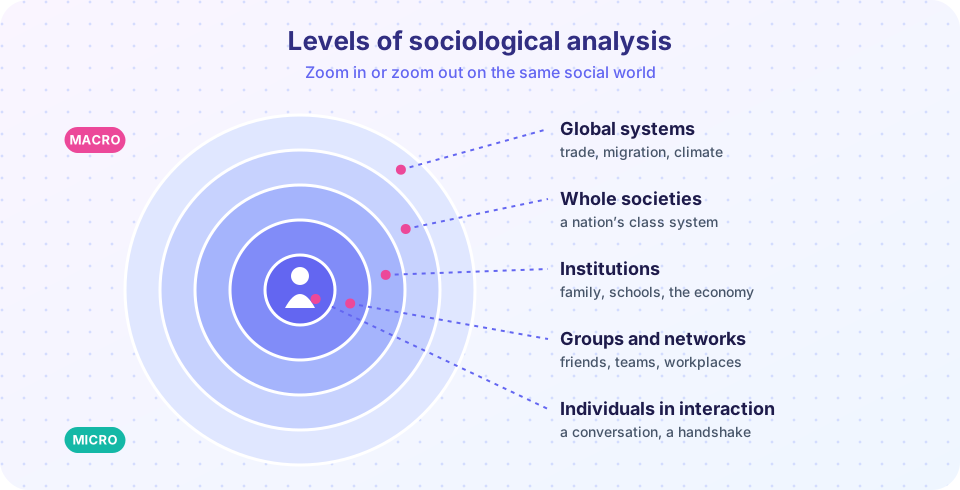
Micro-level: study of small-scale, face-to-face interaction.
Macro-level: study of large-scale structures such as the economy, the state or global systems.
Social fact: Durkheim's term for ways of acting, thinking and feeling that exist outside any one person and constrain them, such as laws or customs.
Unit of analysis: what a study describes: individuals, groups, organizations, or whole societies.
A definition, and what "social" means
Sociology is often defined as the study of society, but "society" is slippery. A helpful working version is: sociology studies how people's lives are shaped by their relationships with others, within groups, institutions and whole societies. The key word is social: it points to things that depend on other people. A language, a price, a marriage and a punishment are social. Hunger is biological, but what counts as dinner, who eats first and who goes without are social.
The discipline took shape in nineteenth-century Europe and North America, when industrialization, big cities and political revolutions made old ways of life visible as changeable. People asked: what holds a society together? Why is there so much inequality? Why does it change? These remain the big questions of the field.
How sociology differs from its neighbors
Disciplines overlap, and each asks a different main question.
- Psychology focuses on the individual mind and behavior: memory, motivation, personality. Social psychology sits near the border and studies how others influence individuals.
- Economics studies how people and societies allocate scarce resources through markets and incentives. Sociology asks how markets themselves rest on trust, norms and power, and why who gets what is so unequal.
- Anthropology studies human cultures, traditionally through long fieldwork in a small community. Sociology often examines large, complex societies, with surveys as well as fieldwork.
- Political science studies government and power; sociology studies how power is spread through families, workplaces and everyday life too.
None of these is "better". They are lenses, and many problems need several. A sociologist studying addiction, for example, might look at community, class and policy, and a psychologist at craving and learning, and a doctor at the body.
Micro and macro: levels of analysis
The picture above shows five levels. Micro-level sociology studies interaction: how two strangers manage a conversation, how a teacher's expectations shape a pupil. Macro-level sociology studies large patterns: how an economy produces unemployment or how migration changes a country. A common middle level, sometimes called meso, covers organizations and communities.
The same topic can be studied at several levels. Take education:
- Micro: How do teachers and pupils communicate in a classroom, and what do pupils learn about themselves from it?
- Meso: How do school rules and local funding affect one school?
- Macro: How do national school systems affect inequality between social classes?
Good analysis moves between levels. That movement is the heart of the sociological imagination, which you will meet in chapter 2.
More than the sum of the parts
A central idea is that a society is not just a pile of individuals. Émile Durkheim argued that groups have properties that no member has alone, a bit as water has properties that hydrogen and oxygen do not. A suicide rate, a divorce rate or an unemployment rate belongs to the group, and it shows stable patterns even though each person decided for personal reasons.
A classic way to see this is Mark Granovetter's 1978 threshold model of collective behavior. Imagine a crowd where each person joins an action (say, a protest) only when a certain number of others have already joined. If thresholds are spread 0, 1, 2, 3 and so on up to 99, one starter triggers everyone. But if just one person with threshold 1 is replaced by someone with threshold 2, the chain breaks and only one person acts. The two crowds have almost identical averages, yet very different outcomes. You cannot predict what a group will do by averaging its members; you must understand how they are connected. You can test this in the simulation below.
Evidence and values
Sociologists collect evidence through surveys, interviews, observation, experiments, official statistics and historical documents (chapter 8 covers these in detail). They use theories to organize and explain what they find. Like all sciences, they aim to be systematic, open about methods and open to being wrong.
Values still enter. Max Weber argued that researchers should aim to be value-free in how they conduct and report research, while recognizing that values legitimately guide what we choose to study: poverty, crime or health because we care about them. Others, from Karl Marx to feminist and critical scholars, argue that sociology should also aim to change society. This debate is alive today.
Study habit. When you meet a social claim, ask three questions: Who is the unit of analysis? What is the evidence? What else could explain it? You will use these questions in every chapter.
Common misconceptions
"Sociology is the same as psychology." Psychology centers on individuals. Sociology centers on relationships, groups and structures, even when it studies individual outcomes.
"If I can think of an exception, the pattern is false." Social patterns are tendencies across many people, not laws without exceptions. Your grandmother who beat the odds does not erase a statistical link between income and health.
"Social causes mean nobody is responsible." Explaining what makes an action more likely is different from excusing it. Both choice and circumstance matter.
Try it
First, an interactive lens. Choose a level of analysis to see the kind of question a sociologist asks about the same topic: music.
Second, Granovetter's threshold model. Each person acts once the number of people already acting reaches their threshold. Compare a crowd with thresholds 0 to 99 against the same crowd where one person's threshold is changed. This is a toy model with made-up numbers, used to show how structure, not just averages, decides outcomes.
Press Run (or Ctrl + Enter) to see the result here.
Program input · what you'd type while the program runs
Type the answers before you press Run, one per line. Each time the program reads a line (with input()), it gets the next line from this box.
Check your understanding
Quick check · 5 questions
of 5 answered You scored / 5 · perfect!
-
1. Which description best fits macro-level sociology?
Macro-level analysis studies large structures and patterns such as economies and societies. -
2. Which of these is a social fact in Durkheim's sense?
Social facts are ways of acting and thinking that exist outside any one person and constrain them, such as laws and customs. -
3. In the threshold model, why did two crowds with almost identical average thresholds have very different outcomes?
A single gap in the chain of thresholds can stop a cascade, so group outcomes depend on how members are connected. -
4. Weber's idea of value-freedom says that researchers should
Weber thought values properly guide the choice of topic, but evidence should be gathered and reported as fairly as possible. -
5. A study compares school exam results across 50 countries. Its unit of analysis is
The study describes and compares countries, so countries are the units of analysis.
Summary
- Sociology studies how relationships, groups and institutions shape lives, and how people shape them back.
- It differs from psychology, economics and anthropology mainly in its main question and level of focus.
- Micro, meso and macro levels look at the same world from different distances; good analysis moves between them.
- Social outcomes are more than the sum of individuals: how people are connected decides what the group does.
- Sociology relies on evidence and theory while acknowledging the role of values.
Next: Founders of Sociology
Track your progress
Create a free account to tick off lessons and pick up where you left off on any device.
of Sociology lessons completed