


















Lesson 23 of 46 · Deviance and Social Control
Labeling and Differential Association
How is deviance learned, and what does a label do? Study Sutherland, Hirschi, Becker, Lemert and Goffman, with simulations of selective enforcement and label feedback.
Strain theory looks at pressure. Two other families of theory look at what happens inside groups and in the reactions of others. Learning theories ask how people pick up rule-breaking, or rule-following, from the people around them. Labeling theory turns the question around and asks who gets tagged as deviant, and what the tag does to a life.
What you will learn
- Explain differential association and white-collar crime.
- Describe Hirschi's four social bonds.
- Distinguish primary from secondary deviance and explain master status.
- Show with a simulation how selective enforcement distorts official records.
Key terms
Differential association: Sutherland's idea that deviance is learned in close groups through an excess of attitudes favoring rule-breaking. Primary deviance: a first, often minor, act of norm-breaking. Secondary deviance: further deviance that follows being labeled. Master status: a label that overrides other parts of a person's identity. Stigma: an attribute that deeply discredits someone in the eyes of others (Goffman).
Learning deviance: Sutherland
Edwin Sutherland (Principles of Criminology, 1939) argued that criminal behavior is learned, like other behavior, mostly in small, intimate groups. People learn techniques (how to pick a lock) and, more importantly, attitudes: whether breaking the law seems excusable. The core claim is that a person becomes delinquent when they have an excess of definitions favorable to violating the law over definitions unfavorable to it. Frequency, duration and intensity of contact matter.
Sutherland also drew attention to white-collar crime: crimes committed by respectable people in the course of their jobs, such as fraud, price-fixing or unsafe products. His point was that crime is not concentrated among the poor. It is just policed less and prosecuted differently when offenders are powerful. Learning theory fits: in a firm where everyone cuts corners, the "definitions" are favorable to law-breaking.
Control theory: why most people conform
Travis Hirschi (Causes of Delinquency, 1969) asked the opposite question. Why do most people not offend? His answer is social bonds:
| Bond | Meaning |
|---|---|
| Attachment | Caring about others' opinions (parents, friends, teachers) |
| Commitment | Investment in conventional goals; something to lose |
| Involvement | Time taken up by legitimate activities |
| Belief | Accepting that the rules are right |
Weak bonds make deviance more likely. Control theory has been influential in studies of juvenile delinquency, though it does not say much about why some groups define conduct as deviant in the first place.
Labeling: what happens after the act
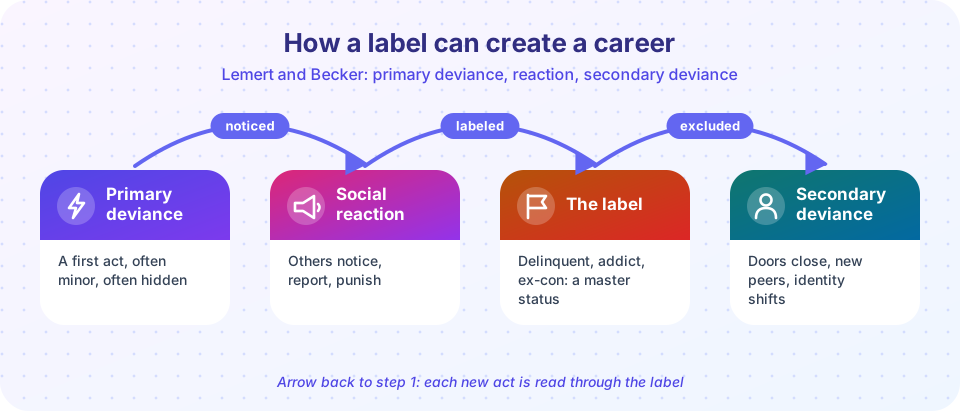
Frank Tannenbaum (1938) spoke of the "dramatization of evil," and Edwin Lemert (1951) separated primary from secondary deviance. Many people break rules once in a while, such as skipping school or shoplifting a snack. If nothing follows, the act stays a minor episode. If others react strongly, the person may be pushed into a new role: suspended student, "troublemaker," "ex-offender." Employers hesitate, teachers expect less, old friends drift away, and new friends are often others with the same label. Secondary deviance then grows out of the new situation.
Howard Becker (Outsiders, 1963) stated the core idea plainly: deviance is not simply a quality of an act, but a result of rules being applied to it by others. Rule-makers, whom he called moral entrepreneurs, campaign to define new kinds of rule-breaking. A law against a drug, for instance, creates criminals out of users who did nothing different the day before.
Erving Goffman (Stigma, 1963) described how a stigma works. A visible or known mark such as a criminal record, a disability or a diagnosis can become a master status that crowds out everything else. People then manage "spoiled identity" through hiding, covering or disclosing.
David Rosenhan's 1973 study, On Being Sane in Insane Places, is often cited as a labeling demonstration. In it, researchers reported being admitted to psychiatric hospitals after claiming to hear a voice, and later behaving normally. It sparked reforms in diagnosis, but later critics have questioned parts of its method and reporting, so treat it as a famous, contested example rather than firm proof.
What labeling theory does and does not claim
It does not claim that rule-breaking has no real causes or that nobody is harmed. It claims that the reaction matters, that official reactions are selective, and that the label can become a cause of further trouble. Critics say it underplays the causes of the first act. Defenders reply that the first act is already covered by strain and learning theories.
Press Run (or Ctrl + Enter) to see the result here.
Program input · what you'd type while the program runs
Type the answers before you press Run, one per line. Each time the program reads a line (with input()), it gets the next line from this box.
Press Run (or Ctrl + Enter) to see the result here.
Program input · what you'd type while the program runs
Type the answers before you press Run, one per line. Each time the program reads a line (with input()), it gets the next line from this box.
Both models are demonstrations. They show the logic of selective enforcement and of a feedback loop, not measured results about any real place.
Common misconceptions
"Labeling theory says there is no real deviance." It says deviance is created through definition and reaction, and the reaction can amplify what began as minor. It does not deny harm.
"Only criminals learn crime from others." Differential association applies equally to learning law-abiding attitudes, and to white-collar offending inside firms.
Check your understanding
Quick check · 5 questions
of 5 answered You scored / 5 · perfect!
-
1. In Sutherland's theory, criminal behavior is mainly
Differential association: deviance is learned through interaction in intimate groups. -
2. Which of Hirschi's bonds refers to the time taken up by conventional activities?
Involvement leaves little time or opportunity for deviance. -
3. Secondary deviance is best described as
Lemert distinguished the first act from deviance that grows out of the new labeled role. -
4. Becker's phrase 'moral entrepreneurs' refers to
Moral entrepreneurs push for rules that define behavior as deviant. -
5. In the patrol simulation, why do records differ when behavior is equal?
Recorded crime reflects detection as well as behavior.
Summary
- Sutherland: deviance is learned in intimate groups; white-collar crime shows it is not just a poverty problem.
- Hirschi: attachment, commitment, involvement and belief keep most people conforming.
- Lemert and Becker: reactions can turn primary deviance into secondary deviance; rules and rule-makers define what counts.
- Goffman: stigma and master status can crowd out other identities.
- Official records reflect enforcement as well as behavior (the next lesson goes deeper).
Track your progress
Create a free account to tick off lessons and pick up where you left off on any device.
of Sociology lessons completed