


















Lesson 26 of 46 · Inequality: Class, Race and Gender
Chapter 6 Overview: Inequality, Class, Race and Gender
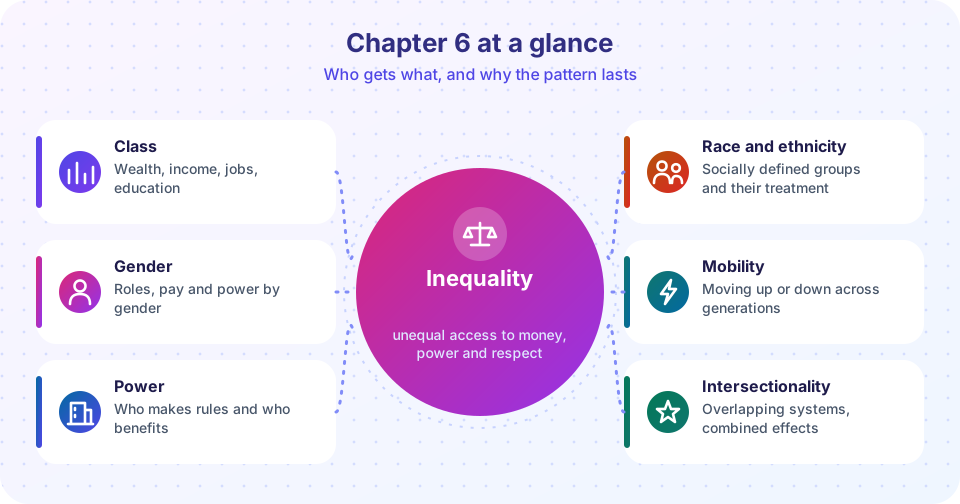
A map of chapter 6: how sociologists describe and measure unequal access to money, power and respect, and how class, race and gender shape life chances.
Two children are born on the same day in the same country. One grows up in a house full of books, with parents who know how schools work. The other grows up in a crowded flat with parents who work two jobs. Their talents may be similar, but their chances are not. Social inequality is the unequal distribution of resources, opportunities and respect among people in a society. Sociologists study it because it affects almost everything else: health, education, safety, voting and even life expectancy.
What you will learn
- Distinguish inequality of income, wealth, power and status.
- Explain why sociologists speak of systems and structures rather than only individual effort.
- Preview class, race and gender as separate and overlapping sources of advantage and disadvantage.
- Interpret a simple share-of-income comparison.
Key terms
Stratification: the ranking of people into layers by access to resources, power and prestige. Income: money received over a period; wealth: what a person owns minus what they owe. Life chances: the odds of obtaining things such as education, health and safety (Weber). Social mobility: movement between positions in the stratification system.
Income, wealth, power, status
Different resources are unevenly spread, and they do not always move together.
- Income is a flow: salary, profits, benefits.
- Wealth is a stock: homes, savings, businesses, minus debts. Wealth is usually far more unequal than income, because it accumulates and can be inherited.
- Power is the ability to get your way even against resistance (Weber's definition).
- Status is social honor and prestige. A priest or a nurse may have high status and modest income.
Sociologists also ask whether inequality is explained by individual effort and talent, as many people believe, or by structure: the rules, institutions and inherited advantages that shape who gets chances. The chapter shows evidence on both and why, in practice, they interact.
The lenses of the chapter
| Lesson | Focus |
|---|---|
| Social class and mobility | Marx, Weber, Bourdieu; the Lorenz curve and Gini coefficient; intergenerational mobility |
| Race, ethnicity and segregation | Race as a social construction; prejudice vs discrimination; Schelling's model |
| Gender and intersectionality | Sex and gender, doing gender, pay gaps, Crenshaw |
| Chapter 6 review | Compare and quiz |
Inequality has layers
Three big dimensions
They overlap in real lives.
Two ways to explain it
Common misconceptions
"Inequality is only about money." Wealth, power, status, health and safety are unequal too, and they reinforce each other.
"If inequality exists, it must be deserved." Some differences reflect effort, but studies repeatedly show that family background, neighborhood and discrimination also matter. The relative weight of each is debated, and good analysis shows evidence for both.
Check your understanding
Quick check · 4 questions
of 4 answered You scored / 4 · perfect!
-
1. Which pair correctly distinguishes income and wealth?
Income is received over time; wealth is a stock of assets less liabilities. -
2. Weber's idea of life chances refers to
Life chances are the probabilities of access to resources and opportunities. -
3. Wealth is usually
Wealth accumulates and passes between generations, so it is typically more concentrated. -
4. In the calculator, if the top 10% receive 30% of income, the average person in the top 10% receives about how many times the average of the other 90%?
The top average is 30/10 = 3.0 and the rest average 70/90, about 0.78, so the ratio is about 3.9.
Summary
- Inequality covers income, wealth, power and status.
- Wealth is usually more concentrated than income.
- Sociologists look at structure as well as effort and talent.
- The chapter covers class, race, gender and how they intersect.
Track your progress
Create a free account to tick off lessons and pick up where you left off on any device.
of Sociology lessons completed