


















Lesson 28 of 46 · Inequality: Class, Race and Gender
Race, Ethnicity and Segregation
Why sociologists call race a social construction, how prejudice differs from discrimination, and how Schelling's model and audit studies show segregation and bias at work.
People often treat race as a fact of biology. Sociologists, geneticists and historians agree that it is not that simple: the way societies sort people into racial categories has changed over time and differs between countries, even though the effects of those categories on people's lives are very real. This lesson explains that apparent paradox, then looks at how discrimination and segregation work, using two famous pieces of evidence: a thought experiment turned simulation and a field experiment on job applications.
What you will learn
- Distinguish race from ethnicity, and explain "social construction."
- Separate prejudice, discrimination and institutional discrimination.
- Explain Schelling's segregation model and what it does and does not show.
- Read the logic of an audit (correspondence) study.
Key terms
Race: a socially defined category based on perceived physical traits and ancestry. Ethnicity: a shared culture, ancestry, language or heritage that a group sees as its own. Prejudice: a prejudgment or attitude about a group; discrimination: unequal treatment of people because of group membership. Institutional (structural) discrimination: policies or practices that produce unequal outcomes even without individual hostility. Segregation: the separation of groups, by law (de jure) or in practice (de facto).
Race and ethnicity as social constructions
A social construction is a category that is made real through shared belief, law and practice. It does not mean "imaginary." Money is a social construction too, and it moves the world.
Why do sociologists say that of race?
- Categories change. The groups counted as "white" in the United States have shifted over census years; Brazil uses a spectrum of color terms; South Africa's apartheid state (1948-1994) legally sorted people into four racial groups. The same person could be classified differently in different countries.
- Genetic variation does not follow the categories. Humans differ in many traits, but variation is mostly continuous and found within, not between, the groups defined by everyday racial labels.
- The categories have consequences. Laws, schools, banks and employers acted on them, so the categories shaped wealth, health and safety.
Michael Omi and Howard Winant (1986) called this process racial formation: racial meanings are continually made and remade through politics and culture. W. E. B. Du Bois, in The Souls of Black Folk (1903), described the "color line" as the central problem of the twentieth century and was one of the first to study race with systematic data, in The Philadelphia Negro (1899).
Ethnicity usually refers to shared culture and ancestry that group members themselves claim, such as Welsh, Punjabi or Yoruba. Race is more often imposed from outside; ethnicity more often claimed from inside. In real life they overlap.
Prejudice and discrimination are not the same
Robert K. Merton (1949) noticed that attitudes and actions can come apart. A person can be prejudiced but not discriminate (for instance, because the law forbids it) and another can have no prejudice yet take part in discriminatory practices. Sociologists therefore distinguish:
| Level | Example |
|---|---|
| Prejudice (attitude) | Believing a group is less trustworthy |
| Individual discrimination | A landlord refuses to rent to someone because of their ethnicity |
| Institutional discrimination | A lending rule or map that marks entire neighborhoods as high-risk, shutting residents out of loans |
A well-documented US example is redlining: in the 1930s the federal Home Owners' Loan Corporation drew maps grading neighborhoods, and lenders and federal housing programs later used similar maps. Black neighborhoods were commonly marked as risky, which limited access to mortgages and the wealth that housing brings. Historians still trace gaps in homeownership and wealth to this period, while debating how much of today's gap each policy explains.
Schelling's model: mild preferences, strong segregation
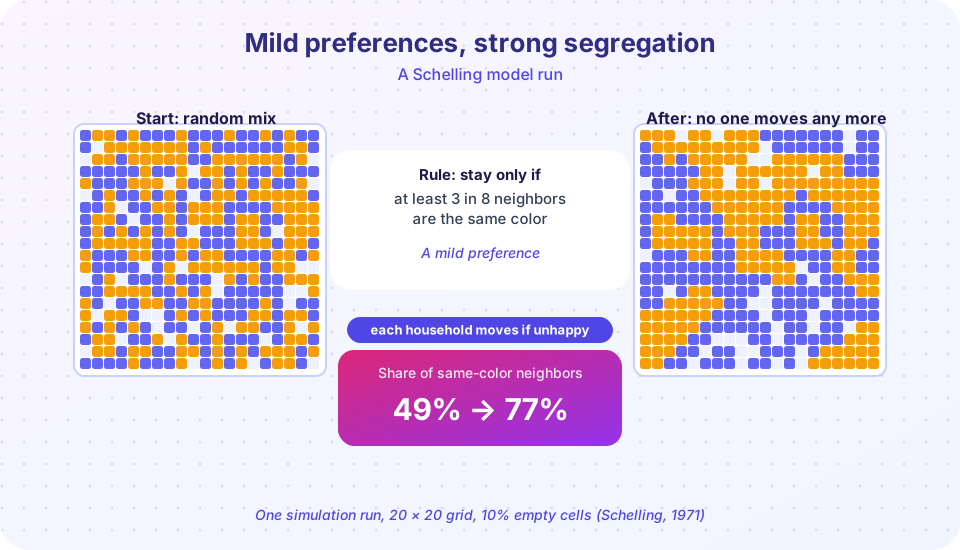
In 1971 the economist Thomas Schelling asked a puzzling question. Could neighborhoods become strongly segregated even if nobody wants segregation? He imagined a grid of two kinds of households. Each household is content as long as at least a certain share of its neighbors resemble it, and moves if not. The result: even a mild preference, such as wanting 3 of 8 neighbors to be like you, can tip the whole grid into clusters.
Why? Each move that leaves a mixed neighborhood slightly raises the share of one group in the neighborhoods it left and joined. That change makes others unhappy, who then move too, and so on. Small preferences are amplified by feedback.
What the model shows and does not show:
- It shows a mechanism: individual choices can add up to collective outcomes nobody intended.
- It does not prove that preferences alone cause real-world segregation, and it says nothing about who should be blamed. Historical records show that laws, covenants, lending rules and violence produced much of it, and that housing prices, jobs and school boundaries matter too.
Press Run (or Ctrl + Enter) to see the result here.
Program input · what you'd type while the program runs
Type the answers before you press Run, one per line. Each time the program reads a line (with input()), it gets the next line from this box.
Evidence of discrimination: audit studies
How do you measure discrimination when employers rarely say it aloud? Researchers use audit (correspondence) studies: send applications that are identical except for a signal of group membership, and compare responses. Marianne Bertrand and Sendhil Mullainathan (2004) sent about 5,000 fictitious resumes to job advertisements in Boston and Chicago, randomly assigning names that were distinctively white-sounding or Black-sounding. The resumes with white-sounding names received about 50% more callbacks. Because the resumes were otherwise equivalent and names were assigned at random, the difference is hard to explain by anything but the name's effect on employers. Later experiments in many countries and for many groups have found comparable patterns, with sizes varying by country, job and period.
The test below applies the standard test for a difference between two proportions to rates close to those reported in that study.
Press Run (or Ctrl + Enter) to see the result here.
Program input · what you'd type while the program runs
Type the answers before you press Run, one per line. Each time the program reads a line (with input()), it gets the next line from this box.
Common misconceptions
"Race is a social construction, so it isn't real." The categories are made by people, but their consequences in law, income, health and safety are real and measurable.
"Segregation just reflects what people prefer." Schelling's model shows that even mild preferences can aggregate into strong segregation, but law, finance and violence shaped real cities. The two explanations are not rivals.
"Discrimination requires hateful individuals." Institutional rules can produce unequal outcomes without personal hostility.
Check your understanding
Quick check · 5 questions
of 5 answered You scored / 5 · perfect!
-
1. Calling race a 'social construction' means
Constructed does not mean unreal: people act on the categories. -
2. Which is an example of institutional discrimination?
Institutions can produce unequal outcomes through their rules and maps. -
3. In Schelling's model, what produces clustering?
Individual choices aggregate into an outcome nobody intended. -
4. In an audit study, why are names assigned at random?
Random assignment rules out other explanations. -
5. Which statement about Schelling's model is correct?
Historical policies and discrimination also matter.
Summary
- Race and ethnicity are socially constructed categories with real consequences; ethnicity is more often self-claimed.
- Prejudice (attitude) differs from discrimination (action) and from institutional discrimination (rules and practices).
- Schelling's model shows how mild preferences can produce strong segregation, as a mechanism not a full explanation.
- Audit studies use randomized signals to measure discrimination.
Track your progress
Create a free account to tick off lessons and pick up where you left off on any device.
of Sociology lessons completed