


















Lesson 13 of 46 · Culture and Socialization
Socialization Theories: Cooley, Mead and Goffman
Learn how sociologists explain the self: Cooley's looking-glass self, Mead's stages and generalized other, Goffman's impression management, with notes on Freud, Piaget and isolated children.
A newborn knows no language, no rules and no sense of self. Within a few years the same child can use words, follow rules, imagine how others feel and say "I". Where does that self come from? A long-running debate, often called nature versus nurture, asks how much comes from biology and how much from experience. Sociologists do not deny biology, but they emphasize that a self, a sense of who I am, can only develop through interaction with other people. This lesson presents the main theories of that process.
What you will learn
- What socialization is, and why sociologists say the self is social.
- Cooley's looking-glass self and Mead's stages, the "I" and the "me", and the generalized other.
- Goffman's idea of impression management.
- How psychological theories (Freud, Piaget, Kohlberg) relate, and what evidence about isolated children does and does not show.
Key terms
Socialization: the lifelong process of learning culture and developing a self.
Looking-glass self: Cooley's idea that we form our self-image from imagining how others see and judge us.
Significant other: a person whose opinion matters strongly to us, such as a parent.
Generalized other: Mead's term for the standards of the community or society as a whole, internalized as "what people expect".
Impression management: Goffman's term for the ways people control how others see them.
The social self
Sociologists stress that people are born with capacities (brains, needs, temperaments) but become persons through relationships. Language is learned from others; rules are taught; identity is reflected back. Without any social contact, the capacities cannot unfold. That is why socialization is central: it is how culture gets inside individuals, and how individuals become members.
Cooley's looking-glass self
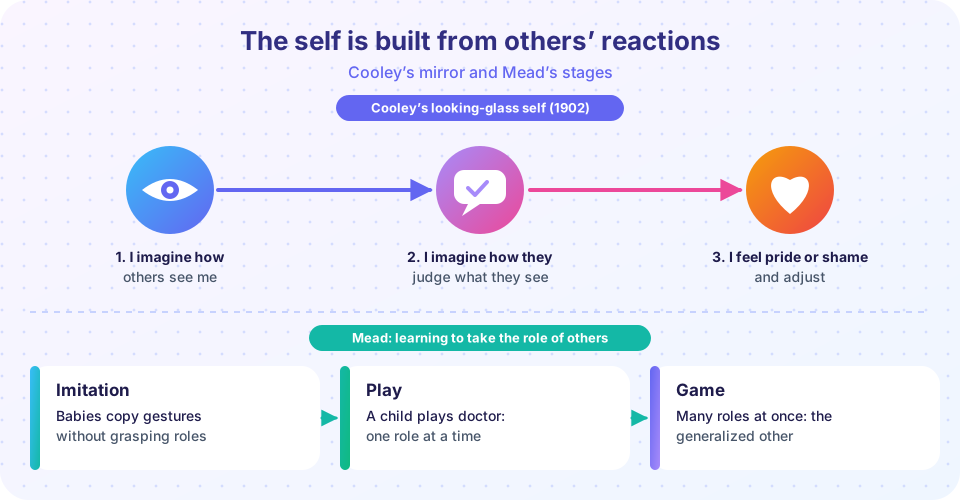
Charles Horton Cooley (1864-1929) wrote in 1902 that we see ourselves as in a mirror, but the mirror is other people's minds. The process has three steps:
- We imagine how we appear to others (how we look, act, speak).
- We imagine how they judge that appearance (clever? kind? awkward?).
- We feel something (pride, shame) and adjust our self-image and behavior.
Notice what matters is what we imagine others think, which may be wrong. A student who believes teachers see her as hopeless may stop trying, even if teachers actually think otherwise. Cooley also introduced the idea of primary groups, small, intimate groups such as family and close friends, that shape the self most deeply.
Mead: taking the role of the other
George Herbert Mead (1863-1931) argued that the self arises in social interaction through role-taking: imagining a situation from another's point of view. He described stages:
- Imitation (preparatory stage). Babies imitate gestures and sounds without understanding them.
- Play. Young children (roughly ages three to five) pretend to be specific people (a doctor, a parent), taking one role at a time. These models are significant others.
- Game. Older children learn to handle multiple roles at once, as in a team sport where you must anticipate what everyone expects. They internalize the generalized other, the standards of the community ("what people in general expect").
Mead also distinguished two parts of the self. The "me" is the socialized part: the organized attitudes of others that we have internalized. The "I" is the spontaneous, creative part that responds to them. The self is a conversation between the two, so we are neither robots nor free of society.
Goffman: the self as performance
Erving Goffman (1922-1982), in The Presentation of Self in Everyday Life (1959), compared social life to theater. People are actors who manage the impressions they give. On front stage (a job interview, a classroom) we perform expected roles with appropriate "props" and manners; back stage (home, among friends) we relax and drop the act. Goffman argued the self is not a hidden core that we then express; it is, in large part, what emerges from performances that others accept. Social media gives a modern version: curating a profile is impression management at scale. Goffman also described total institutions (see the next lesson).
Psychological views of development
- Sigmund Freud (1856-1939) proposed that personality involves the id (drives), ego (reality-oriented self) and superego (internalized rules). Sociologists value his emphasis on early childhood and internalized norms, but his ideas are hard to test and are widely criticized.
- Jean Piaget (1896-1980) described four stages of cognitive development (sensorimotor, preoperational, concrete operational, formal operational). Details have been revised, but the idea of qualitatively different stages of thinking influenced education.
- Lawrence Kohlberg (1927-1987) proposed stages of moral reasoning from self-interest to conventional rule-following to principled reasoning. Carol Gilligan criticized his work, arguing that his scheme favored an ethic of justice and downplayed an ethic of care; later research finds both orientations in men and women.
Sociologists add that these stages are shaped by culture: what counts as maturity or a good child differs between societies.
What isolated children can and cannot tell us
Rare cases of severe isolation have been used to illustrate socialization. Genie, discovered in Los Angeles in 1970 at about 13 after years of confinement, learned many words but never mastered ordinary grammar, which supports the idea of a sensitive period for language. Anna and Isabelle, studied by Kingsley Davis in the 1940s, show differing outcomes: Isabelle, found about age six, advanced rapidly with intensive help. Harry Harlow's experiments (1950s-60s) with infant rhesus monkeys found they preferred a soft cloth surrogate to a wire one that gave milk, showing the importance of contact comfort, although monkeys are not humans.
Handle these cases with care: they involve abuse, malnutrition and unknown background, so we cannot separate lack of socialization from other harms. More systematic evidence comes from studies of children raised in very deprived institutions, such as the English and Romanian Adoptees study, which found that early deprivation can have lasting effects but also that many children recover substantially, especially with earlier adoption into caring homes. These findings support the view that early relationships matter, without proving rigid critical periods for everything.
Common misconceptions
"Socialization means brainwashing." It is ordinary learning of language and rules; people also question and change what they learn.
"The self is fixed by adolescence." Selves keep changing with new relationships, jobs and cultures.
"Isolated-child cases prove the nurture side of the debate." They are tragic and confounded cases. Biology and social experience both matter.
"Goffman says everyone is fake." He says presentation is a normal part of social life, not necessarily deceit.
Try it
First, a toy model of the looking-glass self. A person's self-image moves toward the average of the judgments they perceive, with each audience weighted by how much they matter. It is a deliberately simple illustration with made-up numbers.
Press Run (or Ctrl + Enter) to see the result here.
Program input · what you'd type while the program runs
Type the answers before you press Run, one per line. Each time the program reads a line (with input()), it gets the next line from this box.
Second, a front-stage and back-stage demonstration of Goffman's idea. Toggle the stage and see how the same person presents differently.
Check your understanding
Quick check · 5 questions
of 5 answered You scored / 5 · perfect!
-
1. In Cooley's looking-glass self, the key to self-image is
We form our self-image from our imagined impression of how others see and judge us. -
2. Mead's 'generalized other' refers to
In the game stage children internalize what society in general expects. -
3. Which stage does Mead associate with taking one specific role at a time?
In play, children pretend to be particular people, such as a parent or doctor. -
4. Goffman's 'back stage' is where people
Back stage is the private region where the performance can be dropped. -
5. Why should evidence from isolated children be treated cautiously?
Confounding factors prevent clear conclusions, though the cases remain illustrative.
Summary
- Sociologists see the self as a social product that emerges through interaction.
- Cooley's looking-glass self: imagine how others see me, imagine their judgment, feel and adjust.
- Mead: the self develops through role-taking in imitation, play and game stages, with a creative "I" and a socialized "me".
- Goffman: everyday life involves impression management, front stage and back stage.
- Psychological theories complement these views; isolated-child cases are suggestive but confounded.
Next: Agents of Socialization
Track your progress
Create a free account to tick off lessons and pick up where you left off on any device.
of Sociology lessons completed