


















Lesson 7 of 46 · The Sociological Imagination
The Sociological Imagination
Learn C. Wright Mills's sociological imagination: how to link biography and history, tell personal troubles from public issues, and ask three questions about any situation.
Most of the time we explain our lives in personal terms: I got the job because I worked hard; I am in debt because I spent too much; we divorced because we grew apart. These explanations are not false, but they are incomplete. Behind each of them stand labor markets, prices, laws, expectations about gender and marriage, and the era in which we happen to live.
In 1959 the American sociologist C. Wright Mills published The Sociological Imagination, a short, fierce book that gave a name to the skill of seeing both levels at once. It remains the best one-sentence answer to "why study sociology?"
What you will learn
- What Mills meant by the sociological imagination and its "promise".
- How to distinguish personal troubles from public issues, and why the line moves with scale.
- Three questions that turn any situation into a sociological analysis.
- Critiques and limits of the idea.
Key terms
Biography: the course of one person's life.
History: the larger story of a society and its era, which gives individual lives their setting.
Personal troubles: private matters of an individual's character and immediate relationships.
Public issues: matters that go beyond any one person's local environment and involve the organization of society.
Social structure: patterns of relationships and institutions that organize society.
The core idea
Mills argued that people often feel "their private lives are a series of traps". They sense that something is wrong but cannot say what, because they look only at their immediate surroundings. The sociological imagination is the "quality of mind" that lets them grasp "what is going on in the world and what may be happening within themselves" by connecting biography and history within society.
Think of a person born in a country in 1950 versus 2000. The same talent and effort meet very different options for schooling, careers, housing and technology. Their biography differs because their history differs. A sociologist always asks: in what kind of society, in what time, is this person living?
Troubles and issues
Mills drew a central contrast. Personal troubles occur within a person's character and their direct relations with others. They are matters of the individual and the small circle of people they know. Public issues transcend those local settings: they concern how the institutions of a society interact.
Mills's own illustration was unemployment. When, in a city of 100,000, just one man is out of work, that is his personal trouble, and we would look at his skills and circumstances. When, in a nation of 50 million workers, 15 million are unemployed, that is a public issue, and we cannot hope to find its solution within the range of opportunities open to any one individual. The structure of opportunity has collapsed. The same pattern holds for marriage and housing: if a few couples divorce, look at them; if divorce rates soar, look at law, work and culture.
Two cautions. First, the line is not sharp. A trouble becomes an issue as it becomes widespread, and people may only discover that their trouble is shared when it is named. Second, naming something an issue does not make the individual experience unreal. Both are true at once.
Three questions to ask
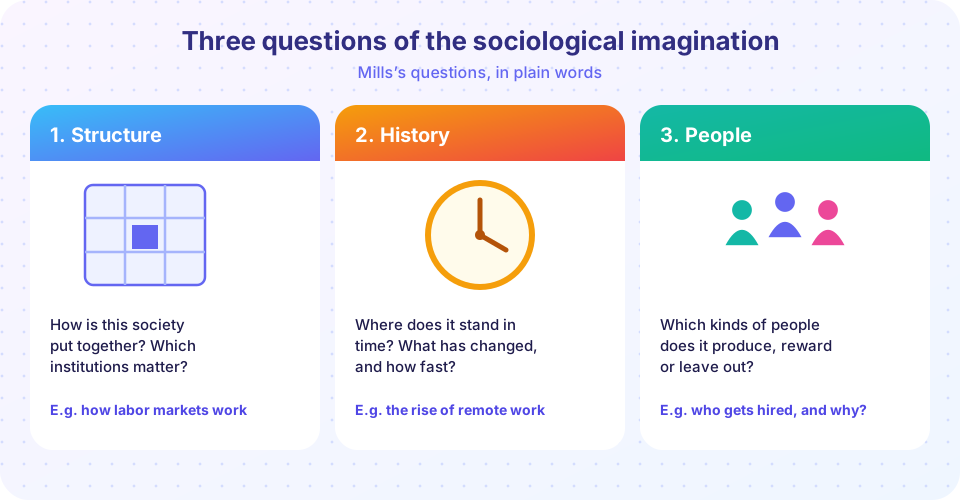
Mills proposed three kinds of questions for anyone using the sociological imagination (here put in modern words):
- Structure: What is the structure of this society, and how do its parts fit together? Which institutions matter for this situation?
- History: Where does this society stand in history? How has it changed, and what is changing it now?
- People: What kinds of people does this society produce, reward, or leave out in this period?
Take student debt. Structure: how are colleges funded, who lends, what do degrees do in the job market? History: tuition has risen faster than wages in many countries over recent decades, and degrees were once rarer. People: which students feel they must borrow, and who is excluded from higher education at all? The result is a far richer explanation than "some people spend too much".
Making the familiar strange
A habit that helps is defamiliarization: pretending to be an outsider who cannot take things for granted. Why do we line up for a bus? Why do we give gifts? Why does a handshake mean anything? Peter Berger described this as seeing the general in the particular, and the strange in the familiar. Once you notice rules that nobody wrote down, you start to see social structure.
Strengths and limits
The sociological imagination has been influential because it gives people a way of connecting their lives to society and a basis for democratic debate: what the public issues are, and what could be done. It also warns against two errors: explaining everything by individual fault (blaming the individual) and explaining everything by social forces (blaming society).
Critics point out some limits. Mills wrote forcefully against what he called "grand theory" (abstract system-building) and "abstracted empiricism" (data without ideas), yet some scholars say his own account of power was too simple. The distinction between troubles and issues can also be too tidy: individuals do not experience social forces in pure form, and structural factors act through personal circumstances, so most real problems have both aspects. Finally, to see social causes is not to decide what to do: values and politics still enter.
Practice. Take one headline this week. Write what is said about individuals, then write three social conditions that might also matter. Check one of them with real data.
Common misconceptions
"If it is a public issue, individual effort is pointless." Structure sets the odds; effort still matters and can also change structures when many people act together.
"The imagination is for radicals." Mills was critical of power, but the skill itself is used by researchers, policy makers and business analysts of every persuasion.
"A trouble is a mistake of the person." Calling something a trouble describes its scale and location, not blame.
Try it
First, a scale calculator. Edit the numbers and see how the same kind of event looks at different scales. The rule of thumb in the code (a share above 5% suggests an issue worth structural analysis) is a teaching heuristic, not a standard from sociology.
Press Run (or Ctrl + Enter) to see the result here.
Program input · what you'd type while the program runs
Type the answers before you press Run, one per line. Each time the program reads a line (with input()), it gets the next line from this box.
Second, an imagination builder. Choose a trouble, then try to answer the three questions yourself before revealing a sample answer.
Check your understanding
Quick check · 5 questions
of 5 answered You scored / 5 · perfect!
-
1. According to Mills, unemployment of 15 million out of 50 million workers is
When structures of opportunity fail on that scale, the problem lies in the organization of society. -
2. Which of these is a 'history' question in Mills's sense?
History questions place the situation in time and ask how and why change is happening. -
3. Which statement about the troubles-issues distinction is most accurate?
A trouble becomes an issue as it becomes widespread, and structure acts through personal circumstances. -
4. Defamiliarization means
It helps you notice taken-for-granted rules and patterns. -
5. 'Blaming the individual' and 'blaming society' are both
The imagination asks you to combine the two levels.
Summary
- The sociological imagination links individual biography with history and social structure.
- Personal troubles occur in a person's immediate world; public issues involve the organization of society, and the line moves with scale.
- Three questions (structure, history, people) turn any situation into a sociological analysis.
- Avoid both blaming only the individual and blaming only society, and remember that seeing causes is not the same as choosing values.
Next: Durkheim and Suicide
Track your progress
Create a free account to tick off lessons and pick up where you left off on any device.
of Sociology lessons completed