


















Lesson 16 of 46 · Social Structure and Groups
Chapter 4 Overview: Social Structure and Groups
Preview chapter 4: how statuses, roles, groups, networks and organizations form the structure of social life, with a clickable network demo and a map of the lessons.
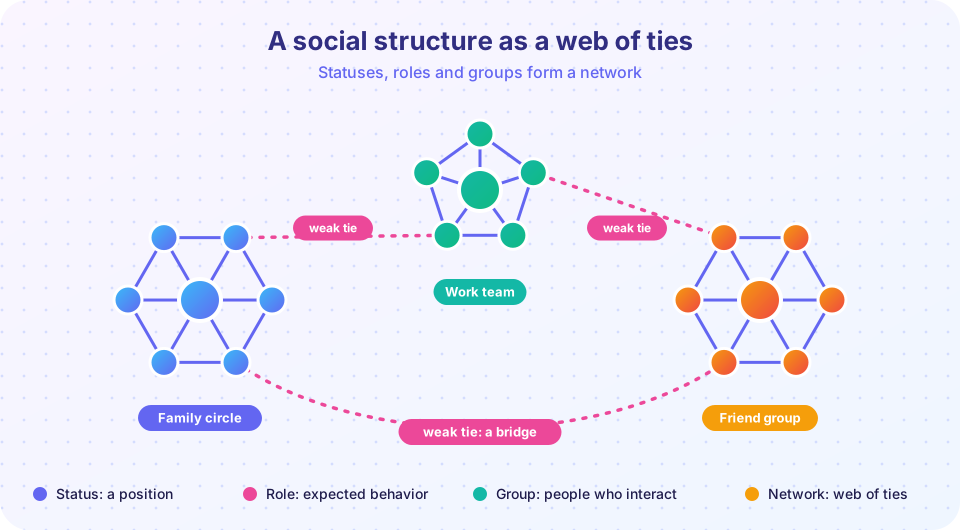
Every day you step into and out of places with rules you did not write. At home you are a daughter or a parent; at school a student; at the match a fan. In each place there are expectations about what you do and who you answer to. You belong to groups, some you chose and some you did not, and you are linked to hundreds of people by ties of varying strength. Together these positions, expectations, groups and links make up social structure: the framework that gives everyday life its shape.
This chapter zooms in on the building blocks of that framework and on the larger organizations built from them.
What you will learn
- How this chapter extends the idea of structure from chapter 2.
- What each lesson covers and how the concepts connect.
- Which skills you will gain: describing roles, mapping networks and analyzing organizations.
Key terms
Status: a recognized position in society, such as student or parent.
Role: the behavior expected of someone in a status.
Group: two or more people who interact and share a sense of belonging.
Social network: the web of ties linking individuals and groups.
Organization: a large, formal group with goals, rules and a division of labor.
The chapter at a glance
From positions to expectations
From people to networks
From groups to organizations
What each lesson covers
- Status and Roles: ascribed and achieved statuses, master status, role expectations, role conflict and role strain, and the idea of a role set.
- Groups and Networks: primary and secondary groups, in-groups and out-groups, conformity and obedience experiments, and Granovetter's "strength of weak ties".
- Organizations and Bureaucracy: Weber's ideal-type bureaucracy, the iron law of oligarchy, McDonaldization and total institutions.
- Chapter 4 Review: a zoom-out diagram, flashcards and a ten-question quiz.
Why this matters
Many of the issues in later chapters, from crime and inequality to family and education, are best understood through roles, groups and organizations. Structure explains why different people in the same position behave alike, why a message spreads in one community and not another, and why large institutions can feel impersonal. It also helps you see how individuals can change things: by playing a role differently, by building a new tie, or by redesigning a rule.
Common misconceptions
"A role is a script people must follow exactly." Roles are expectations that people interpret and negotiate.
"A group is just a crowd." A group has interaction and a sense of belonging; people waiting at a bus stop are a mere aggregate.
"Bureaucracy is always bad." It also brings fairness, predictability and expertise; the problems come when rules become ends in themselves.
Try it
Build a tiny social network. Click one person, then another, to add or remove a tie. The tool counts ties and compares them with the maximum possible (density).
Check your understanding
Quick check · 3 questions
of 3 answered You scored / 3 · perfect!
-
1. A role is
Statuses are positions; roles are the expectations attached to them. -
2. Which is a social network?
A network is a pattern of connections among individuals and groups. -
3. A bureaucracy is best described as
Weber described bureaucracy by hierarchy, written rules, division of labor and impersonality.
Summary
- Social structure is built from statuses, roles, groups, networks and organizations.
- This chapter explores each in turn, from small ties to large bureaucracies.
- These concepts help explain behavior, information flow and the feel of modern institutions.
Next: Status and Roles
Track your progress
Create a free account to tick off lessons and pick up where you left off on any device.
of Sociology lessons completed