


















Lesson 38 of 46 · Social Change, Globalization and Research
Social Movements and Collective Action
Why do people join movements? Compare deprivation, resource mobilization, political process and framing theories, see free riding, and run Granovetter's threshold model.
Women winning the vote, workers forming unions, people in many countries protesting against apartheid, colonial rule or climate inaction: social movements have been among the most important engines of social change. Yet movements raise a puzzle. If a movement wins, everyone benefits whether they took part or not. Taking part may be risky or tiring. So why does anyone join? And why do some movements take off while others fade? This lesson covers the main answers and lets you run a model that shows how small differences can change the outcome.
What you will learn
- Define social movement and collective action.
- Compare the main theories of why movements arise and succeed.
- Explain the free-rider problem and how movements address it.
- Run and interpret Granovetter's threshold model.
Key terms
Social movement: a sustained, organized collective effort to bring about or resist change, usually outside regular institutions. Free-rider problem: the temptation to enjoy a collective benefit without paying the cost of working for it (Olson, 1965). Framing: how movements define a problem and a solution so that people will join (Snow and Benford). Threshold: the share of others already participating that a person needs to see before joining (Granovetter).
Why people join: four explanations
- Deprivation and grievance. The earliest explanations stressed anger. Ted Gurr (1970) argued that relative deprivation, the gap between what people expect and what they get, fuels rebellion. But grievances are common and movements are not, so grievance alone is not enough.
- Resource mobilization. John McCarthy and Mayer Zald (1977) argued that movements need money, organizations, skills, meeting places and leaders. People and groups with resources can mobilize; others cannot. Here movements are organized efforts, not just outbursts of emotion.
- Political process. Charles Tilly and Doug McAdam (Political Process and the Development of Black Insurgency, 1982) added political opportunities: elections, splits among elites, allies and weakened repression make action more likely to succeed. Movements are shaped by the structure of the political system.
- Framing and identity. David Snow and Robert Benford (1988) examined how organizers frame issues: diagnosing a problem, offering a solution and giving people reasons to act. Scholars of new social movements such as Alain Touraine and Alberto Melucci pointed to identity, culture and quality-of-life issues, in movements for peace, the environment, gender and sexuality.
These are complementary. A useful summary is that movements form when grievances, resources, opportunities and compelling frames come together.
The free-rider problem
Mancur Olson (The Logic of Collective Action, 1965) noted that if a movement wins a public good such as cleaner air, you receive it whether you march or not. A rational individual might stay home. Yet people do join. Explanations include selective incentives (member benefits, friendship, status), moral commitment, social pressure through networks, and the satisfaction of acting on identity. Movements often build tight networks that make participation visible and valued.
Tipping points: Granovetter's threshold model
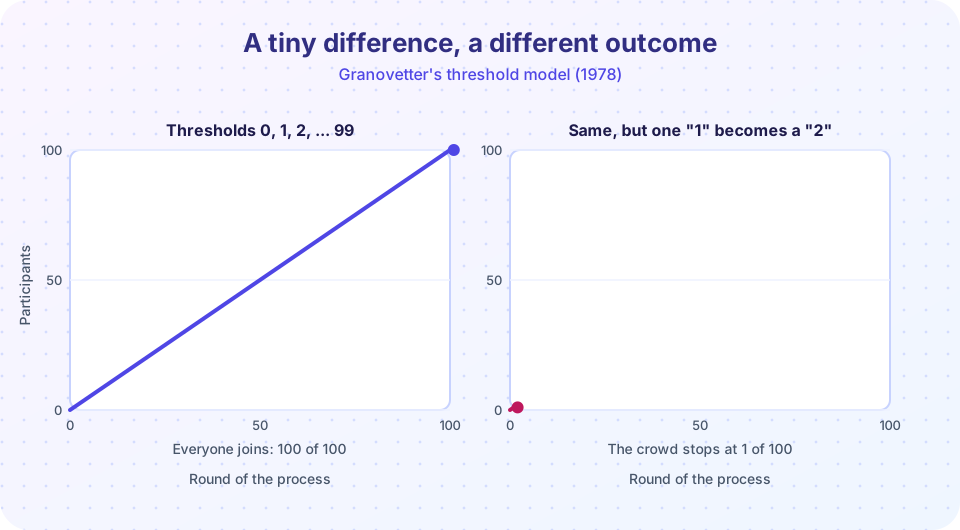
Mark Granovetter (1978) proposed that each person has a threshold: the number (or share) of others who must already be participating before they join. A person with threshold 0 starts anything; a person with threshold 10 joins once ten others have.
Imagine a crowd of 100 with thresholds 0, 1, 2, 3, ..., 99. The person with threshold 0 begins; this triggers the person with threshold 1; that triggers 2; and so on until everyone has joined. Now change one thing: nobody has threshold 1 and there are two people with threshold 2. The average attitude barely changes, but the cascade now stops after a single participant. The model shows why outcomes can be so unpredictable: small differences in the distribution of thresholds can flip a crowd from calm to a riot or a protest from huge to nothing. It also shows why surveys of average opinion may predict collective behavior poorly.
Press Run (or Ctrl + Enter) to see the result here.
Program input · what you'd type while the program runs
Type the answers before you press Run, one per line. Each time the program reads a line (with input()), it gets the next line from this box.
Press Run (or Ctrl + Enter) to see the result here.
Program input · what you'd type while the program runs
Type the answers before you press Run, one per line. Each time the program reads a line (with input()), it gets the next line from this box.
Both programs are models. Real people do not hold fixed numerical thresholds, but the logic of cascades, where the first few participants matter and where visible participation recruits others, appears in studies of riots, protests, and the spread of norms.
Do movements work?
Success is hard to define: policy change, new rights, recognition or shifts in public opinion. Erica Chenoweth and Maria Stephan (Why Civil Resistance Works, 2011) studied hundreds of resistance campaigns from 1900 to 2006 and found that nonviolent campaigns achieved their major goals roughly twice as often as violent ones, partly because they attract broader participation. Their findings have been debated and updated, and some later work suggests success rates have declined in recent years.
Digital media have changed organizing. Zeynep Tufekci (Twitter and Tear Gas, 2017) argued that online tools let movements gather large crowds quickly but may skip the slow organizational work that builds lasting capacity, which makes them powerful at starting and sometimes weaker at sustaining pressure.
Common misconceptions
"Movements are just angry crowds." Resource mobilization and political process theories show that organization, resources and opportunity matter as much as anger.
"People join because they are irrational." Joining can be a rational response to selective incentives, networks and identity.
"Thresholds are fixed facts about people." The model is a simplification: people's thresholds shift with information, risk and the behavior of others.
Check your understanding
Quick check · 6 questions
of 6 answered You scored / 6 · perfect!
-
1. The free-rider problem is that
Olson argued that rational individuals may avoid costly action when they can benefit anyway. -
2. Resource mobilization theory stresses
McCarthy and Zald argued movements need organizational resources. -
3. Political opportunities include
They make action more likely to succeed. -
4. In Granovetter's crowd with thresholds 0, 1, 2, ..., 99, how many join?
Each person joining triggers the next, so the cascade reaches everyone. -
5. Change the crowd so the '1' becomes a second '2'. How many join?
Only the threshold-0 person joins; nobody else's threshold is met. -
6. Snow and Benford's 'framing' refers to
Frames give people reasons to act.
Summary
- Movements arise where grievances, resources, political opportunities and persuasive frames come together.
- The free-rider problem explains why joining is puzzling; selective incentives, identity and networks help solve it.
- Granovetter's threshold model shows how small differences in thresholds can make cascades start or stop.
- Evidence suggests nonviolent campaigns often succeed more than violent ones, though findings are debated; digital media change but do not replace organization.
Track your progress
Create a free account to tick off lessons and pick up where you left off on any device.
of Sociology lessons completed