


















Lesson 39 of 46 · Social Change, Globalization and Research
Sociological Research Methods
Learn how sociologists move from question to conclusion: surveys, experiments, fieldwork, sampling bias, correlation versus causation and research ethics, with two simulations.
Sociology is not just a collection of theories. It is a way of checking them against evidence. When someone says "inequality is rising" or "social media isolates people," a sociologist asks: how do you know? What did you measure, from whom, and could something else explain the result? This lesson walks through the research cycle, the main methods, and the most common traps.
What you will learn
- Describe the steps of the research cycle.
- Compare surveys, experiments, fieldwork, interviews and existing records.
- Explain sampling, bias and margin of error in plain language.
- Distinguish correlation from causation and recognize confounders.
- State the main ethical rules of research with people.
Key terms
Hypothesis: a testable statement about a relationship between variables. Operationalization: turning an abstract concept into something measurable. Reliability: a measure gives consistent results; validity: it measures what it claims to. Sample and population: the people studied versus the larger group they are meant to represent. Confounder: a third variable that influences both the cause and the effect you are studying.
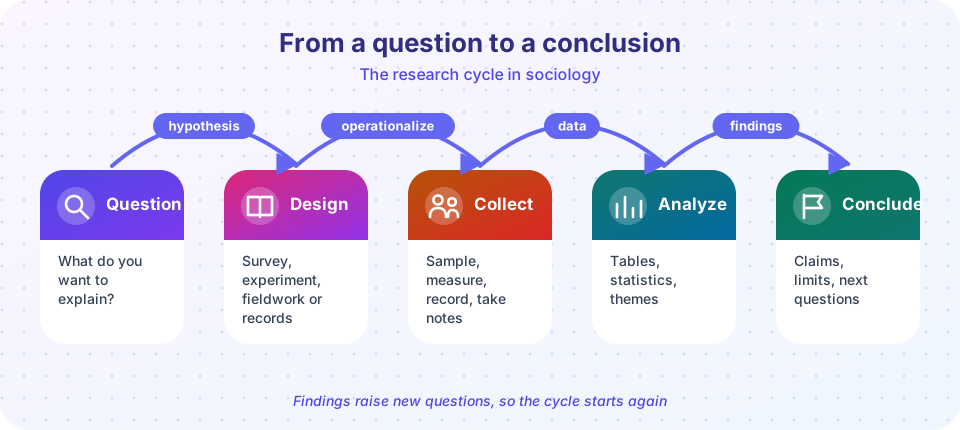
The research cycle
- Question. Start with something puzzling: why do some students from poor families succeed?
- Design. Turn the question into a testable hypothesis and choose a method. Define key concepts through operationalization: "social class" might become household income, occupation and education.
- Collect. Choose a sample, gather data, and record how you did it.
- Analyze. Use tables, statistics or coded interviews to find patterns.
- Conclude. State what the evidence shows, what it cannot show, and what to study next.
A measure is reliable if repeated measurement gives similar results, and valid if it measures the concept you care about. A bathroom scale that always reads 2 kg too high is reliable but not valid.
Main methods
| Method | What it is | Strength | Limit |
|---|---|---|---|
| Survey | Standard questions to many people | Large samples, comparison, numbers | Depends on wording and honesty; shallow |
| Experiment | Researcher assigns conditions (often randomly) | Strongest evidence on cause | Artificial settings; ethical limits |
| Field and audit experiments | Randomized tests in real settings, such as identical resumes | Real-world behavior | Narrow focus; deception issues |
| Participant observation (ethnography) | Living and observing within a group | Rich detail, meaning from insiders' viewpoint | Time-consuming; small and hard to generalize |
| Interviews | Open conversations | Depth, reasons and meanings | Time; interviewer effects |
| Existing records and content analysis | Census, court files, texts, media | Cheap, long-term | Made for other purposes; gaps |
Classic examples: Émile Durkheim's Suicide (1897) used official statistics; William Foote Whyte's Street Corner Society (1943) was based on years of observation in a Boston neighborhood; Bertrand and Mullainathan's resume study (see the race lesson) was a field experiment. Many projects use mixed methods, combining numbers with interviews. Max Weber's idea of Verstehen (interpretive understanding) reminds researchers that meanings matter, which is why qualitative methods remain central.
Sampling
You cannot ask everyone, so you ask a sample. The sample must represent the population, and that means probability sampling: everyone in the population has a known chance of selection. A simple random sample gives everyone an equal chance; stratified samples guarantee representation of groups; cluster samples pick whole units such as schools. Non-probability methods, such as convenience or snowball sampling (asking participants to refer others), are cheaper and sometimes the only option for hidden populations, but cannot support claims about the whole population.
A famous failure: in 1936 the magazine Literary Digest mailed a poll to millions of people drawn from telephone and car-owner lists, received about 2.4 million replies and predicted that Alf Landon would beat Franklin Roosevelt. Roosevelt won by a landslide. The sample was huge but biased: during the Depression, owners of cars and phones were richer, and those who replied were a self-selected subset. A much smaller random-style sample used by George Gallup got the result right. The lesson is that bias is not fixed by size.
With a random sample, results come with a margin of error. For a proportion near 50%, at the 95% confidence level, it is about 1.96 * sqrt(0.25 / n): roughly 3 percentage points for 1,000 people and 5 for 400. (See the survey project.)
Press Run (or Ctrl + Enter) to see the result here.
Program input · what you'd type while the program runs
Type the answers before you press Run, one per line. Each time the program reads a line (with input()), it gets the next line from this box.
Correlation and causation
Two variables are correlated when they tend to move together. That does not mean one causes the other. There are at least four possibilities: X causes Y; Y causes X; both are caused by a third variable Z (a confounder); or the relationship is chance. To argue for causation, researchers use randomized experiments, natural experiments, control variables and designs that follow people over time, and they check rival explanations.
Press Run (or Ctrl + Enter) to see the result here.
Program input · what you'd type while the program runs
Type the answers before you press Run, one per line. Each time the program reads a line (with input()), it gets the next line from this box.
In the invented world above the true effect of tutoring is zero, yet a naive analysis finds a strong association. Real studies often cannot measure every confounder, which is why randomization is so powerful.
Research ethics
Research on people can cause harm, so it follows rules. Key principles, summarized in documents such as the Belmont Report (1979) in the United States and codes of professional associations:
- Informed consent: participants know what the study involves and can refuse or withdraw.
- Avoiding harm: minimize risks, including distress and exposure of private information.
- Confidentiality and anonymity: protect identities and data.
- Honesty and justice: report methods truthfully; do not exploit vulnerable groups.
- Review: an ethics board or institutional review board examines the plan.
Laud Humphreys' Tearoom Trade (1970), which observed anonymous sexual encounters in public restrooms and traced participants through license plates without their knowledge, is a classic case of controversy over deception and privacy, and it helped shape later rules.
Common misconceptions
"A bigger sample is always better." Size reduces random error, not bias. A large biased sample can be far off.
"A strong correlation proves cause." It can come from a confounder or reverse causation.
"Qualitative research is unscientific." It answers different questions, such as meaning and process, with systematic methods.
Check your understanding
Quick check · 6 questions
of 6 answered You scored / 6 · perfect!
-
1. Operationalization means
For example, defining 'class' as household income and education. -
2. A scale that always reads 2 kg too high is
It is consistent (reliable) but does not measure true weight (valid). -
3. Why did the 1936 Literary Digest poll fail?
Size does not fix bias. -
4. A confounder is
It can create a correlation without a causal link. -
5. Which method assigns conditions at random to test cause?
Randomization makes groups comparable. -
6. Informed consent means participants
It is a core ethical principle.
Summary
- Research moves from question to design, collection, analysis and conclusion.
- Methods trade breadth, depth, realism and control; mixed methods combine strengths.
- Random sampling allows generalization with a margin of error; bias is not cured by size.
- Correlation is not causation; confounders and rival explanations must be considered.
- Ethical research needs consent, harm avoidance, confidentiality and review.
Next: Chapter 8 review
Track your progress
Create a free account to tick off lessons and pick up where you left off on any device.
of Sociology lessons completed